Commercial vs Editorial Use: The 30-Second Answer
Advertising, promotional use, commercial stock licensing, and other uses that imply a recognizable person endorses a product, service, brand, or message generally require a valid model release. Genuine news, documentary, educational, and some expressive or fine-art uses may not require one — although privacy, defamation, national image-rights laws, and platform rules can still apply. The same photograph can be editorial in one context and commercial in another, so the safest practice is to obtain a release at the shoot whenever future advertising or commercial licensing is possible. Usage intent changes. A release obtained upfront protects the image regardless of where the market takes it.
This distinction is not academic. Stock platforms reject images without valid releases. Clients get sued. Photographers lose income — and in the worst cases, face legal claims for misappropriation of likeness. We have seen photographers lose licensing deals because they could not produce a release for an image shot months earlier. The model had moved, changed their number, or simply stopped responding. That single missing signature turned a sellable asset into a liability.
In this guide, we break down what commercial and editorial use actually mean for photographers, where the legal line sits, what Getty Images, Adobe Stock, and Shutterstock require, and how to protect yourself before you press the shutter.
What Is a Model Release — And Why It Is the Linchpin
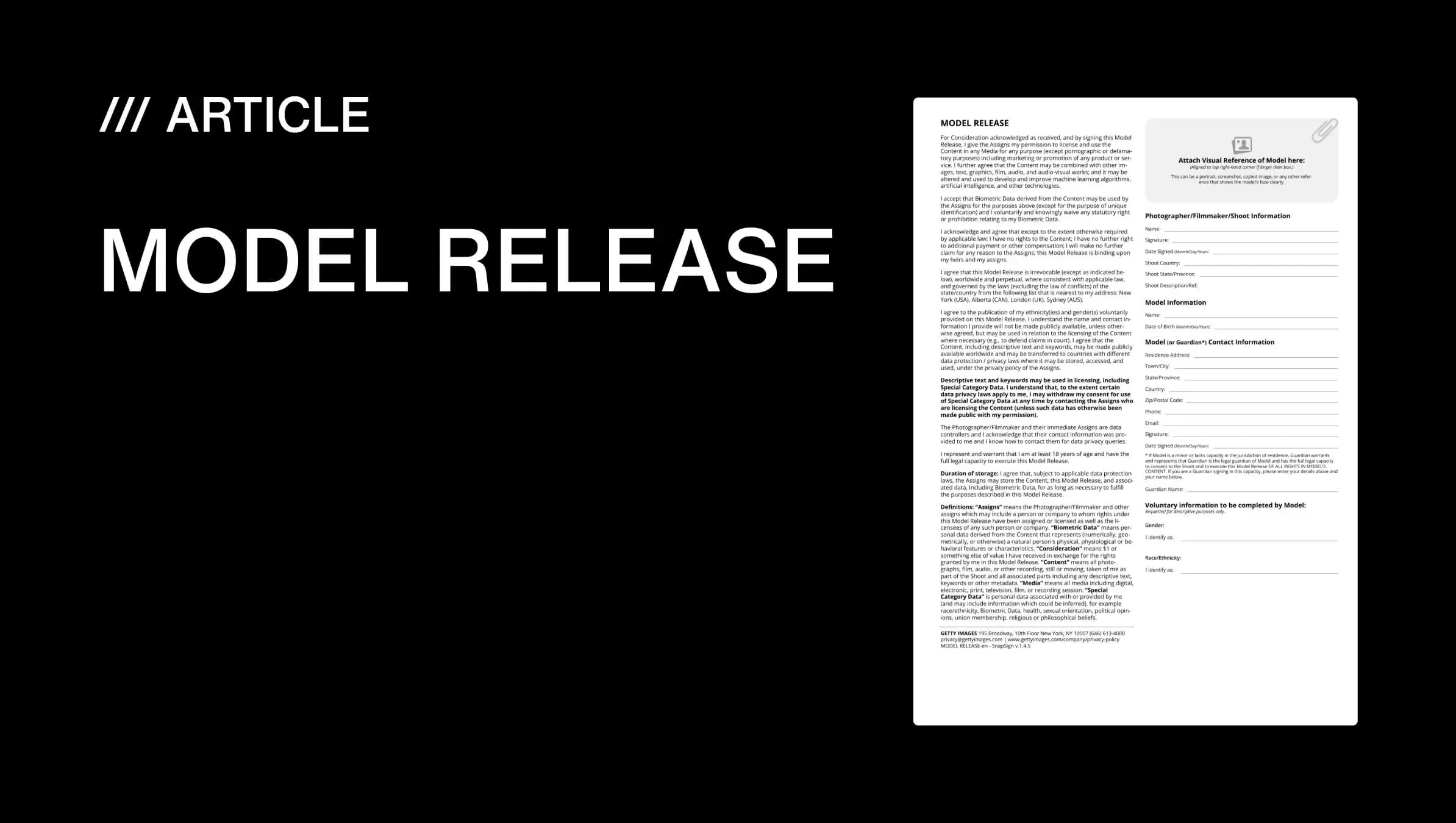
A model release is a signed legal document in which the person being photographed grants the photographer permission to use their likeness. Without one, you own the copyright to the image — but you may not have the right to use the person's face in advertising, commercial stock, or other contexts that imply endorsement. Copyright and likeness rights are separate legal assets, and a release addresses the second one.
This is the core concept behind model release requirements in commercial photography. Copyright lets you license the photograph itself. A model release covers uses where the subject's identity carries the message — advertising, brand campaigns, commercial stock. Both matter, but they apply to different stages of the licensing chain.
The release creates a paper trail that stock platforms, clients, and courts can rely on. We built SnapSign so that trail is cryptographically verifiable — every signed Contract generates a SHA-256 hash, which means you can prove the release has not been altered since the moment it was signed.
This article provides general educational information, not legal advice. Model-release and image-rights rules vary by jurisdiction, contract, publication context, and platform policy. For decisions about specific images or intended uses, consult a qualified attorney. Platform requirements are reviewed periodically — always verify against current platform documentation.
Commercial vs Editorial Use: The Key Differences
The simplest test: would a reasonable person think the subject is endorsing whatever the image is attached to? If yes, you are in advertising or promotional territory — and generally need a release. If the image informs or documents without implying endorsement, a release may not be required, though privacy and defamation laws can still apply. The distinction is not about whether money changed hands. It is about whether the subject appears to support a message, product, or brand. Exact requirements depend on jurisdiction and context.
Here is how the two categories break down side by side:
| Factor | Commercial Use | Editorial Use |
|---|---|---|
| Purpose | Promote, advertise, or sell | Inform, educate, or document |
| Endorsement implied? | Yes — the subject appears to support the message | No — the subject is part of a story, not a pitch |
| Model release required? | Always | Usually not — but context determines everything |
| Stock platform acceptance | Requires valid model release | Accepted under editorial license without a release |
| Licensing revenue | Higher — broader usage rights | Lower — restricted usage terms |
| Examples | Ad campaigns, brand websites, product packaging, sponsored posts, commercial stock | News articles, documentaries, textbooks, non-promotional blog posts, museum catalogs |
The column that matters most to your bottom line is the third one. A photo you can only license editorially earns less and reaches fewer buyers than the same photo with a signed release behind it. The release is what unlocks the full commercial market.
What Is Commercial Use in Photography?
A commercial use definition in photography is straightforward: the image is used to promote, advertise, or generate revenue through an implied endorsement. When someone sees a photo of a person next to a product, a brand logo, or a call to action, the law assumes that person supports what is being sold. That assumption is what a model release exists to document — the subject explicitly consented to that association.
Commercial use covers more ground than most photographers realize:
- Advertising campaigns — print, digital, billboard, or social media ads where a person's image sells a product or service
- Brand websites and landing pages — any page that markets a business using photography of real people
- Product packaging — from coffee bags to software boxes, any retail surface with a human face on it
- Sponsored social media posts — if a brand paid for the post or the photographer is marketing their own services, it is commercial
- Stock photography with a commercial license — the most common revenue path for working photographers, and the one where a missing release costs the most
- Portfolio and website use — has a promotional purpose, so obtaining permission is the safest practice. Whether portfolio display legally requires a release depends on jurisdiction, context, and how prominently the image is used to market the photographer
A use is not automatically commercial merely because money is earned. The key question is whether the image promotes a product, service, brand, or message, or implies that the subject endorses it. A news organization earns revenue, but its publication can remain editorial. A paid documentary can be expressive use, not advertising. The photographer who shot a portrait for a friend's LinkedIn headshot and later sees it on a consulting firm's homepage? That image likely crossed the line into promotional use — and without a release, both the firm and the photographer may be exposed. The same principle matters for model releases for photo and video productions: every recognizable person intended for commercial use should be covered by an appropriate release, talent agreement, or other valid authorization.
What Is Editorial Use in Photography?
Editorial use photography serves a different purpose: it informs, documents, or tells a story without selling anything. The person in the photo is part of a narrative, not a pitch. Because no endorsement is implied, the law does not require their consent in the same way — which is why editorial use does not typically require a model release.
Editorial use is not a blanket exemption. Privacy, defamation, confidentiality, national image-rights laws, and restrictions involving minors or vulnerable subjects may still apply — even when the use itself is editorial. The key word is "typically," and the protection is narrower than it looks. Here is where editorial use holds:
- News photography — press coverage, photojournalism, and current events reporting where the public interest outweighs individual consent requirements
- Documentary projects — long-form visual storytelling, film documentaries, and investigative photo essays
- Educational materials — textbooks, academic publications, museum exhibits, and scholarly articles
- Non-promotional blog posts and magazine features — articles that report on or analyze a topic without selling a product alongside the image
The boundary is fragile. A photo that appears in a newspaper article about urban fashion is editorial. That same photo, licensed to a clothing brand for a lookbook or an Instagram ad, is now commercial. The image did not change. The use did — and that is the entire legal distinction.
This is the trap photographers walk into most often. You shoot what you think is editorial work — a street portrait, a candid at an event, a behind-the-scenes frame from a production. Months later, a buyer requests a commercial license, and you cannot fulfill it because no release exists. The image is frozen in editorial-only territory, earning a fraction of what it could. The fix costs nothing: get the release at the shoot, every time, regardless of how you plan to use the image today.
What Stock Platforms Require: Getty Images, Adobe Stock, and Shutterstock
Stock platforms are where the commercial-vs-editorial distinction hits your wallet. A commercial use model release is the single document that separates a licensable asset from an editorial-only file. Each major platform enforces its own requirements — and requirements change, so always check the platform's latest official documentation before submission.
Getty Images Model Release Requirements
Getty Images is known for rigorous contributor standards. For commercial submissions containing a recognizable person, Getty generally requires a valid model release that includes the model's full legal name, signature, the photographer's details, the shoot date, and a witness signature. Our SnapSign templates are designed to meet Getty's contributor requirements: required fields are enforced before the Contract can be signed, reducing omissions that manual workflows can miss.
Adobe Stock Model Release Standards
Adobe Stock requires a model release for commercial content showing recognizable people. Their guidelines cover "recognizable people or property" — if a person could identify themselves in your image, a release is generally expected for commercial licensing. Adobe's specific requirements, including witness rules and signature format, should be verified against their current contributor documentation before submission.
Shutterstock Editorial vs Commercial Policy
Shutterstock draws a clear public line between commercial and editorial content. Their contributor help center states: commercial content "promotes, sells, or advertises a product, service, or idea" and requires a model release. Editorial content "informs, educates, or tells a story" and can be submitted without a release — but only under an editorial license with restricted usage. Shutterstock's own definition is the top-ranking result for "commercial vs editorial use." As with all platforms, check current policy before uploading — requirements and processes can change.
| Platform | Requires Model Release for Commercial? | Accepts Editorial Without Release? | Witness Signature Required? |
|---|---|---|---|
| Getty Images | Yes — strictest standards in the industry | Yes, editorial-only license | Yes |
| Adobe Stock | Yes — for all recognizable people | Yes, editorial-only license | Not always required |
| Shutterstock | Yes — commercial license requires release | Yes, editorial-only license | Not always required |
Requirements vary by contributor program, content type, jurisdiction, and current platform policy. Always verify against the platform's latest official documentation.
The Gray Areas Every Photographer Hits
The definitions are clear. The real world is not. Here are the three situations where photographers most often get the commercial-editorial line wrong — and what it costs when they do.
Social Media: A Distribution Channel, Not a Legal Category
Social media is only a distribution channel. A post may be personal, editorial, expressive, promotional, or advertising depending on its content and purpose. If you post a photo to market your services, promote a client's brand, or participate in a sponsored collaboration, that is promotional use. Even a subtle call to action — "DM for rates," a link in bio, a tagged brand — can shift the context. The platform does not determine the use. The content and intent do.
Your Portfolio: Best Practice Is to Get Permission
A professional portfolio has a promotional purpose, so obtaining permission is the safest practice. If you display images of people on your website, in your printed book, or on your Instagram grid as part of your professional presence, having a release for every recognizable person reduces risk substantially. Whether portfolio display legally requires a release depends on jurisdiction, context, contract terms, and how prominently the image is used to market the photographer. Most photographers skip this step. Most never face consequences. But when a subject objects — and it does happen — the absence of a release turns a portfolio asset into a dispute that could have been avoided with a signature at the shoot.
Street Photography: Editorial Until It Is Not
Street photography is typically editorial by default: you are documenting public life. But the moment you sell a street photo as stock with a commercial license, submit it to an ad campaign, or license it for brand use, you shift into promotional territory. The image has not changed — but its legal context has. For commercial licensing, you generally need a release for every recognizable person in the frame, which in a busy street scene is often impossible to obtain after the fact. The rule for street photographers who sell their work: shoot first, but get the release before you license. For a deeper dive into the legal nuances of public-space photography, read our street photography and model releases guide.
When You Do Not Need a Model Release
There are situations where the law genuinely does not require a release. These are narrow, specific, and worth knowing precisely — because photographers who rely on them too broadly get burned.
- Pure editorial publication — the image appears in a news article, documentary, textbook, or academic paper with no promotional context attached
- Fine art — galleries, museum collections, and limited-edition print sales may receive protection as expressive use rather than advertising. The treatment varies substantially by jurisdiction, scale, presentation, and context
- Images where no person is recognizable — silhouettes, back-of-head shots, heavily obscured faces, or crowd scenes where individuals are unidentifiable. If a person is reasonably identifiable, assess the intended use, jurisdiction, and applicable likeness or privacy rights. For advertising and commercial stock, obtain a release
- Public domain and newsworthiness exceptions — in the United States, newsworthy images enjoy First Amendment protection that can override right of publicity claims. This is not a blanket shield — it is a case-by-case defense
These exceptions are real but fragile. The safest approach, and the one we recommend to every photographer who uses SnapSign, is to get the release at the shoot regardless of how you plan to use the image today. The 90 seconds it takes to hand someone a phone with a digital release open costs nothing. Reconstructing a release six months later, when the model has changed their number and moved cities, can cost you the entire licensing fee.
Digital vs Paper Model Releases: Why the Format Matters
Getting a release signed is only half the battle. Keeping it findable, organized, and verifiable is the other half. Paper releases can work — well-organized studios and production companies have relied on them for decades. But at scale, paper is harder to search, share, back up, and audit than digital records. They get lost in gear bags. Coffee spills on them. You need a specific release for a shoot from eighteen months ago and it is buried in a folder somewhere in your studio, if it exists at all.
Digital releases also solve a deeper problem: completeness. With paper, a model can skip the date field or leave the witness line blank, and you only discover the omission when a stock platform rejects the submission. Digital forms can prevent submission until required fields are completed — catching omissions that paper workflows must catch manually.
Digital releases also unlock remote signing. A model who cannot make it to the shoot location, a parent who needs to sign a minor model release for their child, a property owner who lives in another state — all of them can sign through a tokenized Signature Request link that expires after 48 hours. No printing, no scanning, no chasing signatures across time zones. The signed PDF lands in your account, hashed and timestamped, ready for stock submission or client delivery.
We wrote more about this shift in our guide to switching to digital model releases. The short version: paper costs you time and puts your licensing revenue at risk. Digital closes the gap.
Final verdict - Commercial vs Editorial Use
The commercial vs editorial distinction comes down to a single question: does this image imply endorsement of a product, brand, or message? For advertising, promotional use, and commercial stock licensing, get a release — signed and dated. For genuine news, documentary, and educational contexts, a release is typically not required, though privacy and defamation laws still apply. Outside those clear categories, requirements depend on jurisdiction, contract, and context. But here is the practical bottom line: usage intent changes. The photo you shot for a personal project becomes a stock submission six months later. An editorial image gets a commercial license request from a buyer. Get the release at the shoot. It takes under two minutes and it protects the image regardless of where the market takes it.