Quick answer — who provides the model release when agencies are involved?
There is no universal rule — model release responsibility on agency shoots is negotiated, not assumed. In practice, it breaks down into three roles. The photographer or client typically drafts and provides the actual release document, specifying the usage rights, media formats, and compensation terms. The agency acts as the model's legal representative — they review the release, negotiate terms to make sure the usage matches the booking contract, and have the model sign the paperwork. The third variable is the type of shoot: on commercial bookings, usage rights are strictly tied to the client's contract negotiated by the agency; on test shoots, a standard promotional release provided by the photographer is the norm. Unless your contract clearly places release responsibility on the client or agency and indemnifies you against claims, bringing your own model release and getting it signed on set is the safest practice. The exception is work-for-hire or staff-photographer arrangements where the client owns the intellectual property outright — in those cases the client's release is the only one that matters, and your job is to verify it exists, not to duplicate it.
I learned this the hard way on a commercial shoot years ago. The agency assured me everything was covered. Six months later the brand wanted to extend the campaign to a new territory, and suddenly nobody could produce a release that covered that usage. The images were unusable, the deal fell through, and I spent weeks untangling a paperwork problem that would have taken two minutes to prevent on set. That experience is why I built SnapSign — and why this article exists.
What a model release actually covers — and why agencies complicate it
The baseline — what a model release is
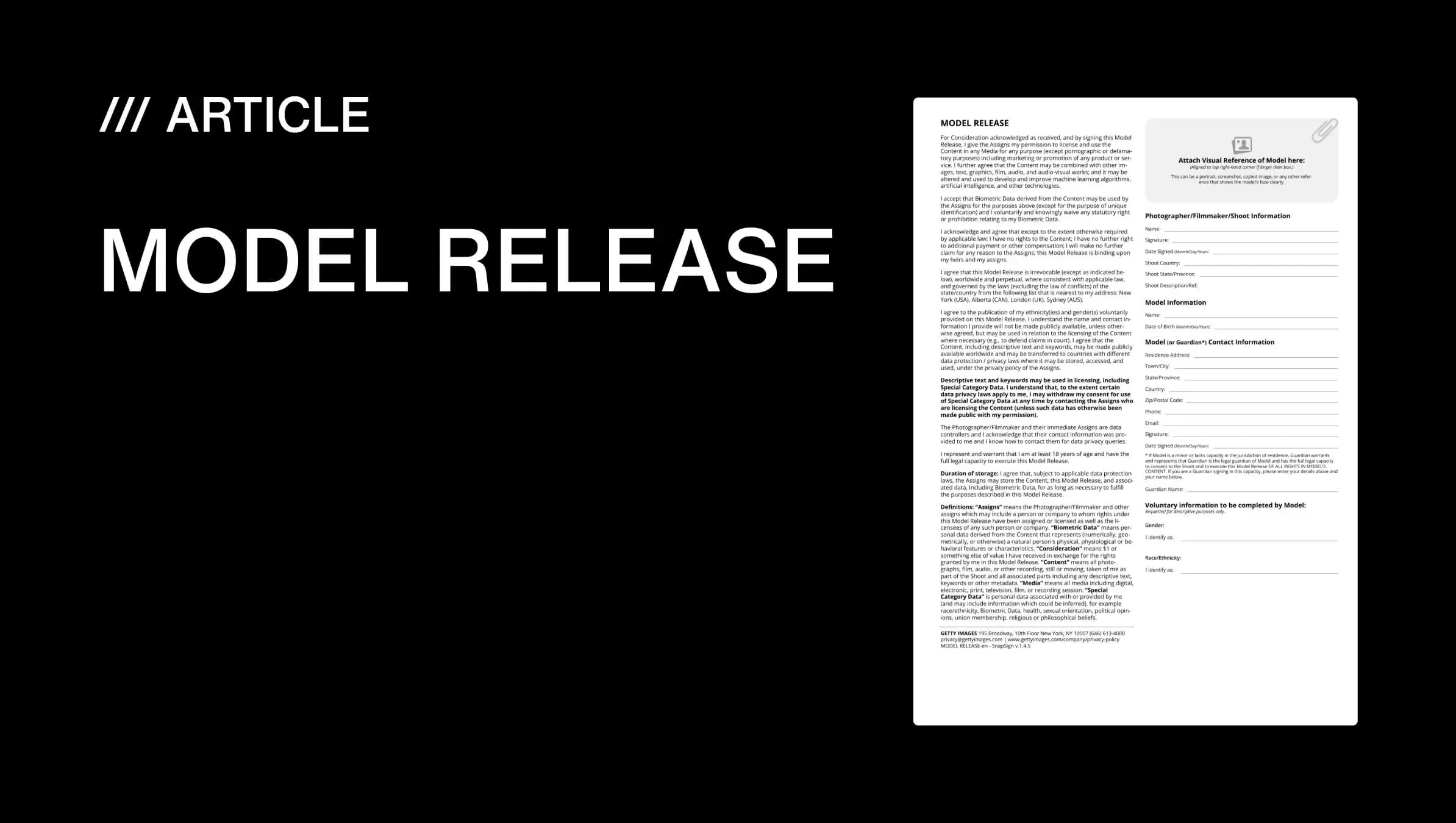
A model release is a legal document that grants a photographer permission to use a person's likeness for commercial purposes. Without one you cannot sell images on stock platforms like Getty Images or Adobe Stock, license work to brands for advertising, or defend yourself if a model objects to how their image is used. It is the single document that separates a photograph you took from a photograph you can actually make money with.
At minimum, a valid model release identifies the photographer, the model, the shoot date, and the scope of permitted use. It needs a signature — from the model, and from a parent or legal guardian if the model is a minor. That is the baseline when you book a model directly. Things get more complicated when an agency enters the picture.
Why adding an agency changes the equation
When an agency is involved, three parties have a stake in the release: the photographer, the model, and the agency. Each has different interests. The model wants to control where their image appears. The agency wants to protect their talent and their commission structure. The photographer wants the broadest possible usage rights to maximize the value of the images.
An agency-provided release is generally drafted to reflect the agency's and client's contractual needs — which may not always match the photographer's intended future use. It may restrict commercial use to a single campaign, limit the territory to one country, or set a time window after which the images cannot be used. If you plan to license the images to a stock photography platform, submit them to a different client later, or use them in your portfolio across multiple markets, an agency release may not give you the rights you need. You may not discover this until a platform rejects your submission or a client's legal team flags the restriction.
What happens when nobody knows who is responsible
It usually plays out the same way. The shoot goes well. Everyone is happy. Months later a brand wants to license an image for advertising, or the photographer submits the work to a stock platform — and someone asks for the model release. The agency points to the photographer. The photographer points to the agency. The model's agent says they thought someone else handled it. And the images sit in limbo.
The financial consequences are real. A commercial licensing deal can be worth thousands of dollars — and it evaporates the moment a brand's legal team cannot verify the release. Major stock platforms — including Getty Images and Adobe Stock — generally reject submissions with missing or inadequate releases. The notification is often terse and does not explain exactly which clause failed review — you just see that your content was not accepted. And if a model later objects to how their image is being used and there is no release? You are looking at legal action, settlement costs, and reputation damage in an industry where word travels fast.
So who actually carries the responsibility — and when? The answer depends on the type of agency you are working with. A model agency, an advertising agency, and a production company all operate under different norms, and the default assumptions shift with each one. Here is how it breaks down.
Scenario breakdown — who handles the release in each situation
Working with a model agency
Model agencies sometimes include a release as part of the booking agreement — effectively bundling the agency model release contract into the booking paperwork. On the surface this sounds ideal — the agency handles the paperwork, you show up and shoot. But the release you get is generally drafted to reflect the agency's and the client's contractual needs, and those may not always match your intended future use. It may limit usage to editorial only, restrict the territory, or include a time-bound usage window that expires before the images have earned back their production cost.
Read the fine print. If the release says "editorial use only," your images cannot be used for advertising, stock photography, or brand campaigns. If it limits usage to "one year in the United States," your images become unusable for international clients and expire on a calendar date. If the signer is an agency representative rather than the model themselves, you need to verify they have legal authority to sign on the model's behalf — depending on the jurisdiction and the specific terms of the agency agreement, they may not. Some stock platforms require the model's own signature regardless of any agency power of attorney.
Working with an advertising agency
On large advertising campaigns the agency or the end client typically handles releases through their legal department. These are the shoots where you are hired as a photographer but do not own the final images — the agency or brand does, and they carry the legal responsibility for clearing usage rights. In these cases the agency provides the release, the model signs it as part of the campaign contract, and you are unlikely to be asked for paperwork after the fact.
But this structure applies to big-budget campaigns with formal contracts. On smaller freelance gigs booked through an agency — a lookbook, a test shoot, a social media campaign — the lines blur. The agency may treat the commercial shoot as a simple model release booking with no legal infrastructure behind it. And when the brand comes back six months later asking for expanded usage rights, the photographer is the one scrambling to find a release that may not exist.
Working with a production company
Production companies sit somewhere between model agencies and advertising agencies. On a film set or commercial video production, the production company typically manages releases for cast and crew as part of the production workflow — especially on union productions where contracts are standardized under guild agreements like SAG-AFTRA. But on smaller independent productions, documentary shoots, or music videos, the responsibility may fall to whoever is producing, and if that is you, the release is your job.
If you are hired as a cinematographer or stills photographer on a production, ask the producer or line producer before the shoot: "Who is handling model releases for cast and extras?" Get the answer in writing — an email is enough. If the answer is vague, bring your own release forms and have each person sign. On a set with twenty background actors, chasing signatures after wrap is a logistical nightmare that costs you time you do not have.
Freelance and direct-to-model shoots
No agency involved? Then the release is 100% your responsibility. No grey area, no shared burden, nobody to point at later. You find the model, you bring the release, you collect the signature. This is the cleanest workflow — and the one where digital releases save the most time.
Comparison table — agency type vs release responsibility
| Agency type | Who typically provides the release | Photographer's backup step | Risk level |
|---|---|---|---|
| Model agency | Agency may provide — often with usage restrictions | Get your own release signed on set — unless it is a work-for-hire contract | High — restrictions can kill licensing deals |
| Advertising agency (large campaign) | Agency or client legal team | Confirm in writing before the shoot | Low — legal infrastructure exists |
| Advertising agency (small freelance) | Often falls to the photographer | Treat it like a direct booking — bring your own release | High — no one else is thinking about it |
| Production company | Production company on large sets; photographer on small ones | Ask the producer; bring releases as backup | Medium — depends on production scale |
| No agency (direct booking) | Photographer — 100% | No backup needed — just do it right the first time | Low — you control everything |
The double-sign strategy — your insurance policy
Here is the single most useful thing you can take from this article: unless your contract explicitly makes the client or agency responsible for releases and indemnifies you, get your own release signed on set — even when the agency says they are handling it. This is not about distrusting the agency. It is about owning a backup that you control.
There is one clean exception. On a work-for-hire or staff-photographer shoot where the client owns all intellectual property, the client's release is the only one that matters. Your own release adds nothing, because you do not hold licensing rights to begin with. In every other scenario — freelance bookings, test shoots, lookbooks, any shoot where you retain usage rights — the double-sign strategy applies.
An agency release can have problems you do not discover until it is too late. The model's signature might be missing. The usage scope might be narrower than what the agency verbally promised. The release might have expired under a time limit buried in the fine print. The agency might have changed their filing system and cannot find the document two years later. When any of these things happen — and they do happen — having your own signed release means the difference between a minor inconvenience and a lost licensing deal.
The double-sign strategy costs you two minutes on set: hand the model your release, they sign, you move on. If the agency's release is perfect, yours sits in storage as insurance. If the agency's release has a problem, yours saves the shoot. It is the cheapest insurance policy in commercial photography.
What to check in an agency-provided model release
Usage scope and restrictions
The most important line in any model release is the usage scope — what the photographer is allowed to do with the images. Look for words like "editorial only," "personal use," or "portfolio use." These are restrictions. A release that says "editorial use only" means you cannot use the images for advertising, stock photography, or brand campaigns. If stock licensing is part of your plan, you need a release that explicitly permits commercial use and stock platform submission.
Also check whether the release grants rights to the photographer or to the agency. Some agency releases assign usage rights to the agency, not to you — which means the agency controls where the images can be used, and you need their permission to license them to anyone else.
Duration and territory
Some agency releases include a time limit — for example, "valid for two years from the date of signature." After that window closes, you lose the right to use the images. Others restrict the territory: "valid in the United States only." If you license images internationally or to clients who operate across borders, a territory-restricted release is as good as no release at all for those uses.
Many photographer-drafted commercial releases grant worldwide and perpetual rights — the standard that stock platforms and most commercial clients expect. That said, negotiated campaigns with celebrities, actors, or major advertising buyouts often include narrower terms by design. The key is knowing which terms your release carries before you need to rely on them. That alone is reason enough to carry your own.
Who actually signed it
Check the signature line. Did the model sign, or did an agency representative sign on the model's behalf? In many jurisdictions an agent can sign for a model only if they hold explicit legal power of attorney — and even then, some stock platforms require the model's own signature, not a representative's. If the model is a minor, the signature must come from a parent or legal guardian, not an agency representative. A release signed by the wrong person is not a release — it is a piece of paper that will fail review.
Digital releases vs paper — why it matters on agency shoots
Paper model releases are much easier to misplace on complex productions. On an agency shoot with multiple models, a paper release needs to be printed, signed, and stored — and if one goes missing, you are chasing signatures from people who have already moved on to their next booking. Digital releases solve this problem at the root.
A digital model release is signed on a phone or tablet, saved to the cloud, and accessible from any device. You can share the signed PDF with the agency, the client, and your own records in seconds. There is no folder to misplace, no coffee spill to ruin a signature page, no "I think I left it in the studio" conversation six months after the shoot. For agency workflows where three or four parties need access to the same document, digital scales far more efficiently — no couriers, no scanned PDFs with mismatched file names, no "which version is the final one" email threads.
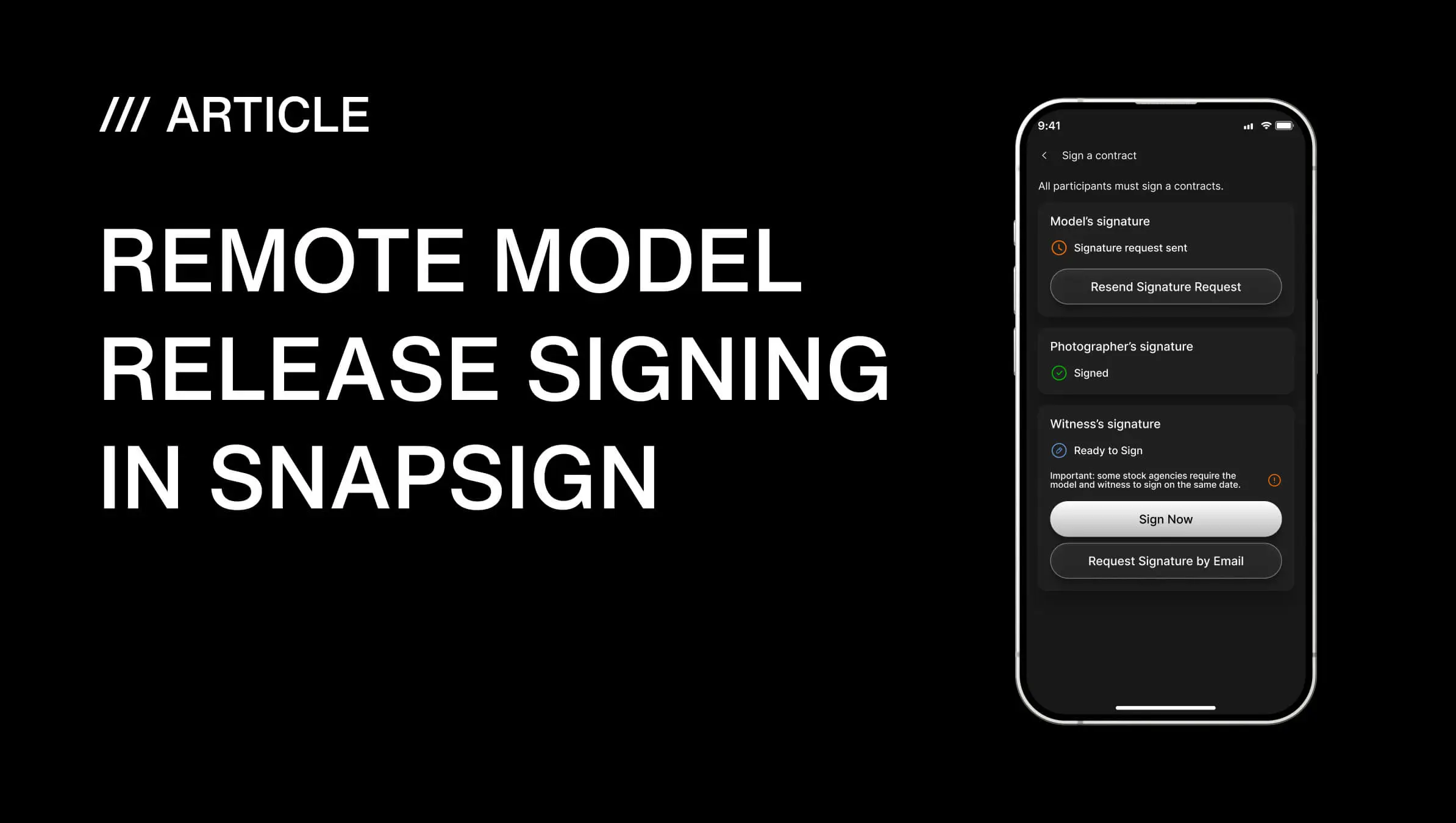
We built SnapSign specifically for this workflow. A remote Signature Request lets you send the release to a model's agent for review, to the model for signing, and back to you — all before the shoot day. Nobody needs to install anything. When the shoot wraps, the signed Contract is already stored, searchable, and ready to share. And every signed Contract is cryptographically hashed with SHA-256, so you can prove the release has not been altered — a trust signal that matters when an agency or a brand's legal team asks for verification.
Legal risks of getting it wrong
The legal framework around model releases rests on the right of publicity — the right of every person to control the commercial use of their own likeness. In the United States this right varies by state. In the European Union it is governed by privacy and data protection law. In both jurisdictions, using someone's image commercially without their consent exposes you to legal action.
The practical consequences are threefold. First, financial: settlements and legal fees in right-of-publicity cases can reach six figures. Second, platform: stock photography platforms have nearly zero tolerance for missing or inadequate releases — a submission with paperwork gaps typically does not pass review, and repeated rejections can affect your contributor standing. Third, reputation: agencies and brands talk to each other. A photographer who cannot produce clean paperwork on one job is a photographer who does not get called for the next one.
The rules are clear on paper — but the messiest situations are the ones photographers actually run into on set. Here are the four scenarios that come up most often, and how to handle each one.
Common scenarios photographers run into
"The agency says they have it covered"
This is the most dangerous sentence in commercial photography. It costs nothing to say, and it shifts the burden of verification onto the one person who will actually suffer the consequences — you. When an agency representative tells you the release is handled, your response should be: "Great — can you send me a copy so I have it in my records?" If they cannot produce it, they have not handled it. Get your own release signed on set.
There is another layer to this that photographers often miss. When the agency or client provides the release, the signed document typically belongs to them — not to you. As one photographer put it on r/photography: "You might not be able to use the images yourself, in case the model releases go to the client directly rather than to you." This is especially common on commercial shoots where the brand's legal team drafts the paperwork. The release exists, the shoot is legal, but your portfolio rights vanish because you never held a copy of the document that granted them. If you want the images in your portfolio or plan to license them to other clients later, you need a release that names you as the rights holder — not just the agency.
"The model was booked through two agencies"
This happens more often than you would think — a model is represented by one agency in New York and another in Los Angeles, or by a mother agency in one country and a booking agency in another. Both agencies may claim to handle the release. Neither may actually have authority to sign on the model's behalf. In this situation the safest path is to get the release signed by the model directly, on set, regardless of what either agency says. A model's own signature cuts through every layer of agency ambiguity.
"The shoot was six months ago and the brand wants more usage rights"
The brand licensed the images for a regional campaign. Then the brand decides to take it national — or global. They ask for the model release to verify the usage rights, and suddenly the agency's release from the original shoot has restrictions that block the expanded use. The brand walks away, and you lose a licensing fee that could have been larger than the original shoot budget.
This is where a self-provided release with broad, perpetual, worldwide usage terms pays for itself. If you have your own release from the shoot day — with no time limit, no territory restriction, and clear commercial usage rights — you can go back to the brand and say yes. If you are relying on the agency's release with its narrow scope, you say no and watch the revenue go to someone else.
"The agency release is in a language I cannot read"
International fashion shoots, destination campaigns, models booked through foreign agencies — you may receive a release in French, Italian, Japanese, or another language you do not speak. Do not sign something you cannot read. Do not accept a model's signature on a document you cannot verify. If the release is in a language you do not understand, get it translated or use your own release in a language you and the model both understand. A release you cannot read is not a release — it is a liability.
When the agency genuinely handles everything
There are situations where you genuinely do not need to worry about the release. On a major advertising campaign with a formal production contract, the agency or brand legal team manages every piece of paperwork — releases, location agreements, talent contracts. You are hired as a photographer, you deliver the images, and the client owns the legal clearance. In these cases your contract should explicitly state that the agency or client is responsible for all model releases and usage rights clearance, and that you are indemnified against any claims arising from missing or inadequate releases.
If those clauses are not in your contract, the responsibility is not as clear as the agency says it is. Read your contract. If it is silent on releases, assume the responsibility is yours and act accordingly.
Decision tree — who handles the release on your shoot?
If your head is spinning from all the variables, here is a quick filter. Start at the top and work down. Where you land tells you what to do.
| Step | Question | If yes | If no |
|---|---|---|---|
| 1 | Is this a work-for-hire where the client owns all IP? | Verify the client's release exists. Your own release is not needed — the client's release governs all usage. | Go to step 2 |
| 2 | Is an agency providing a release as part of the booking? | Review it — check usage scope, duration, territory, and signer. Go to step 3 | Go to step 4 |
| 3 | Does the agency's release grant the rights you need — now and for any foreseeable future use? | You are covered — but still get your own copy. Go to step 5 | Go to step 4 |
| 4 | Do you plan to license the images to stock platforms, other clients, or use them beyond the original campaign? | Bring your own release with broad commercial terms. Get it signed on set. | Agency release may be sufficient — confirm in writing. Go to step 5 |
| 5 | Do you have a copy of every signed release stored somewhere you control? | Done. You are protected. | Get copies now — before anyone asks for them. |
Pre-shoot checklist for agency bookings
Before you walk onto an agency shoot, run through these five questions. They take sixty seconds and prevent the kind of paperwork scramble that kills licensing deals months after the fact.
- Ask who provides the release. Is it the agency, the client, or you? Get the answer in writing — an email counts.
- Ask who signs. The model? An agency representative? A parent or guardian for a minor? Confirm the signer has legal authority.
- Ask who stores the signed document. If the answer is "the agency" or "the client," request a copy for your own records before wrap.
- Ask who can expand usage rights later. If the brand wants to take a regional campaign national in six months, who do you call — the agency, the model, or both?
- Get your own copy. Regardless of who provides the release, leave the shoot with a signed copy — digital or paper — stored somewhere you control.
These five questions apply to every agency type in the scenario breakdown above. The answers change depending on whether you are working with a model agency, an ad agency, or a production company — but the questions do not.
How SnapSign simplifies agency-shoot releases
We built SnapSign to remove the paperwork friction from shoots — and agency shoots have more friction than most. Instead of printing, signing, scanning, and emailing release forms between three parties, the entire workflow lives in one place. SnapSign is a model release app designed for photographers who need releases signed on set, on location, and on tight timelines — exactly the conditions agency shoots create.
For shoots with multiple models booked through agencies, our Group Events feature lets you create a roster, send a single Invitation Link or QR code, and let each model sign their release on their own device — no app install required. You can see who has signed and who has not in real time, resend Signature Requests to anyone who has not completed theirs, and download all signed Contracts as PDFs when the event is finalized. The agency can receive copies of every signed release without you forwarding a single email.
For one-on-one agency bookings, a Signature Request lets you send the model release by email. The model's agent can review it before the model signs — transparency that agencies appreciate. The link expires after 48 hours if unsigned, so there is no open-ended liability floating in someone's inbox. And because every signed Contract is cryptographically hashed, you can prove to an agency, a client, or a stock platform that the release has not been altered since the moment it was signed.
No matter how you handle the agency side of the paperwork, having your own release signed on set is the habit that protects you. A digital release makes that habit fast enough to actually do it every time.
Final verdict — agency model releases
When you work with agencies, model release responsibility is a negotiation — not a default. Some agencies provide releases, some do not, and the ones that do often include restrictions that serve their interests, not yours. The only release you can count on is the one you brought yourself. Get it signed on set, store it digitally, and treat the agency's release as a bonus — not as your only line of defense. Two minutes of paperwork on the shoot day buys you a lifetime of clean licensing and the ability to say yes when a brand's legal team comes calling.