Why Everyone Panics About 2257
If you’ve been on OnlyFans for even a little while, you’ve probably seen people panicking about “2257 rules,” compliance reviews, or sudden bans that land out of nowhere. Maybe you’ve even had that knot in your stomach when someone writes on X/Twitter:
“My account just got banned for a 2257 violation — and I have NO idea what I did wrong.”
The reality is harsh but simple: most creators don’t get banned because they’re doing something criminal. They get banned because nobody ever explained how surprisingly simple 2257 compliance can be when you treat it like part of your workflow, not a mystery.
This guide breaks everything down like a conversation between two creators at the kitchen table — no legal jargon, no corporate speak, no confusing law-school energy. Just straight-up, practical advice to keep your account safe, your content legal, and your income protected.
For official reference, you can also check the 18 U.S.C. 2257 text and the OnlyFans 2257 information page.
What Is 2257 in Simple Terms?
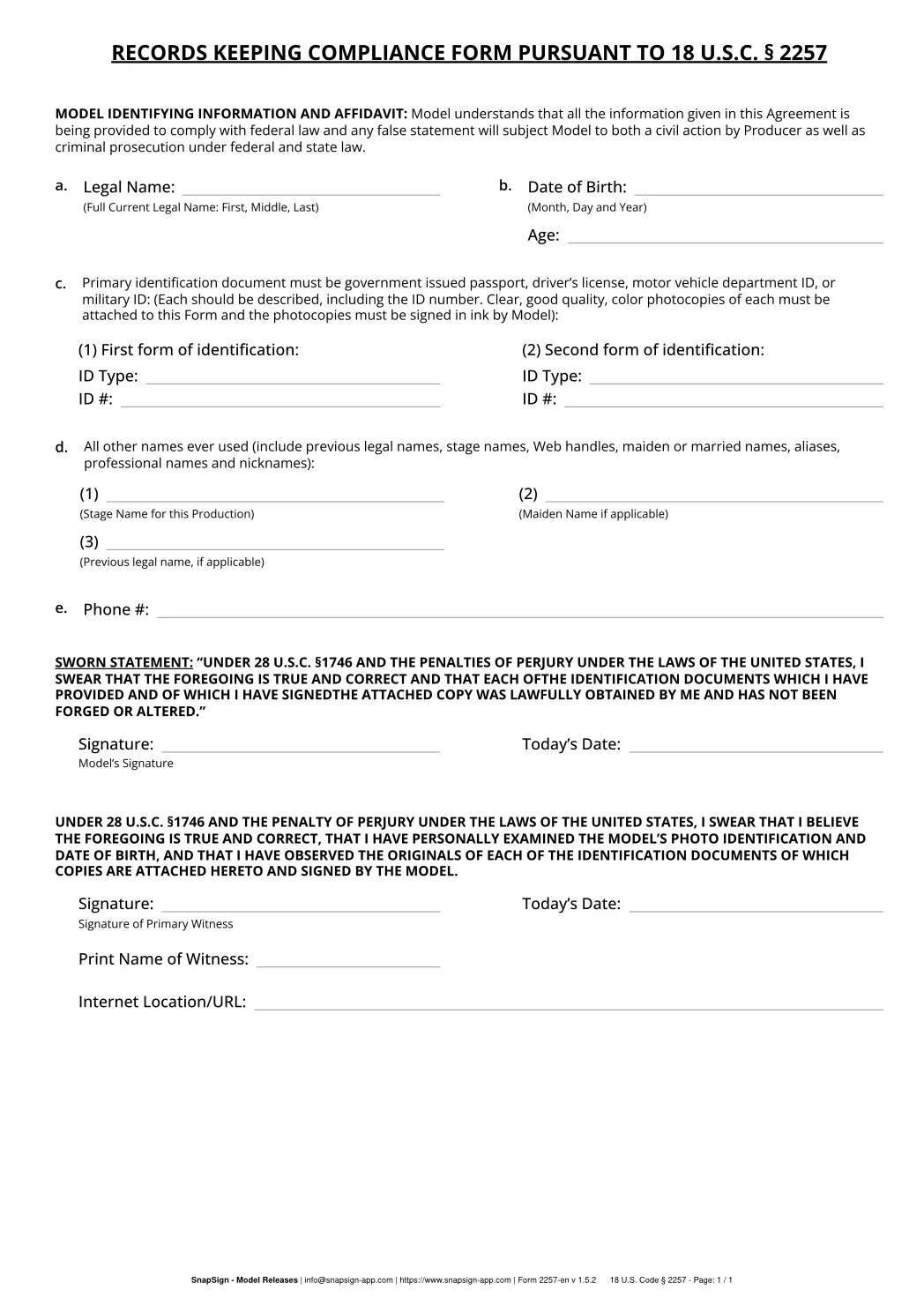
2257 is a U.S. federal law that says: if you create sexually explicit content, you must make sure every person in that content is over 18 — and you must keep proof of that.
In practice, that means collecting and storing:
- • government-issued IDs
- • legal names
- • dates of birth
- • signed model releases
for every performer that appears in explicit content. It applies to all kinds of explicit content — OnlyFans videos, couples content, collabs, group scenes, customs, and pretty much anything that could reasonably be described as adult material. There’s a reason platforms and regulators are obsessed with this: age checks and records are now treated as a core safety and compliance issue worldwide, and adult platforms are expected to prove they’re doing this properly.
How to Avoid a 2257 Ban on OnlyFans
Avoiding a 2257-related ban on OnlyFans comes down to a few boring, repeatable habits — but those boring habits are what keep your account alive.
You verify people before you film, you get them to sign a proper release, you store your documents somewhere safe and not chaotic, and you don’t upload collaborations until the other performer has gone through OnlyFans’ own verification process. If you build good habits into your routine early, you’ll automatically dodge most of the compliance drama that takes out other creators.
Plenty of creator-focused blogs and agencies now have entire guides about “my OnlyFans account got suspended” and how to get it back — which pretty much proves how common this is. Sites like XCreatorMgmt, Rulta and other OnlyFans-focused agencies openly talk about suspensions for verification and policy violations and walk creators through appeals and recovery.
What Is 18 U.S.C. 2257? A Clear Explanation for Creators
2257 exists for one main reason: to prevent minors from appearing in adult content. The law requires anyone who produces explicit material to verify age, record legal identity, and keep proper documentation on file. It doesn’t care if you’re a giant studio or one person with an iPhone — the rules are the same.
This doesn’t just apply to studios and big-budget sets. It also covers:
- • solo creators
- • couples content
- • collabs with friends
- • clip stores
- • independent adult photographers and videographers
- • basically anyone who films and publishes explicit content, including on subscription platforms like OnlyFans
If you upload explicit content, you are legally treated as a producer, even if you film alone in your bedroom. For a more formal legal explanation, OnlyFans links their 2257 compliance details on their 2257 information section.
Why OnlyFans Enforces 2257 So Aggressively
OnlyFans isn’t being dramatic when they crack down on compliance — they’re being protective, mostly of their payment infrastructure and regulatory status.
The platform is watched by:
- • Visa and Mastercard
- • banks and payment processors
- • anti-trafficking organizations
- • regulators like Ofcom in the UK
In March 2025, Ofcom fined Fenix International (the operator of OnlyFans) £1.05 million for providing inaccurate information about age-verification measures and “challenge age” settings in its system, a story covered both in regulatory commentary and tech media. That fine wasn’t about one creator — it was about how seriously governments now treat age checks on adult platforms.
A single serious mistake, or even the perception that minors could slip through, can threaten their ability to process payments for everyone on the site. That’s why when something looks off — an unverified face, a masked person, a blurred collaborator, an ID that looks ancient or unreadable — they don’t hesitate. They freeze the post, remove the content, or lock the account while they investigate.
From their perspective, if they don’t enforce 2257 strictly, the entire platform could be at risk. From your perspective, that means you have to be as serious about documentation as they are.
Who Has to Follow 2257 Laws on OnlyFans?
Are OnlyFans Creators Legally Considered “Producers”?
"Short answer: yes."
If you film, edit, upload, distribute, or sell explicit content, the law considers you a producer. That word might sound “studio-level,” but legally it absolutely includes independent creators. Producers are the people responsible for 2257 compliance — so if you’re creating content for OnlyFans or similar platforms, that’s you.
When 2257 Actually Applies
2257 applies whenever your content includes:
- • actual or explicit nudity
- • sexual acts
- • visible genitals
- • masturbation
- • penetration
- • sexual posing
- • heavily implied sexual behavior
- • multiple performers
If someone appears in the content in a sexual context — even just for a few seconds — they need to be over 18 and properly documented. That includes partners, friends, collab creators, couples content, paid performers, and anyone else whose body appears in an explicit way alongside you.
2257 Requirements Explained
Think of 2257 as three main responsibilities plus one “smart extra.”
1. Collecting Government-Issued ID
You need to see and store a valid government-issued photo ID for each performer. That ID should clearly show:
- • full legal name
- • date of birth
- • a photo that actually looks like them
- • the issuing authority (country, state, etc.)
- • the expiration date
Some age-verification guides aimed at creators go as far as to warn that trying to get clever around ID checks is a direct highway to instant suspension or banning — they treat ID as the single most important element of adult compliance. You’ll see this sentiment echoed in various educational blogs and “how to legally create adult content” resources.
2. Collecting a Signed Model Release
An ID proves age. A model release proves consent and permission to use and distribute the content. A solid model release:
- • links the real person (their legal identity) to the content
- • states that they agreed to be filmed
- • confirms they understand you can use the footage commercially
- • is signed and dated by both sides
3. Storing Records Properly
Good 2257 record-keeping means you don’t just “have the files somewhere” — you know exactly where they are and could produce them if someone asked. Your documents should be:
- • organized
- • ideally encrypted or stored securely
- • backed up
- • labeled in a way that makes sense to you
If your IDs and releases are lost between screenshots and memes in your camera roll, that’s not compliance — that’s chaos.
4. Adding 2257 Statements
You don’t have to add a 2257 statement to every OnlyFans post, but it’s a smart move for long-form videos or anything that might get downloaded and reposted.
A short text stating that all performers were over 18 and that records are maintained in accordance with 18 U.S.C. 2257 can help if your content surfaces somewhere else without context.
How OnlyFans Detects 2257 Violations
OnlyFans uses a blend of human moderators and internal systems to scan for risk. They pay special attention to content where there’s clearly more than one person on screen, guest appearances, or anything that suggests someone else is behind the camera. Red flags for them include:
- • unverified additional faces
- • masked or blurred people
- • IDs that look too old or too low-quality to trust
- • camera angles that obviously suggest a third person is filming
- • background people who weren’t part of verification
- • performers who simply look too young
If something doesn’t sit right, they freeze the post, remove the content, or request documents. This isn’t theoretical — there are entire guides and agencies dedicated to helping creators deal with “OnlyFans account suspended” situations and working through the appeals process. For example, XCreatorMgmt’s suspension guide and Rulta’s appeals resources both publish step-by-step instructions for suspended creators.
What Usually Triggers Strikes
Most strikes don’t come from malicious content. They come from simple, sloppy mistakes — uploading a collab without tagging the other performer, trying to submit a blurry ID photo, skipping a release because “we’re just having fun,” posting the content before OnlyFans has verified the partner, or letting a friend or guest appear in the background without going through any verification.
What Can Lead to Permanent Bans
Permanent bans usually happen when OnlyFans sees a pattern:
- • repeated 2257 violations
- • missing or obviously fake documents
- • refusal to submit anything when asked
- • any serious suspicion that a minor might be involved
There are public examples of high-earning creators being dropped instantly when OF decides the risk is too high. One of the most talked-about cases is Bonnie Blue, who was permanently banned after OF said her extreme “challenge” content and planned “petting zoo” stunt violated its Acceptable Use Policy — a story widely covered in tabloids like The Sun and other media.
That’s a different flavor of violation than 2257 paperwork, but it proves the same point: when OnlyFans thinks something is risky on a legal or ethical level, they will cut off even their biggest earners.
How to Collect and Store IDs & Releases Correctly
Solo Creators Still Need Documents
Even if you never film with anyone else, you still need to take your own documentation seriously. That means keeping a clear, up-to-date copy of your own ID, maintaining a personal 2257 folder, and updating your records when your ID renews.
It sounds overkill, but if you treat your content like an actual business, this is just basic record-keeping.
Couples and Collabs
Once someone else appears on camera, your responsibility multiplies. For each collaborator or partner who appears in explicit content with you, you should have:
- • a clear government ID
- • a selfie of them holding that ID (to link the ID to their face)
- • a signed model release
- • confirmation that they consent to being filmed and published
- • verification approved inside OnlyFans before anything goes live
Model Releases: Doing It the Right Way
Releases shouldn’t be an awkward afterthought. Ideally, you get them signed before filming. A proper model release:
- • connects the performer’s full legal name and date of birth with their ID details
- • spells out that they consent to being filmed
- • states that they permit you to use and distribute the content
- • includes the date and location of the shoot
- • lists you (by your legal name) as the producer
- • ends with the performer’s signature
Safe Document Storage
This is where a lot of creators blow it. Storing IDs and releases casually on your phone is asking for lost files, leaks, or general chaos. A much better approach is to use encrypted folders, secure cloud storage, or a dedicated compliance mobile app like SnapSign that’s built specifically to handle model releases and ID photos.
2257 vs OnlyFans Requirements
| Requirement | 2257 Law | OnlyFans Rules |
|---|---|---|
| Applies To | All explicit content | All creators uploading explicit content |
| Releases | Yes | Yes (especially for collabs) |
| ID Verification | Required | Required inside the OF verification system |
| Storage | Must be organized, secure, and traceable | Must be accessible for review upon OF's request |
| Penalties | Legal or regulatory consequences | Warnings, strikes, content removal, permanent bans |
SnapSign: The Best Mobile App for 2257 Compliance
Most creators don’t struggle with 2257 because it’s too complex — they struggle because managing files manually is hell. SnapSign is designed to fix exactly that. SnapSign includes:
- • ready 2257-compliant templates
- • built-in ID capture
- • automatic timestamps
- • secure cloud storage
- • mobile and remote signing
- • easy onboarding for collabs
SnapSign vs DocuSign vs EasyRelease
| Feature | SnapSign | DocuSign | EasyRelease |
|---|---|---|---|
| 2257 templates | ✅ Yes | ❌ No | Partial |
| Built-in ID capture | ✅ Yes | ❌ No | ❌ No |
| Auto timestamps | ✅ Yes | ✅ Yes | ✅ Yes |
| Best for OnlyFans | ✅ Yes | ❌ No | ❌ No |
| Compliance focus | High | Low | Low |
Why SnapSign Is the Only Tool Creators Should Be Using for 2257 Compliance
Let’s be completely honest here: out of all the tools creators try to use for 2257 documentation, SnapSign is one of the very few that’s actually built for adult creators and fully designed around the compliance problem from start to finish. Everything else — DocuSign, EasyRelease, PDF templates — is basically a generic workaround, not a real compliance solution.
SnapSign isn’t “just another e-signature app.” It’s a full-scale 2257 compliance engine, designed specifically for:
- • adult workflows
- • multi-performer shoots
- • ID linking
- • consent tracking
- • long-term secure record storage
It’s the only tool in this space that’s set up to handle the entire 2257 workflow:
ID → release → timestamp → storage → exportable proof for appeals.
No patchwork. No missing pieces. Less stress.
If you’re serious about keeping your account safe, avoiding bans, and protecting your income, SnapSign is the tool that actually does the job the way this industry requires — with no ugly hacks and no gaps in your documentation chain.