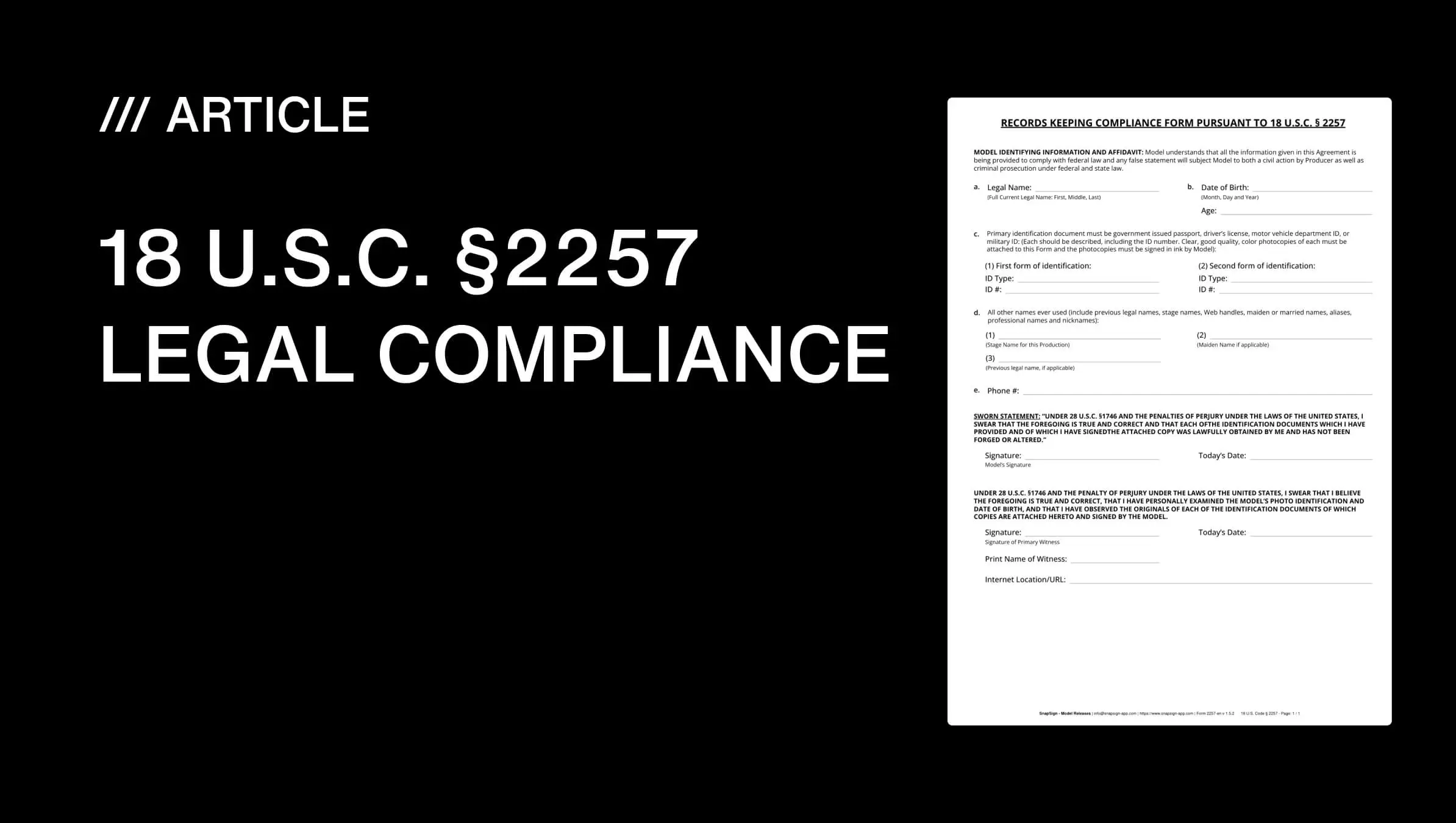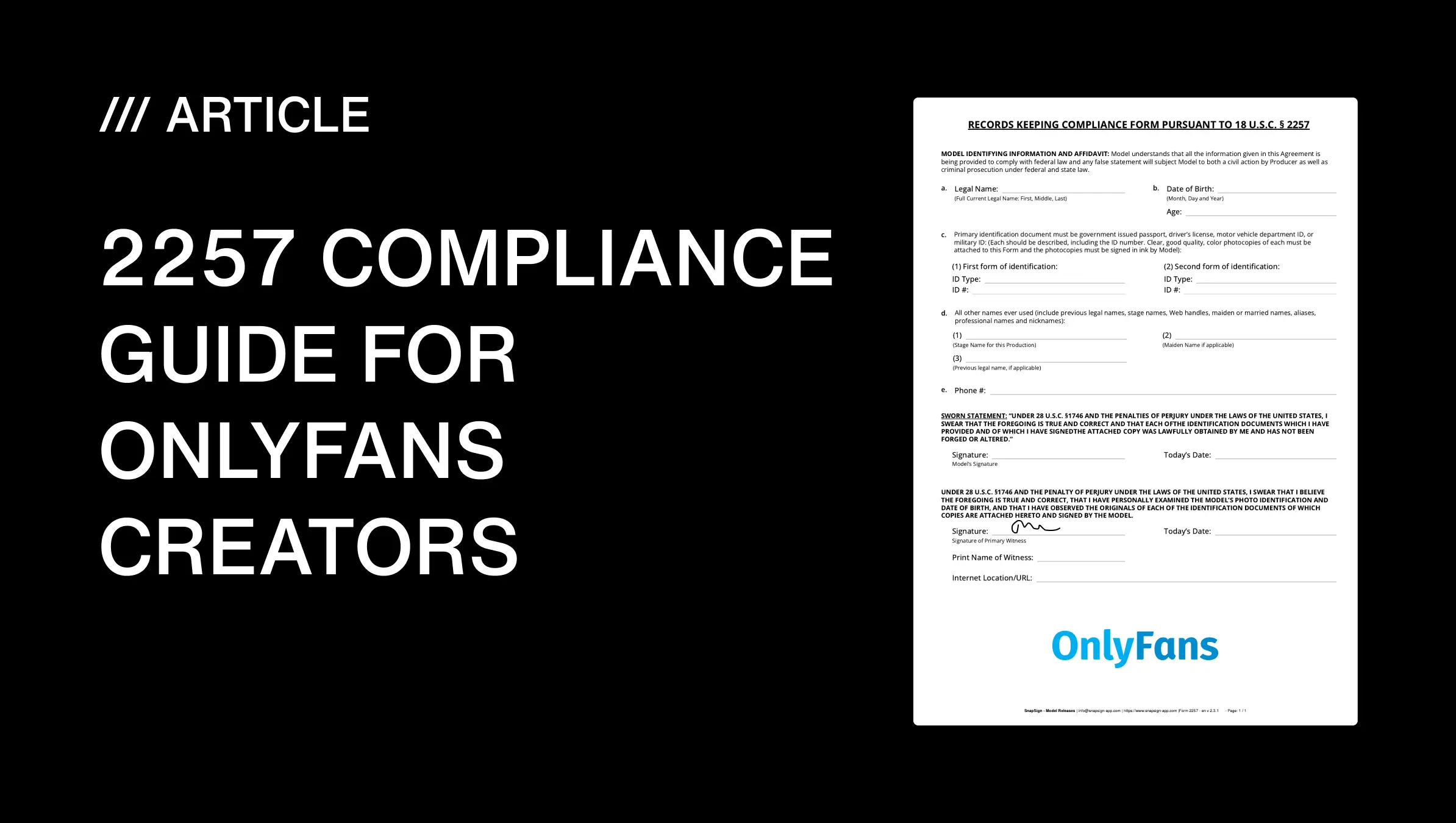
📌 Looking for general 2257 compliance? This guide focuses on OnlyFans-specific rules, ban prevention, and platform requirements. For the complete 18 USC 2257 legal framework — forms, record-keeping requirements, Custodian of Records duties, and compliance for all content types — see our 2257 Compliance Guide: 18 USC 2257 Forms & Requirements.
Bottom line: Most OnlyFans bans are preventable. 2257 compliance comes down to four steps: verify every performer's age with government ID, get a signed model release before filming, store records in an organized system (not your camera roll), and keep those records for as long as the content exists online. This guide covers all four — plus the OnlyFans-specific rules that go beyond the law — so you can post with confidence and survive a compliance audit if it comes. If you already have a strike, jump to how to appeal a 2257 ban.
What Is 2257 Compliance - A Clear Definition
2257 compliance is the federal requirement to verify that every performer in sexually explicit content is over 18, collect government-issued photo ID, obtain a signed model release, and maintain those records in an organized, retrievable system. The law - 18 USC 2257 (also written as 18 U.S.C. § 2257) - applies to anyone who produces explicit content, from a solo creator filming on a phone to a studio with a full crew. There is no small-creator exemption, no casual-creator carve-out, and no "we're just having fun" exception. If you publish explicit content on OnlyFans, the law treats you as a producer, and the obligations are yours.
In practice, 2257 compliance means four things: verify age with government ID, collect a signed release from every performer, store 2257 records securely so they survive a lost phone or dead hard drive, and keep those records for as long as the content exists online. Missing any one of these - even by accident - can trigger a strike, and repeated failures lead to a permanent ban. This guide walks through each obligation, the platform rules that go beyond the law, and the workflow that keeps your account safe.
For the full legal text, see 18 U.S.C. § 2257. OnlyFans maintains a 2257 information page with their compliance expectations. For historical context on the legislation, see the Child Protection and Obscenity Enforcement Act on Wikipedia. The core logic is straightforward: prevent minors from appearing in adult content by requiring producers to keep proof that every performer is an adult who consented. What trips creators up is not the logic - it is the execution. Most bans happen because documentation is scattered, incomplete, or missing entirely when the platform asks for it.
A note on scope: this article focuses on OnlyFans-specific 2257 enforcement - platform rules, ban triggers, and appeal workflows. For a broader guide covering 2257 across all adult content types, read our full 2257 compliance guide.
Who Must Follow 2257 Rules on OnlyFans
Are OnlyFans Creators Legally "Producers"?
Yes - and the word covers more than most creators assume. Under 18 U.S.C. § 2257, a producer is anyone who films, edits, publishes, reproduces, or distributes sexually explicit content. If you press record, upload to OnlyFans, or even repost someone else's explicit clip, you are a producer. The law does not distinguish between a production company with payroll and one person with a phone - the obligations are identical.
This also captures secondary producers: people who publish, reproduce, or reissue explicit content they did not film themselves. Running a clip store or hosting user-submitted explicit material puts the same record-keeping burden on you as the person behind the camera carries.
Does 2257 Apply to Solo Content?
Yes. A solo creator filming themselves is still producing sexually explicit content. You must maintain proof of your own age and identity - a copy of your valid government ID, stored with your records, updated when the ID expires. Platforms may keep their own verification files, but that does not transfer your legal obligation. The records are your responsibility.
Once another person appears on camera - partner, friend, collab creator, paid performer - your responsibility multiplies. You need documentation for every person, every time. No exceptions for long-term partners. No shortcuts for "we trust each other." No workarounds for people who prefer to stay anonymous. The law requires documentation. The platform enforces it. The consequences for skipping it are identical regardless of your relationship to the person on screen.
Why OnlyFans Enforces 2257 So Aggressively
OnlyFans is not being heavy-handed for the sake of it. The platform's enforcement posture is driven by payment infrastructure risk. Visa, Mastercard, and banking partners require adult platforms to demonstrate robust age-verification and content screening. A single verified case of underage content - or a pattern of undocumented performers - threatens the payment processing agreements that keep the entire platform running.
This is why regulators treat adult platform compliance as a systemic issue rather than an individual creator problem. When a platform cannot demonstrate that its creators follow 2257, the risk extends beyond one account - it becomes a financial and legal liability for the platform itself. The result is what creators experience: fast enforcement, low tolerance for ambiguity, and an appeal process that hinges entirely on documentation quality.
From the platform's perspective, the math is cold but rational: losing one creator who cannot produce records costs less than losing payment processing for every creator on the site. From your perspective, the lesson is equally clear. Your documentation is your insurance policy. When OnlyFans asks for proof, the only thing standing between you and a ban is what you kept - and how well you kept it.
What 2257 Actually Requires - The Four Obligations
The record-keeping requirements under 18 U.S.C. § 2257 come down to four concrete obligations. None are complicated, but all are non-negotiable.
1. Age verification - collect government-issued photo ID for every performer. The ID must be valid (not expired), show a clear photo, display the performer's full legal name and date of birth, and identify the issuing authority. A passport, driver's license, or national ID card all work. Store a clear photo or scan - a dim, blurry snap where the text is barely legible is worthless when you need it.
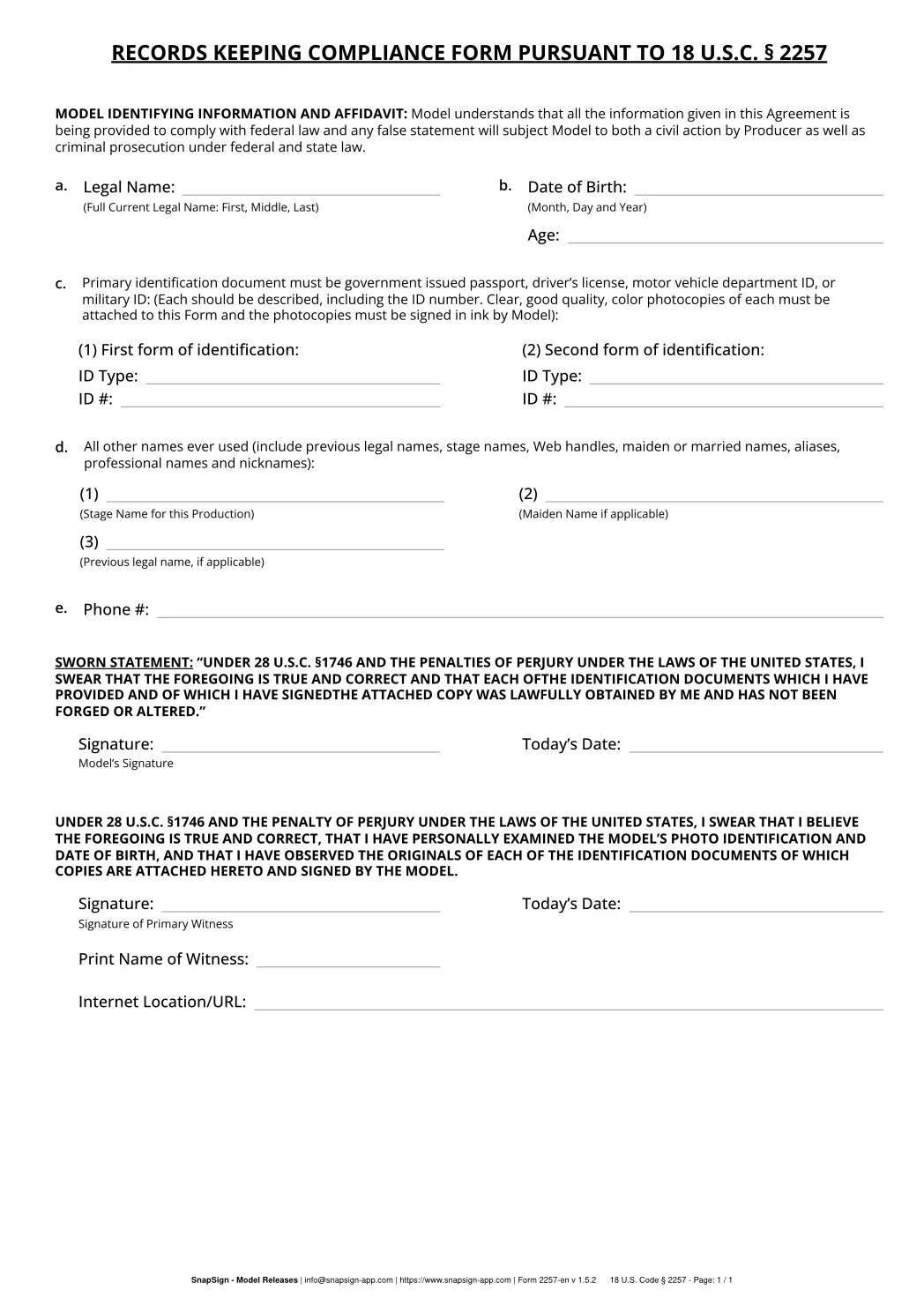
You must also record every name the performer has ever used: legal name, stage names, aliases, maiden names. Our Form2257 template includes dedicated fields for ID document details and all performer aliases so nothing gets missed.
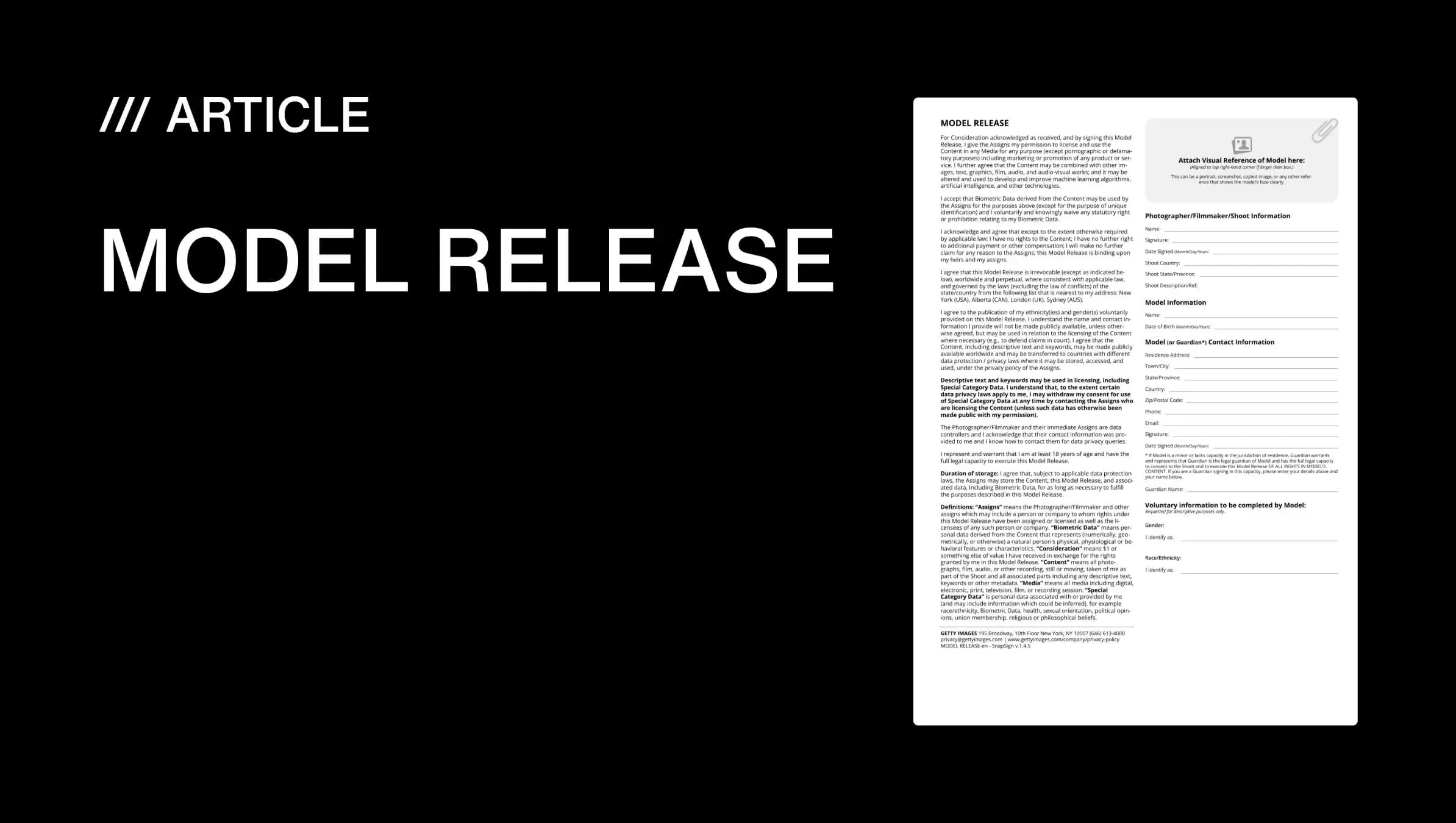
2. Collect a signed model release. An ID proves age. A model release proves consent - that the performer agreed to be filmed, understood the content would be published, and granted you the right to distribute it. A solid release links the performer's legal identity to the content, includes the date and location of the shoot, names you as the producer, and carries both signatures. Get it signed before filming starts, not after. For more on what makes a release legally sound, see our model release guide.
3. Store 2257 records in an organized, accessible system. "Accessible" means you can produce the documents when asked - not that they exist somewhere in your camera roll between screenshots and memes. Records should be organized by performer, clearly labeled, backed up, and stored in a way that survives a lost phone or dead hard drive. Encrypted cloud storage is the practical baseline. A dedicated compliance tool adds timestamps, chain of custody, and tamper evidence - the difference between a five-minute appeal packet and a multi-day scramble.
4. Maintain records for the life of the content. Federal guidance recommends retaining records for seven years from production or five years after you permanently stop producing, whichever is longer. For creators whose content lives online indefinitely - leaks, reposts, and archives included - this means effectively permanent retention. If the content exists anywhere, your documentation should too.
Managing IDs, releases, and records across multiple performers and shoots gets messy fast - especially when you are also filming, editing, and posting. We built SnapSign's Form2257 template to handle all four obligations in one workflow: built-in ID capture, a dedicated 2257 participant form with every field the statute requires, automatic timestamps, SHA-256 hashing for tamper evidence, and cloud storage that survives a lost phone. The table later in this guide shows exactly which fields the template covers and why each one matters for compliance.
2257 Law vs OnlyFans Rules - What's Different
The federal statute sets the legal floor. OnlyFans builds its own enforcement layer on top - sometimes matching the law exactly, sometimes going further. Understanding the difference matters because you need to satisfy both.
| Requirement | 18 U.S.C. § 2257 (Federal Law) | OnlyFans Platform Rules |
|---|---|---|
| Applies to | All producers of sexually explicit content | All creators uploading explicit content to the platform |
| ID verification | Government-issued photo ID for every performer | Government ID plus platform's own internal verification process |
| Model release | Required - signed consent linking performer to content | Required - especially enforced for collaborations |
| Collab rule | Release required for each performer in explicit content | Release required AND performer must complete OnlyFans verification before content goes live |
| Storage | Organized, secure, retrievable on demand | Must be accessible when OnlyFans requests documentation during review |
| Penalties for failure | Federal criminal penalties for knowing violations | Content removal, strikes, account suspension, permanent ban |
| Masked performers | Still requires documentation - anonymity does not waive obligations | Not permitted - all performers must be verifiable regardless of face visibility |
What Triggers a 2257 Strike - And What Leads to a Ban
How OnlyFans Detects Violations
OnlyFans combines automated systems and human moderators to flag potential 2257 issues. The platform pays particular attention to content with multiple people on screen, guest appearances, or anything suggesting someone else behind the camera. Red flags include unverified faces, masked or blurred people, IDs that look too old or too low-quality to trust, camera angles that imply a third person filming, background people who were never verified, and performers who appear underage.
When the system flags something, the response is swift: freeze the post, remove the content, or lock the account while requesting documentation. Thousands of creators go through this process every year. The ones who come out the other side are the ones with organized records.
The Collab Verification Rule - This Is the One That Gets People
Posting collaboration content before the other performer completes OnlyFans' verification is the single most common trigger for a 2257 compliance strike. It trips up even experienced creators because the logic feels backwards: you have a signed release, you have the ID, you did everything right - but the platform has not yet confirmed the other person's verification, and until it does, any content featuring them is a violation.
The rule is absolute. Wait for the verification confirmation. No exceptions for teasers. No "we already filmed it." If another person appears in explicit content on your page, their verification must be complete before the upload happens.
Strikes vs Bans - Where the Line Is
Most strikes come from simple, preventable mistakes: uploading a collab without tagging the other performer, submitting a blurry or expired ID, skipping a release, posting before verification is complete, or letting someone appear in the background without documentation. A single strike - resolved quickly with clean documentation - is rarely fatal.
Permanent bans happen when OnlyFans sees a pattern: repeated violations, missing or obviously fake documents, refusal to submit anything when asked, or any serious suspicion involving a minor. The platform does not negotiate on these. When documentation does not exist, there is nothing to appeal with.
Common 2257 Record-Keeping Mistakes That Get Creators Banned
After years of watching creators navigate compliance - and building the tooling for it - a handful of mistakes show up in nearly every ban story. None of them are complicated. All of them are preventable.
Posting content with unverified collaborators. Having a signed release and ID in hand is not enough. OnlyFans requires the performer to pass its own verification process before any content featuring them goes live. Creators who skip this step - even with perfect paperwork - get the content pulled and a strike on their account. Wait for the verification confirmation email. No exceptions.
Using expired or blurry IDs. An ID that expired last month or a photo so dim the birth date is illegible will fail a review. The platform treats an unreadable ID the same as no ID. Check expiration dates before filming. Take the ID photo in good light, flat on a dark surface, with the text filling the frame.
Skipping the release because "we trust each other." Long-term partners, close friends, even spouses - the documentation requirement does not care about the relationship. If the person appears in explicit content, they need a signed release. Trust is not a substitute for paperwork when the platform asks for proof.
Letting someone appear in the background without documentation. A person walking through the shot, a reflection in a mirror, a voice off-camera - if another person is detectable in your content, and they are not documented, the content is non-compliant. Clear the set before filming. No unverified people anywhere near the camera.
Storing records only on a phone. Phones get lost, stolen, dropped in water, and run out of space. If your only copy of a performer's ID and release lives on a single device, you are one accident away from a compliance gap you cannot close during an appeal. Cloud storage - encrypted, backed up, organized by performer - turns a lost phone from a disaster into an inconvenience.
Forgetting to record performer aliases and stage names. 2257 requires every name a performer has ever used - legal name, stage names, aliases, maiden names. A release that only lists "Raven" without the legal name and former aliases is incomplete. Use a template with dedicated alias fields so nothing gets missed.
How to Collect and Store 2257 Records Correctly
Before You Film
Build documentation into your pre-shoot routine. Verify every performer's ID - check that it is valid, unexpired, and clearly legible. Have them sign the model release before the camera turns on. Take a selfie of each performer holding their ID next to their face - this links the document to the person and is one of the first things OnlyFans requests during a review. In SnapSign, the Form2257 template captures the ID photo, ID type, and ID number directly within the performer's record, so everything stays linked.
For collaborations, confirm that each performer has either completed OnlyFans verification or started the process. Do not film with anyone who refuses to provide ID or sign a release - no matter how well you know them. A person unwilling to document their identity before filming will not become cooperative when the platform suspends your account.
Storing Records - What "Secure and Organized" Actually Means
"I have them somewhere" is not a storage strategy. A proper 2257 record system means each performer has a labeled record containing their ID photo, a selfie with the ID, the signed model release, the filming date, and all names and aliases they have used. Records for different shoots should be separated - a release from six months ago does not cover content filmed yesterday.
Cloud storage trumps local storage. A phone gets lost. A hard drive fails. Encrypted cloud storage with proper backups means your compliance does not depend on a single device surviving. We designed SnapSign to keep Contracts in cloud storage with SHA-256 hashing - each signed document carries a cryptographic fingerprint that proves it has not been altered since signing. For a platform review or appeal, this kind of tamper-evident record carries far more weight than a folder of unverifiable scans.
OnlyFans 2257 Compliance Checklist
Copy this. Print it. Tape it to your filming setup. If you do these six things every time, you will never lose an appeal for missing documentation.
- Verify government ID - check that it is valid, unexpired, and clearly legible. Photograph it flat in good light.
- Take a selfie with the ID - the performer holding their ID next to their face. This links the document to the person.
- Get the model release signed - before filming, not after. Include all aliases, stage names, and former legal names.
- Confirm OnlyFans verification - for every collaborator, wait for the platform's verification confirmation before uploading any content featuring them.
- Store records in the cloud - encrypted, organized by performer, backed up. Not just on your phone.
- Retain records for the life of the content - if the content exists anywhere online, your documentation needs to exist too.
How SnapSign Handles 2257 Compliance
We built SnapSign because we saw creators struggling with the exact compliance gaps that get accounts banned. The problem is never the law - it is the logistics. Managing ID photos, releases, signatures, and storage across multiple performers and shoots without a dedicated tool is a recipe for missing documents and frantic appeals. On a film set, I have watched photographers pull crumpled paper releases from camera bags and squint at smudged signatures - and we built SnapSign so nobody has to work that way.
What SnapSign's Form2257 Template Includes
Here is exactly what our 2257 template captures - every field the statute requires, built into one form so nothing gets left out.
| Field | What it captures | Why 2257 requires it |
|---|---|---|
| Legal name | Performer's full legal name as it appears on ID | Links the person to their government identity document |
| Date of birth | Verified from government ID | Proves the performer is 18 or older at time of filming |
| Government ID type | Passport, driver's license, or national ID card | Identifies the issuing authority and document class |
| Government ID number | Document number from the ID | Creates an auditable link to a specific identity document |
| Government ID image | Photo or scan of the ID document | Provides visual proof the document exists and was inspected |
| Stage name / aliases | All names the performer has ever used professionally | 2257 requires recording every alias, stage name, and former legal name |
| Maiden name | Previous legal surname if applicable | Covers performers who changed names through marriage or legal process |
| Previous legal name | Any former legal name | Ensures records cover the performer's full identity history |
| Depiction details | Description or reference image of the content | Links the performer's record to the specific content they appear in |
| Location | Where the content was filmed | Establishes jurisdictional context for the production |
| Phone number | Performer's contact number | Enables follow-up contact if records need verification |
| Signature | Performer's legally binding signature | Confirms the performer reviewed and attested to the information |
| Timestamp & SHA-256 hash | Auto-generated on signing - cryptographic fingerprint of the completed Contract | Proves the document has not been altered since signing - chain of custody |
Every signed Contract is timestamped, SHA-256 hashed for tamper evidence, and stored in our cloud - not scattered across your camera roll. When a performer signs through the app or via a secure Signature Request email, the completed PDF carries a cryptographic fingerprint that proves nothing was altered after signing.
For creators who film with multiple people, Group Events let you send Signature Requests to an entire roster at once. Each participant receives a secure, tokenized link with a 48-hour expiry window to review and sign their release from any device - no app install required on their end. This is especially useful for multi-performer shoots, regular collaborators, and anyone managing a rotating cast of partners.
When OnlyFans requests documentation, you export the relevant Contracts as timestamped, hashed PDFs and send a clean, professional appeal packet. No digging through camera rolls. No blurry screenshots of old PDFs. No wondering whether your records will hold up under scrutiny. For the complete technical picture of how we handle 2257 across all content types, read our full 2257 compliance guide.
What to Do If You Get a 2257 Strike or Ban
A 2257 strike is not the end - but how you respond determines whether it becomes one. When OnlyFans flags content and requests documentation, they typically ask for a valid copy of the performer's ID, a selfie of them holding that ID, the signed model release, proof of consent, and the approximate filming date.
If your records are organized, assembling this packet takes five minutes. If they are scattered across your camera roll, emails, and a year-old hard drive, it becomes a multi-day panic that may not succeed. Strikes are usually reviewed within two to five business days. Full account bans take longer - typically five to ten business days - and the review is more thorough.
For a ban appeal, submit everything you have in one clean, organized response. Do not dribble documents across multiple messages. Do not send blurry photos of your laptop screen showing a PDF. Export proper files, label them clearly, and include a brief explanation of what each document is.
If your documentation is solid and your appeal is rejected, consult an attorney familiar with adult content law. The American Society of Media Photographers (ASMP) provides legal resources that can help, and organizations focused on adult industry advocacy can point you toward experienced counsel. But legal help cannot manufacture documents that do not exist - which is why the compliance work happens before the crisis, not during it.
Building a Compliance Habit That Lasts
The creators who stay safe the longest are not the ones with the most legal knowledge - they are the ones who treat documentation as part of the shoot, not an afterthought. Verify ID before filming. Get the release signed. Store everything in one organized place. Confirm platform verification before uploading. Update your own ID when it renews.
None of these steps are hard. The hard part is doing them every time, even when you are tired, even when it feels awkward, even when the other person says "do we really need to do all this?" The answer is always yes - and the people who say yes every time are the ones whose accounts survive.
Final verdict - 2257 Compliance
2257 compliance is not complicated - but it is unforgiving. The platform does not care about your intentions, only your documentation. Build the habit before you need it: verify ID, get the release signed, store everything where a lost phone won't wipe it out. A tool like our Form2257 template turns this from a thing you hope you remembered into a thing you know you did. The time to organize your records is not when OnlyFans asks for them. It is today, before the camera turns on.
Download SnapSign 2257 records form (PDF)
English-only blank PDF (U.S. 2257 record-keeping form layout). The Form2257 template is not available in other languages as a download.