Quick answer — model release red flags
A dangerous model release clause is one that takes more rights than the compensation justifies — often buried in boilerplate that nobody reads until it is too late. The most common offenders: perpetual exclusivity, unlimited usage with no additional payment, one-sided indemnity, and full rights transfers for a flat fee. Every one of them is negotiable — and if it is not, you walk.
Why I Read Every Model Release Clause Twice
Reading a model release front to back is a habit I only built after getting burned once. Early in my career, I signed a release for a campaign without looking past the first paragraph. The payment was fair, the brand was reputable, and I wanted the gig. Months later, a colleague sent me a photo of my face on a billboard in a country I had never visited. The brand had licensed the image to a subsidiary under a clause I had not read — and I earned nothing from it.
That experience made me treat every model release clause as a line item to inspect, not a wall of text to scroll past. I have since reviewed hundreds of releases — as a photographer, as a filmmaker, and as the founder of SnapSign — and the same dangerous clauses appear across industries, from fashion campaigns to stock photography submissions to film productions.
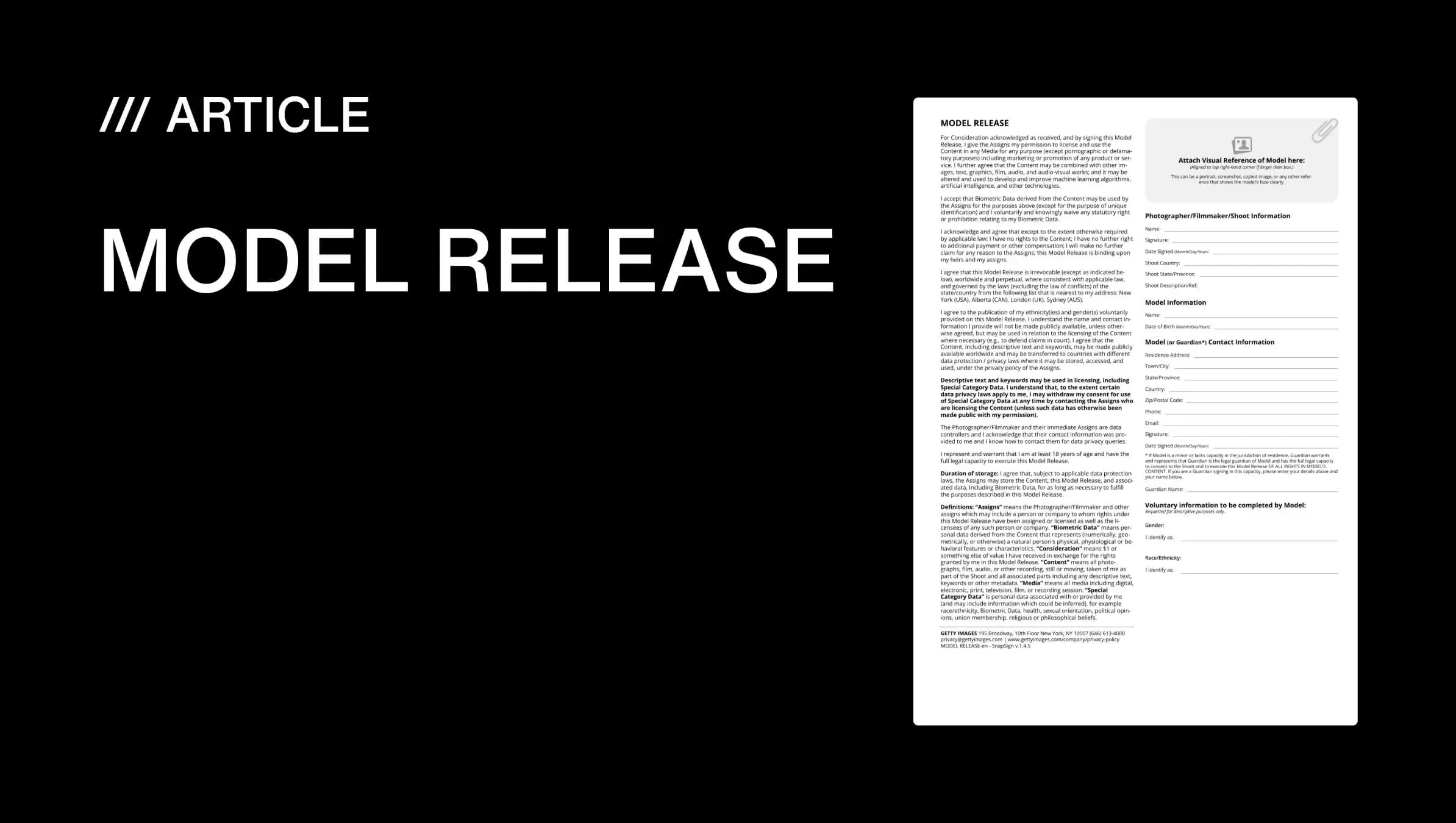
A model release is not just paperwork. It is a contract that defines who can use your image, where, for how long, and for how much. Whether you are signing a photo release form for a one-day shoot or a multi-year model release document for a global brand campaign, one bad model release clause can lock you out of work for years, strip your right to credit, or leave you holding the legal bill when someone else misuses your image. If you are new to all of this — why model releases matter walks through the fundamentals before you get into the fine print.
What a Model Release Clause Actually Controls
A model release clause defines the boundaries of the agreement between the person being photographed and the person using the images. Every clause in a release governs one of four things:
- Scope: where and how the image can be used — commercial, editorial, digital, print, geographic territory
- Duration: how long the permission lasts — one year, five years, perpetual
- Compensation: what the model receives in exchange — flat fee, royalties, usage-based tiers
- Liability: who bears the legal risk if something goes wrong — mutual or one-sided
When these four elements are balanced, you have a fair release. When one party grabs more than their share in any category, you have a red flag.
I am Pavel Demidovich, Film Photographer, Filmmaker, Founder of SnapSign — and I have spent years on both sides of the model release table. This guide pulls from real releases I have reviewed, real clauses I have negotiated, and real mistakes I have watched other photographers make.
The 10 Model Release Clauses to Avoid
Each of these clauses has appeared in real releases I have seen — from stock photography templates, brand contracts, and production agreements. Most photographers encounter these problems in boilerplate model release forms downloaded from the internet, where a generic photography release form template was written without legal review. I will walk through what each clause looks like, how it hurts you, and how to fix it.
1. Perpetual Exclusivity Without Limits
This is the most common dangerous model release clause — and the most damaging. It reads something like: “Model grants exclusive rights to all images from this shoot, in perpetuity, worldwide, across all media now known or hereafter devised.”
What that means in practice: you shoot a sportswear campaign at twenty-two. At forty-five, you are still barred from working with any athletic brand anywhere in the world — because the clause never expires and never narrows.
How it bites: exclusivity is a premium product. Brands pay models and athletes millions for exclusive rights — precisely because it prevents them from working with competitors. A perpetual exclusive clause in a standard model release gives the brand that premium product for a flat fee that likely did not reflect its value.
Fix: Cap exclusivity at six to twelve months. Restrict it to a specific product category and geographic region. After the term ends, the brand keeps usage rights but loses exclusivity — you are free to work with anyone.
2. Unlimited Usage Rights With No Tiered Compensation
“All media, worldwide, perpetual, unlimited usage.” That sentence appears in boilerplate releases more often than any other — and it is a rights grab dressed as standard language.
Here is the math: a local ad campaign and a global brand rollout are not the same product. One runs for three months in a single city. The other runs for two years across five continents. A flat-fee release that grants both without distinction is pricing the local campaign at global rates — or more likely, pricing the global campaign at local rates.
Fix: Define usage tiers. A release should say: print ads in North America for 12 months costs X. Digital advertising across Europe adds Y. Global, all-media, perpetual rights costs Z — and Z should be significantly higher. Usage above the agreed tier requires renegotiation.
3. One-Sided Indemnity Clauses
An indemnification clause in a photography contract says who covers the legal costs when something goes wrong. A one-sided indemnity means only you cover them — even when the other party caused the problem.
Real scenario: a brand takes your image and uses it in a way that violates a third party’s rights — say, pairing it with unlicensed music or running it in a jurisdiction where the release is not valid. You get named in the lawsuit. Under a one-sided indemnity clause, you pay for your defense and theirs.
Fix: Indemnity must be mutual. Each party covers its own liability. If the brand misuses your image, the brand pays. If you misrepresented your right to grant the release, you pay. One-sided indemnity is a non-starter.
4. Full Rights Transfer for a Flat Fee
Selling full copyright for a one-time payment is not inherently unfair — if the payment is massive. Most of the time, it is not.
A full rights transfer means you no longer own your image in any meaningful sense. The brand can resell it, sublicense it, or use it in perpetuity across every channel. If the campaign becomes the face of a multimillion-dollar product line, you do not see a cent beyond the original check.
Fix: License instead of selling. Grant specific usage rights for a defined term with a defined scope. If the brand insists on a buyout, price it accordingly — and include a renegotiation trigger if usage exceeds the original brief. For more on the distinction between licensing and assignment, the ASMP legal resources provide a solid starting point.
5. Moral Rights Waivers Without Safeguards
Moral rights — recognized in many jurisdictions, particularly in civil law countries — protect your right to be identified as the creator and to prevent distortion or mutilation of your work. Waiving them means the brand can crop, filter, recolor, or digitally alter your image in ways you would never approve — and you have no legal recourse.
This is not theoretical. An image can be edited to pair a model with a cause, a product, or a message they oppose. Once moral rights are waived, the damage is done and the waiver is binding.
Fix: Keep moral rights intact where the law allows. Where waiver is required by the client, limit it: alterations must be approved in writing, and the right to object to derogatory treatment survives. For background on moral rights, see the UK Copyright Service.
6. Vague or Open-Ended Revocation Clauses
A revocation clause that lets either party pull consent at any time, for any reason, without notice — that is a silent disaster waiting to happen.
Scenario: you print ten thousand brochures for a client campaign. Two weeks later, the model emails: “I have changed my mind, please stop using my image.” If the release allows unconditional revocation, you eat the cost of ten thousand unusable brochures.
Fix: Lock in a notice period — thirty to sixty days minimum. Define the specific conditions under which consent can be withdrawn. Material breach by the other party is a valid trigger. Changing your mind is not.
7. No Credit or Attribution Clause
Images circulate. A photo you took for a local brand can end up on a stock platform, a blog, a Pinterest board, a competitor’s mood board. Without an attribution clause, your name detaches from your work — and in photography, reputation compounds with every credited placement.
Fix: Add a clause requiring credit “where practical” — in portfolios, promotional materials, and editorial use. This costs the brand nothing and keeps your name attached to your work. If the brand pushes back hard on a credit clause, ask yourself why they do not want your name anywhere near the images.
8. Dispute Resolution in the Other Party’s Backyard
If a contract says disputes must be resolved in a specific city or country — and that city is a twelve-hour flight from you — your right to enforce the contract is theoretical. The cost of showing up erases any recovery you might win.
Fix: Choose a neutral, mutually accessible venue. If the parties are in different countries, specify arbitration under a recognized body. The World Intellectual Property Organization offers mediation and arbitration frameworks designed for creative industry disputes.
9. Overly Broad Non-Compete Clauses
A non-compete that prevents you from working with “any brand in the apparel, footwear, accessories, or lifestyle category for sixty months, globally” is not a non-compete — it is an industry exit. I have seen this clause in a real release, and the model who signed it effectively could not work in fashion for five years.
Fix: Non-competes must be narrow: six to twelve months, specific to the product category of the shoot, restricted to the geographic region where the images were used. If the brand wants broader protection, they pay for it — and the price reflects what you are giving up.
10. Ambiguous Payment Terms
“Payment to be discussed” or “compensation: exposure and portfolio usage” is not a payment clause. It is a placeholder — and when the placeholder sits in a signed contract, you have no enforceable right to be paid.
I have heard this story too many times: the shoot wraps, the images are delivered, and the payment conversation turns into “we will promote you instead” or “the budget shifted, but next time.” There is no next time.
Fix: The amount, payment method, and due date go in the contract. If the release does not include a payment section, add one. Payment of $[amount] via [method] within [N] days of the shoot date. This is not aggressive — it is basic professionalism. For photographers working with multiple models, Group Events let you send individual releases with clear terms to every participant in minutes.
—
Those are the ten clauses. But knowing them in isolation is not enough — the real damage happens when they stack.
How These Clauses Compound
A single red flag in a model release is bad. Two or three together are exponentially worse — and boilerplate releases often bundle them by default.
Here is the real-world compound effect: a release grants perpetual exclusivity plus unlimited usage plus a full rights transfer, all for a flat fee. The model cannot work in that industry again. The brand can use, resell, and sublicense the images forever. The model was paid once and has no right to additional compensation, no right to credit, and no right to object to how the image is used.
That is not a release. It is an asset purchase — and the asset is you.
| Red Flag | What It Looks Like | Fair Alternative |
|---|---|---|
| Perpetual exclusivity | "Exclusive worldwide rights in perpetuity" | 12-month exclusivity, specific category and region |
| Unlimited usage, flat fee | "All media, worldwide, perpetual" | Tiered pricing by usage type, geography, and duration |
| One-sided indemnity | "Model indemnifies brand for all claims" | Mutual indemnity — each party covers its own liability |
| Full rights transfer, no royalties | "All rights assigned to brand" for a flat fee | Time-limited license or buyout priced at market rate |
| Moral rights waiver | "Model waives all moral rights" | Limited waiver with approval right on alterations |
| Open-ended revocation | "Either party may revoke at any time" | 30–60 day written notice, breach-based revocation only |
| No credit clause | No mention of attribution | Credit required "where practical" in all uses |
| Distant dispute venue | "Disputes resolved in [distant city/country]" | Neutral venue or arbitration under WIPO rules |
| Overly broad non-compete | "Any similar brand" for 5 years globally | 6–12 months, product-specific, geographic limit |
| Ambiguous payment | "Payment to be discussed" | Amount, method, and due date in writing |
Now that the full damage is on the table, the natural question is: do real photographers and models actually encounter these clauses, or is this just a checklist of worst-case scenarios? The answer is in the forums.
What Photographers and Models Actually Run Into
The same model release red flags surface repeatedly in photography and creator communities — and the stories are consistent across r/photography, r/videography, and r/onlyfansadvice. I have spent time in these threads because the phrasing people use when they are burning out on a bad contract is different from the phrasing in a legal guide. It is raw, specific, and worth reading before you sign anything.
The most infamous cautionary tale in the photography community — still referenced years later — is the Chipotle lawsuit: a woman sued the restaurant chain for $2.2 billion after they used her photo in advertising without a model release. No release, no permission, massive liability.
But you do not need a billion-dollar lawsuit to feel the consequences of a bad model release clause. The patterns that repeat across photography forums are smaller, quieter, and more common:
“I signed a release for a skincare brand. Six months later a bigger brand wanted me for a campaign. The non-compete blocked it. I lost twice my original fee.” — This is the perpetual non-compete trap in action. The photographer or model takes a gig, the non-compete is overbroad, and the real cost is not the bad clause itself — it is the better gig you cannot take.
“They told me the release was standard. I read it anyway — full rights transfer, no royalties, perpetual. For $150.” — Boilerplate language weaponized. Calling a release “standard” is a negotiation tactic, not a legal assessment. On r/photography, the threads where photographers share flat-fee buyout regrets are consistent: someone sold full rights for a small flat fee and watched the client make multiples of that amount with no additional compensation. There is no such thing as a standard release — only a release someone wants you to sign without reading.
“I shot a brand campaign. They used my image on a product they sold to a company I morally oppose. No moral rights clause — I could not stop it.” — The moral rights waiver with real consequences. When you waive moral rights, you lose control over what your image is associated with — forever.
“The payment was ‘within 90 days of invoice.’ I invoiced. Day 91 — nothing. Day 120 — still nothing. The contract said disputes in their hometown, 3,000 miles away. I never saw the money.” — Ambiguous payment terms plus a distant dispute venue. These two red flags together are the most common recipe for unpaid work in photography.
These are not hypotheticals. They are the stories that repeat across forums because the same boilerplate clauses keep circulating. The lesson: if someone hands you a release and says “it’s standard, everyone signs it,” read it twice.
—
The stories are consistent — and so is the pattern. Every one of these complaints traces back to a specific clause, and knowing which one is the first step to avoiding it. But here is the nuance: not every clause is a dealbreaker in every context.
When These Clauses Might Be Acceptable
Not every red flag is a dealbreaker in every context. The key question is: does the compensation match what you are giving up?
Perpetual exclusivity for a flat fee of $200? Walk. Perpetual exclusivity for a six-figure brand deal with royalties, renewal bonuses, and a defined geographic scope? That is a negotiation, not a red flag — and your lawyer should be in the room.
Full rights transfer for a local coffee shop campaign? No. Full rights transfer priced as a buyout with a multiplier for each additional year of usage? Now you are talking about a commercial arrangement, not exploitation.
The core principle: every right you give away should have a corresponding line item in the compensation. If the compensation section is one line and the rights section is a page and a half, the math does not add up.
For photographers using stock platforms, the bar is even higher. Getty Images model release requirements and Adobe Stock’s model release guidelines both specify what a compliant release must contain — and releases with vague or overreaching clauses may be rejected. A release that is unfair to the model is also unlikely to pass a stock platform’s legal review.
What Goes Into a Fair Model Release
A release that protects both parties is not complicated. It is specific. Here is what should be in every model release you sign or create:
- Named parties: full legal names of the photographer and model, exactly as they appear on government ID
- Shoot description: date, location, and a brief description of the session
- Usage grant: exactly where, how, and for how long the images can be used — with tiered compensation if usage expands
- Compensation: amount, payment method, and due date
- Exclusivity terms: if applicable — scope, duration, territory, and compensation for the exclusivity itself
- Indemnity: mutual — each party covers their own liability
- Credit: required where practical
- Dispute resolution: neutral venue or arbitration
- Revocation: notice period and defined breach-based triggers
- Signatures: model, photographer, and a witness
Every blank in that list is a vulnerability. Fill every one.
For photographers who need releases that work across different shoot types, the model release vs property release distinction matters: a model release covers people, but if you are shooting on private property, you may need both. And if your subject is under 18, a minor model release signed by a parent or guardian is non-negotiable — the same clause red flags apply there too.
Spotting these flags early is what separates a clean, profitable roster from chasing ghosts. Now for the bottom line.
Final verdict — Model Release Clauses
Model release red flags hide in plain sight — inside boilerplate language that nobody reads until there is a problem. Perpetual exclusivity, unlimited usage with no additional compensation, one-sided indemnity, and full rights transfers are the four clauses that cause the most damage, and they often appear together. Read every release before you sign. If a clause takes more than it gives, negotiate it. If the other party will not negotiate, the gig is not worth the liability it carries.