What AI-generated faces and deepfakes mean for your model releases
A traditional model release protects you when you photograph a real person and use their image commercially. It does not cover a face generated by Stable Diffusion, DALL-E, or Midjourney — because there is no person to give consent. That gap between old legal forms and new technology is where photographers and filmmakers get into trouble. An AI-generated face can trigger a right of publicity claim if it closely resembles a real individual, even by accident. A deepfake can violate privacy and defamation laws regardless of whether a release form exists. This article covers what the law requires, what it does not yet address, and how to adapt your contracts so you are protected on both sides of that gap.
I am Pavel Demidovich, a film photographer and filmmaker, and the founder of SnapSign. We built SnapSign to solve the model release problem for working photographers — the app handles 11+ contract templates, remote Signature Requests with 48-hour expiring links, SHA-256 contract hashing for integrity verification, and Getty Images-certified release formats. We have watched AI upend the release landscape in real time. The guidance in this article reflects what we are telling our own users about synthetic media risk.
Quick Answer: AI-generated faces usually do not require a traditional model release — because no real person exists to grant consent. But photographers still face legal exposure: right of publicity claims if an AI face resembles a real person, deepfake liability, stock platform rejections, and copyright uncertainty. A model release with AI-specific clauses covering synthetic likeness risk, deepfake prohibition, and AI disclosure is the difference between a protected workflow and a lawsuit.
Key takeaways:
- A standard model release is legally meaningless for an AI-generated face — there is no person to grant consent.
- Add AI-specific clauses to your release forms: AI enhancement consent, synthetic likeness waiver, and deepfake prohibition.
- Disclose AI use to clients and platforms — transparency protects you legally and builds trust with clients.
The legal gap: why your current model release does not cover AI faces
What a model release is — and what it is not
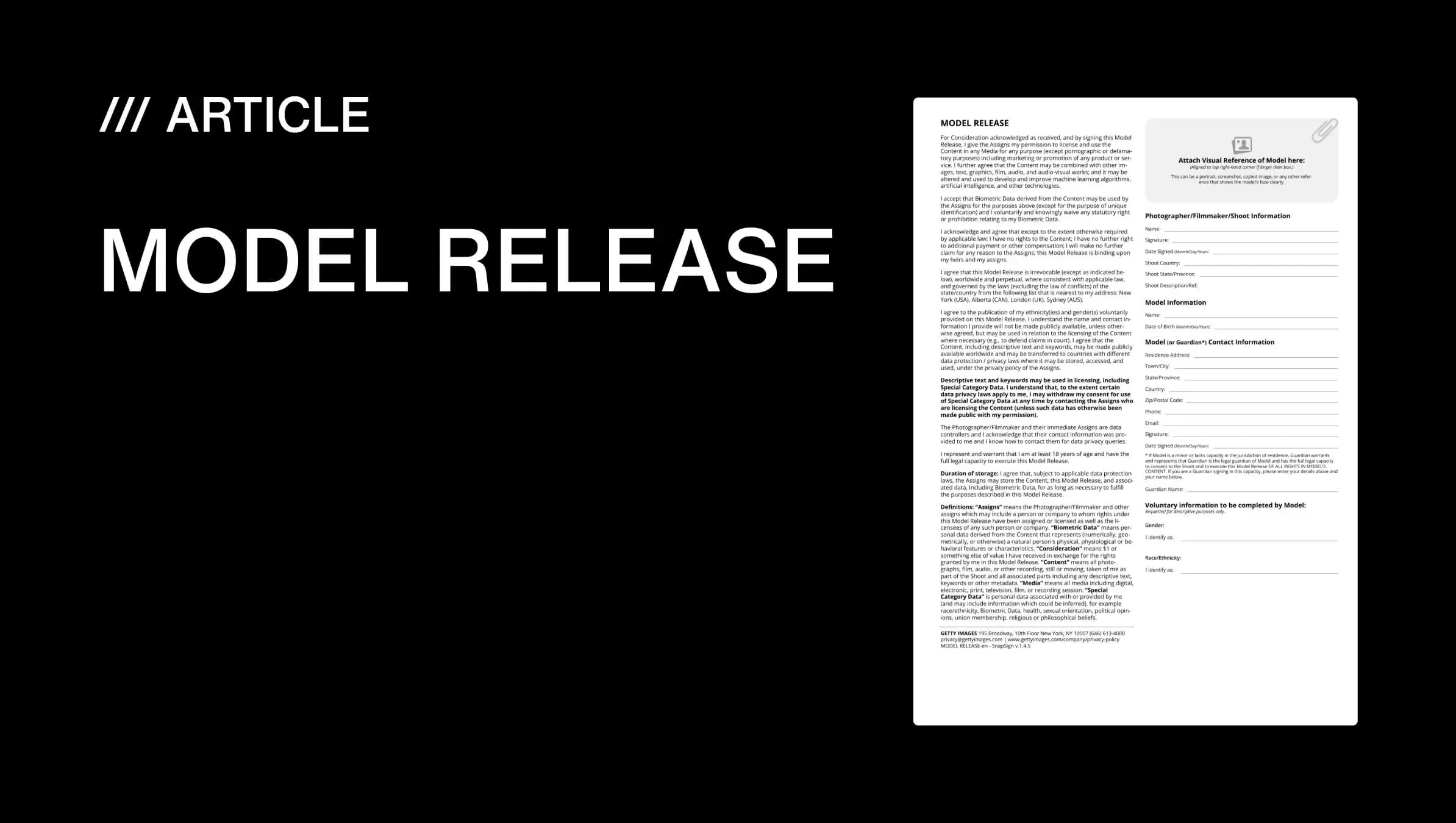
A model release is a contract between a photographer and a real, identifiable person. That person grants permission to use their likeness for commercial purposes — advertising, packaging, stock photography, promotional content — in exchange for consideration. The release creates a legal record of consent. Without it, a photographer who uses someone's image commercially faces claims for invasion of privacy, misappropriation of likeness, and breach of right of publicity. These are not theoretical risks: courts award damages for unauthorized commercial use, and stock platforms reject submissions that lack proper releases.
But a contract requires two parties. An AI-generated face has no legal identity — it cannot grant consent, sign a document, or enforce terms. If you use a traditional model release form for an AI-generated image, the form is legally meaningless because one of the two required parties does not exist. The release does not become "close enough" — it becomes a piece of paper with no legal effect.
The specific risks of AI-generated faces and deepfakes
Unintentional resemblance. Generative AI models are trained on datasets containing millions of real faces. They sometimes produce outputs that closely match a specific real person, even when the prompt did not request that person. If your AI-generated "model" looks like someone's neighbor, a regional actor, or a public figure, that person may have a right of publicity claim — and you will have no release from them because you never photographed them.
Deepfake liability. Deepfake technology swaps one person's face onto another's body or makes a person appear to say and do things they never did. Even if you did not create the deepfake, publishing or distributing it can expose you to defamation, false light, and intentional infliction of emotional distress claims. No model release protects against these torts because the harm is to a person who never consented to any use of their likeness.
Platform rejection. Stock photography platforms have their own release requirements. Getty Images requires a signed model release for every recognizable person in a commercial image. Adobe Stock and Shutterstock maintain similar rules. If your AI-generated stock photo depicts a realistic human face, all three platforms will reject it — not because the face is AI-generated, but because you cannot produce a signed release from a real person. Even if the law is unsettled, platform policy is not: no release, no license. For record-keeping requirements that intersect with AI-generated content questions, see our 2257 compliance guide.
How to protect yourself: adapting model releases for the AI era
Add AI and synthetic media clauses to your contracts
You do not need an entirely new legal framework. You need to update the release forms you already use so they address the specific risks synthetic media creates. And you need to do it before a client forces the issue — not after. In a r/WeddingPhotography thread with 142 comments, a photographer described a client who had been booked for over a year suddenly demanding "no AI at all." The photographer had no contract language to fall back on — and admitted "I guess I need to add something about AI to my contract now." That conversation should happen on your terms, in your contract, before the client raises it.
A well-drafted AI clause in a model release covers three areas:
AI enhancement disclosure. The model acknowledges and consents to the use of AI-based post-processing, compositing, or generative modification of their likeness. This covers you when you use AI tools to retouch, extend backgrounds, or adjust lighting — common workflow steps that blur the line between photography and synthetic generation. This matters because Adobe Photoshop and Lightroom now include generative AI features. In the same r/WeddingPhotography discussion, one commenter put it bluntly: "Clients likely aren't considering that editing programs include legitimate, task-efficiency-focused AI elements when they make these requests. You need to ground this conversation in the real world with a discussion about their specific concerns and the reality of our tools." Your release should acknowledge this reality.
Synthetic likeness risk. The release includes language stating that AI-generated outputs may unintentionally resemble the model or third parties, and the model waives claims arising from incidental AI-generated similarities. This is a forward-looking provision — it anticipates the problem rather than reacting to it.
Deepfake and unauthorized AI use. The contract prohibits the model from using AI tools to create derivative works from shoot images without the photographer's permission, and vice versa. Both parties agree not to use AI to generate deepfakes from the session materials.
A digital model release platform like SnapSign lets you create a Custom Template with these clauses once and reuse it for every shoot — models sign remotely, and the signed PDF carries your AI provisions as enforceable contract terms. For step-by-step guidance, read our remote signing guide. For shoots with multiple participants, Group Events ensure every person on the roster receives the same AI-updated release — no need to manage different contract versions for different models.
Disclose AI use to clients and platforms
Transparency is the cheapest form of legal protection. If you use AI-generated elements in commercial work, tell the client before they pay for the images. If you submit AI-generated or AI-modified images to a stock platform, check the platform's AI content policy and follow it. Most platforms now have one — and violating it can get your contributor account suspended. The FTC has already penalized companies for deceptive AI claims under Section 5 of the FTC Act, and the agency's authority applies to any AI-generated content that misleads consumers about product characteristics.
Stock platform AI content policies at a glance
| Platform | AI-generated images accepted? | AI labeling required? | Model release for AI faces? |
|---|---|---|---|
| Getty Images | No — does not accept AI-generated content | N/A | N/A — real releases only |
| Adobe Stock | Yes, with restrictions | Yes — must be labeled "Generative AI" | Required if face looks like a real person |
| Shutterstock | Yes, via Shutterstock AI pipeline | Yes — AI content tagged in metadata | Not accepted for AI-only faces |
Platform policies change. Contributor agreements are updated regularly. The consistent pattern across all three platforms is that realistic human faces without a signed model release from a real person will be rejected — regardless of whether an algorithm or a camera produced the image. Check Getty Images contributor guidelines and Adobe Stock model release requirements for the latest policies before submitting.
What the law actually says about AI images and personality rights
Right of publicity: the law that matters most
The right of publicity is the legal doctrine that gives every person control over the commercial use of their name, image, and likeness. Unlike copyright — which protects creative works — the right of publicity protects people. If an AI-generated face looks like someone, and you use it to sell something, that person can sue you for violating their right of publicity. Whether the face was generated by a camera or a computer is legally secondary to whether it is recognizably that person.
This is not hypothetical. Courts have consistently held that using someone's likeness for commercial purposes without consent violates their right of publicity. The rise of generative AI gives plaintiffs more ways to claim their likeness was appropriated. The fact that the resemblance was unintentional may reduce damages — but it does not automatically defeat the claim. A model release from the person whose likeness was used is the only document that reliably prevents this kind of lawsuit. For an AI-generated face, you cannot get one. That is the core unresolved risk of synthetic media in commercial photography.
California, New York, and Texas have particularly strong right of publicity statutes. Brands and photographers selling work nationally must follow the strictest applicable standard. The Right of Publicity legal resource tracks state-by-state statutes and case law — bookmark it if you work with AI-generated imagery commercially.
Deepfakes and existing law
Deepfakes are already covered by a patchwork of existing laws. Non-consensual intimate imagery is illegal in nearly all 50 U.S. states and under federal law (15 U.S.C. § 6851). Defamation law covers deepfakes that falsely portray someone in a damaging light. Federal and state election laws prohibit deceptive media in campaign contexts. The legal gap is not that deepfakes go unregulated — it is that enforcement is slow and the technology moves faster than most prosecutors can respond.
For photographers and filmmakers, the practical rule is simple: do not create, publish, or distribute deepfakes of real people without their written consent. A model release with explicit deepfake provisions is the minimum. Even with one, be cautious — the reputational damage from a deepfake-related dispute can outlast the legal outcome.
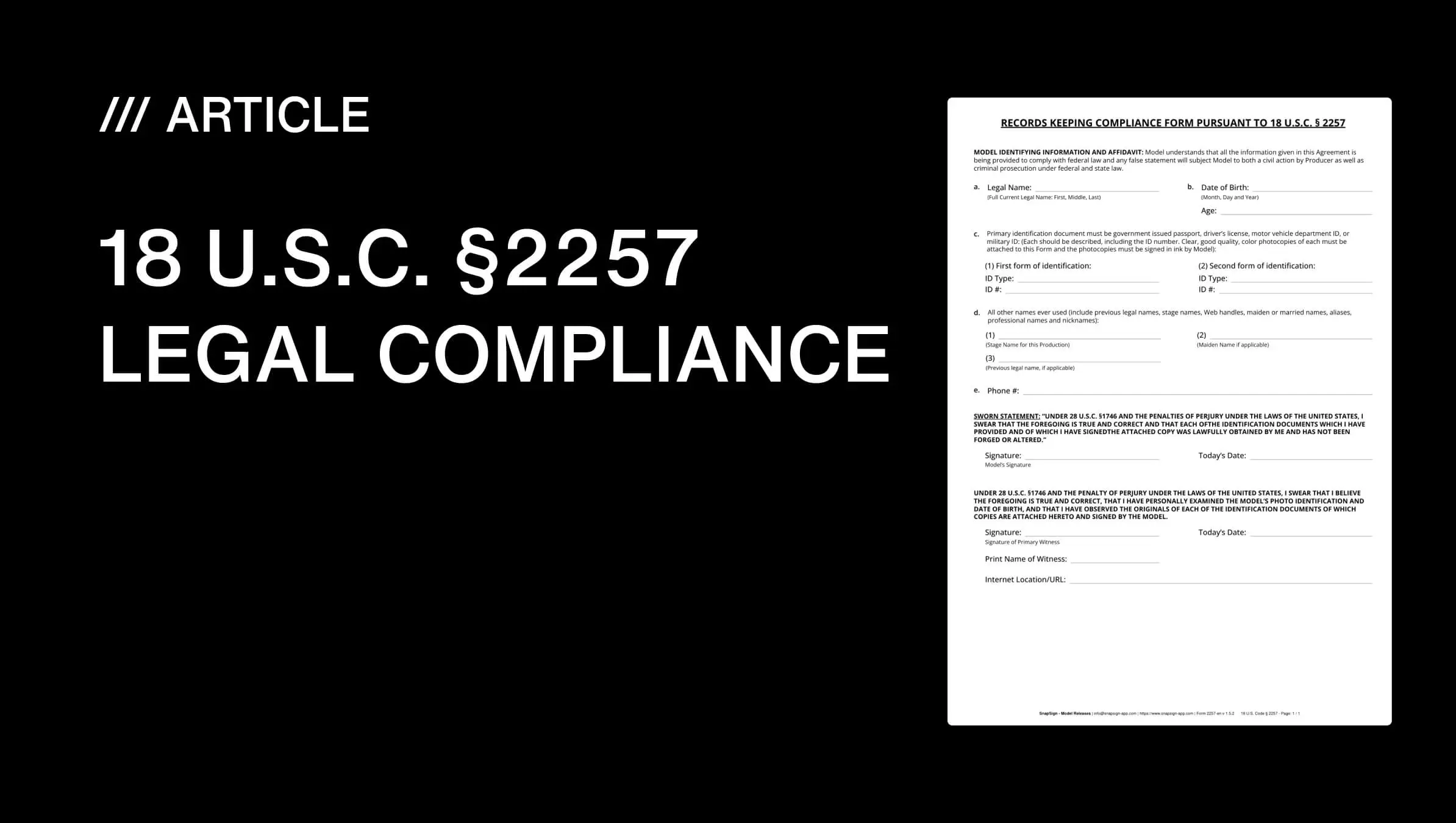
Additional reading: 18 U.S.C. § 2257 record-keeping requirements do not directly address AI-generated images, but if you produce content that could fall under 2257 obligations, read our 2257 compliance guide for the full framework.
Copyright, ownership, and AI-generated images
Owning a camera gives you copyright in the photo you take. Owning a Midjourney subscription does not give you copyright in the image it generates — at least not under current U.S. law. The U.S. Copyright Office has repeatedly ruled that works created entirely by machine, without sufficient human creative input, are not eligible for copyright protection. A text prompt, no matter how detailed, is treated as an instruction to a commissioned artist rather than an act of authorship.
This creates a practical problem for photographers who use AI as part of their workflow. An image that is 80% your photograph and 20% AI-generated background extension is likely copyrightable as a whole, but the AI-generated portion alone may not be. If you submit an AI-generated face to a stock platform that requires you to warrant copyright ownership, you are warranting something you may not have. The safest approach: use AI as an editing tool on your own photographs, not as a replacement for the photograph itself.
For further context, the American Society of Media Photographers provides legal resources on copyright and licensing for professional photographers navigating AI issues.
The ethics of synthetic faces in commercial photography
Legal compliance is the floor, not the ceiling. Even when AI-generated faces are legally permissible, using them raises ethical questions that affect your professional reputation.
Disclosure builds trust. Clients, art directors, and audiences increasingly expect to know whether the images they see are photographs of real people or synthetic generations. Stating upfront that an image is AI-generated or AI-modified signals professionalism and transparency. In a market where deepfakes have eroded trust in visual media, the photographer who discloses earns more respect than the one who gets caught.
Consent extends beyond legal requirements. A model who signed a standard release three years ago did not consent to having their face used to train an AI model or to having AI-generated variations of their likeness distributed commercially. Even if your original release technically covers derivative works, the spirit of consent matters. Ask before using a model's images for AI training or generation. Respecting that boundary protects your relationships and your reputation.
Representation and bias. Generative AI models reflect the biases of their training data. If your AI-generated "models" all skew toward a narrow demographic, your work communicates something about who you value — whether you intend it to or not. This is not a legal risk, but it is a creative and professional one that photographers who work with real, diverse talent do not face.
Traditional model release vs. AI-updated contract provisions
| Provision | Traditional release | AI-updated release |
|---|---|---|
| Grant of rights | Commercial use of likeness | Commercial use of likeness, including AI-modified and AI-composited versions |
| Consent scope | Photography and standard post-processing | Photography, AI enhancement, generative fill, synthetic background replacement |
| Synthetic likeness risk | Not addressed | Waiver for incidental AI-generated resemblances to third parties |
| Deepfake prohibition | Not addressed | Mutual prohibition on AI-generated derivative works without written consent |
| Platform compliance | General commercial use | Explicit authorization for stock platform submission with AI disclosure |
| Integrity verification | Not addressed | SHA-256 hash verification of signed contract; audit trail of AI modifications |
When AI clauses might not be necessary
Not every shoot requires an AI-updated model release. If your work falls entirely outside commercial use — personal projects, fine-art portfolios that are not licensed for advertising, or editorial journalism — the urgency drops. Editorial use is generally exempt from model release requirements in the first place, and adding AI clauses to a release for a non-commercial portrait session adds paperwork without reducing risk. If you never submit to stock platforms and never license images for advertising, the platform rejection risk does not apply to you.
But the line between editorial and commercial is thinner than most photographers think. A personal project posted on Instagram can become commercial if a brand reposts it or if you later license it. A fine-art print sold through a gallery is commercial. If there is any chance your work will cross into commercial territory — and for most working photographers, there is — the AI clause costs you nothing to add once and protects you forever. The exceptions are narrow. When in doubt, include the clauses. You can always choose not to enforce them. You cannot retroactively add them after a dispute starts.
Where the law is heading — and what to do now
Governments are moving on AI regulation. The European Union's AI Act imposes transparency obligations on AI-generated content. California and New York have passed digital replica laws requiring specific consent before using AI-generated likenesses of real people. Federal legislative proposals aimed at AI likeness protection (such as the NO FAKES Act) illustrate the direction lawmakers are heading. Stock platforms update their contributor policies regularly. The direction is consistent across jurisdictions: more disclosure, more consent requirements, and more liability for unlabeled synthetic media.
Waiting for the law to settle before you update your contracts is the expensive choice. The lawsuits are happening now. The photographers and content creators who use AI-generated faces without proper documentation are the defendants. Updating your model releases today — adding AI enhancement, synthetic likeness, and deepfake provisions — costs a fraction of what defending a right of publicity claim will cost. For photographers working with real models who want legal certainty in an AI-uncertain world, the tooling already exists. The gap is in the paperwork — close it before your next shoot.
Final verdict - AI and model releases
Traditional model releases were designed for flesh-and-blood humans, not synthetic faces. Photographers and filmmakers cannot wait for the law to catch up. Update your release forms with AI-specific clauses covering synthetic likeness risk, deepfake prohibition, and AI enhancement disclosure. Disclose AI use to clients and platforms. Get an hour with a media attorney who understands generative AI. A model release that explicitly addresses AI-generated likenesses is the difference between a protected commercial workflow and a lawsuit you cannot afford. Start with your next contract.