How to Copyright Photos and Protect Your Creative Work
Creative freedom is why you picked up a camera in the first place. The instinct to frame something, to catch light at the right angle, to freeze a moment that nobody else saw — that is not something you do for paperwork. You do it because the image demands to exist. Creative freedom photography is not a genre — it is the baseline condition every photographer needs to do their best work. What is creative freedom? It is the ability to shoot what you see, without filtering yourself through fear of theft, misuse, or legal ambiguity. What does creative freedom mean in practice? It means posting your work publicly without worrying that someone will strip your watermark and license it to a brand before you finish your morning coffee.
But creative freedom without legal protection is a liability. You can shoot the best photo of your life, post it, watch it go viral — and then watch someone else license it to a brand, print it on merch, or feed it into an AI training set, all without your name attached and without a cent in your pocket. The difference between being the photographer who gets paid and the one who gets ripped off is not talent. It is knowing how copyright works and acting on it.
This guide is the complete legal roadmap for photographers — from automatic copyright protection and registration to licensing, model releases, and running a legally compliant photography business. It covers what photography copyright actually protects, how to copyright my photos through registration, what photography copyright law says about infringement and fair use, and which legal documents — model releases, licenses, contracts — turn your creative work into protected assets. For deeper dives into specific topics, we link to specialized guides on model releases, stock licensing, and remote signing throughout.
Every photo you take is already copyrighted. The question is whether you can prove it, enforce it, and get paid for it. Here is how.
I picked up a film camera because I wanted to shoot without a screen, without chimping, without the safety net of instant review. That kind of shooting — one frame, one chance — is as close to creative freedom as photography gets. But I also learned, early on, that an unprotected image is like an exposed negative: light hits it the wrong way and it is gone. The legal layer is not the opposite of creative freedom. It is what keeps your work yours.
Here is the lifecycle every photo worth protecting should follow:
| Stage | What happens | Action to take |
|---|---|---|
| 1. Create | You press the shutter. Copyright exists automatically. | Shoot. The photo is yours from that instant. |
| 2. Register | File with the U.S. Copyright Office to make your rights enforceable in court. | Register valuable images in batches (up to 750 published photos per application — check copyright.gov for current pricing). |
| 3. Document | Embed copyright metadata and get model or property releases signed. | Write © info into IPTC fields. Get releases signed before the shutter clicks. |
| 4. License | Define how others can use your work — territory, duration, exclusivity, media type. | Put every license in writing. A verbal agreement is worth nothing in a dispute. |
| 5. Monitor | Reverse-search your portfolio images quarterly to catch unauthorized use. | Google Images, TinEye, Pixsy — run your best work through them regularly. |
| 6. Enforce | Send a DMCA takedown, escalate to the Copyright Claims Board, or file suit. | Registered copyright unlocks statutory damages up to $150,000 per infringement. |
Each stage builds on the one before it. Skip registration and enforcement is nearly impossible. Skip licensing and you leave money on the table. The rest of this guide walks through each stage in detail.
What Photography Copyright Actually Protects
Under U.S. copyright law — and in most countries through the Berne Convention — copyright in a photograph exists the moment you press the shutter. The act of fixing an original image in a tangible medium (film, memory card, hard drive) creates the copyright. You do not need to file anything. You do not need the © symbol. The work is yours from that instant. This is the foundation of photography intellectual property: the image belongs to its creator by default, not by registration.
But “automatic protection” is only half the story. What copyright gives you, in practice, is a bundle of exclusive rights: to reproduce the image, to distribute copies, to create derivative works, and to publicly display it. If someone does any of those things without your permission, they are infringing. The problem is enforcement — and that is where registration separates photographers who can defend their work from those who cannot.
The U.S. Copyright Office is explicit: you cannot file an infringement lawsuit in federal court unless your work is registered. The Copyright Alliance adds the practical layer: registration creates a public record, enables statutory damages, and opens access to the Copyright Claims Board — a faster, cheaper tribunal for disputes under $30,000. The ASMP guide to copyright registration reinforces this from the working photographer’s perspective: registration is not legal insurance, it is legal infrastructure. Without registration, you have a right without a remedy.
| What you get | Automatic copyright | Registered copyright |
|---|---|---|
| Ownership of the image | Yes | Yes, with public record |
| Right to display and license | Yes | Yes |
| File a federal lawsuit | No | Yes |
| Statutory damages (up to $150k) | No | Yes, if registered before infringement or within 3 months of publication |
| Copyright Claims Board access | No | Yes — disputes under $30,000, faster than court |
| DMCA takedown support | Yes, but harder to prove | Yes, with official registration as proof |
How to Copyright Photos: The Step-by-Step Registration Process
The registration process is simpler than most photographers expect. If you have been searching for how to copyright your photography, how to copyright my photography, how do i copyright my photography, or how do you copyright your photography — the answer is the same process whether you are asking for yourself or on behalf of someone else. The Professional Photographers of America calls registration “the single most important step a photographer can take to protect their work” — and the practical barriers are low. For a detailed walkthrough of the application itself, the U.S. Copyright Office registration portal walks through the form fields, fee structure, and common filing mistakes.
Here is how to copyright a photo through the U.S. Copyright Office:
- Go to copyright.gov and create a free account.
- Choose your application type. Standard Application for a single image (a modest fee). Group Registration for published photos — up to 750 images per application (a modest per-batch fee). Group Registration for unpublished photos — also up to 750 images (a somewhat higher fee). Check copyright.gov for current pricing.
- Fill in the details: your name, the title of the work or collection, the year of creation, and whether it is published or unpublished. Public display alone — on Instagram, on your website — does not equal publication in the legal sense. Publication generally means offering copies for sale or distribution to the public.
- Upload digital copies of your photos. The Copyright Office accepts JPEG, TIFF, and other standard formats.
- Pay the filing fee and submit. Protection is retroactive to the submission date.
Processing takes about two months. If you need to enforce your rights sooner, you can pay an additional fee for expedited processing — useful when an infringement is active and you need to file suit quickly.
For photographers who shoot in volume, the group registration option is the most practical path to copyright your photography. If you shoot regularly for clients, register your unpublished work in quarterly batches. If you publish work on a schedule — a new gallery every month, a wedding delivered every weekend — batch-register published images as you deliver them. The goal is not to register every frame. It is to register every image that has commercial value, that is publicly visible, or that you would be genuinely angry to see stolen. If you need to get a copyright for photography on a tighter timeline — for example, you discovered an infringement and need to file suit — the Copyright Office offers expedited processing for an additional fee.
One note that trips up many photographers: work-for-hire. If you are an employee and photography is part of your job, your employer typically owns the copyright — not you. If you shoot weddings as a contractor for a studio, check the contract. If it assigns copyright to the studio, you do not own the images even though you pressed the button. Read the fine print before you sign. If you are starting from scratch and wondering how to start a legal photography business, the first step is choosing a business structure that protects your personal assets — and an LLC is the default choice for most independent photographers.
Registration turns you into a legally recognized copyright holder. But knowing what the law actually says — what counts as infringement, what fair use actually means — turns you into a photographer who can push back with confidence.
Photography Copyright Law: What Creators Need to Know
Photography copyright law in the United States is built on the Copyright Act of 1976, with updates through the Digital Millennium Copyright Act (DMCA) and the Copyright Alternative in Small-Claims Enforcement (CASE) Act of 2020, which created the Copyright Claims Board. The core framework is stable — what changes is how courts apply it to new technology. Photography copyright laws also interact with state-level right of publicity statutes, which govern commercial use of a person’s likeness — separate from copyright but equally important for working photographers.
What Counts as Copyright Infringement
Photography copyright infringement occurs when someone uses your image without permission in a way that violates one of your exclusive rights. This includes: reproducing the image on a website or social media without credit or license, using it in advertising or merchandising without a license, creating derivative works from it, or distributing copies without authorization.
The photographer does not need to prove the infringer knew the image was copyrighted. Infringement is strict liability — if you used it without permission, you are liable, regardless of intent. The “I did not know” defense does not hold up in copyright law. If you are ever on the other side of this — wondering how to check photo copyright status for an image you want to use — start with the U.S. Copyright Office public catalog, then reverse image search with Google Images or TinEye to find the original source. If none of those give you a clear answer, assume the image is fully copyrighted and do not use it without a license.
A thread that surfaced on r/photography captured this tension perfectly. A photographer was approached by a writer for a major publication who wanted to use their images in an online article — with the writer offering to compensate the photographer from what the publication was paying them. The thread drew over eight hundred votes and nearly two hundred fifty comments. The overwhelming consensus from the community: know your usage rights before you say yes. A publication of that size has a licensing budget. If the writer is paying out of their own pocket, the terms are already skewed against the photographer. Own your copyright and license it on your terms — not on someone else’s convenience.
Fair Use Is Not a Loophole
Fair use is the most misunderstood concept in copyright photography. It is not a blanket permission to use images for educational or non-commercial purposes. It is a legal defense — meaning you invoke it after you have been sued, not before you use the image. Courts weigh four factors:
- The purpose and character of the use (commercial vs. nonprofit educational, transformative vs. derivative)
- The nature of the copyrighted work (creative works get stronger protection than factual ones)
- The amount and substantiality of the portion used relative to the whole
- The effect of the use on the potential market for the original
The last factor carries the most weight. If your use replaces the market for the original — if someone sees your post instead of licensing the photo from the photographer — fair use is unlikely to apply, even if the other three factors lean in your favor.
For photographers, the takeaway is practical: fair use is a courtroom argument, not a permission slip. If someone uses your image and claims fair use, do not take their word for it. And if you are the one using someone else’s image, assume you need permission — because the alternative is betting your project on a judge agreeing with your interpretation, and that is a losing bet for most creators.
Copyright tells you what you own. But there is a related question photographers ask just as often — one that has nothing to do with registration and everything to do with where you point your lens.
Is It Illegal to Take Pictures of People?
This is one of the most searched questions in photography copyright — and the answer is more nuanced than a simple yes or no.
In public spaces in the United States, you generally have the right to photograph anyone and anything in plain view. The First Amendment protects photography in public as a form of expression. There is no expectation of privacy on a public street, in a park, or at a public event. If you can see it from a public vantage point, you can usually photograph it.
The restrictions come in three forms. First, commercial use. You can take a photo of a stranger in public and display it as art or editorial content — but if you want to sell that image for advertising, stock photography, or brand use, you need a model release signed by the person in the frame. Second, private property. A shopping mall, a museum, a hotel lobby — these are private spaces where the owner can set rules about photography. Third, reasonable expectation of privacy. You cannot photograph someone through their bedroom window, inside a restroom, or in any context where a person would reasonably expect not to be photographed, regardless of whether you are on public property.
For photographers who shoot in public regularly — street photographers, event shooters, photojournalists — the line between editorial and commercial use is the one that matters most. Editorial use does not require a release. Commercial use does. And if you are not sure which category your work falls into, the safest path is to get the release signed. For more on how releases work in practice, see our model release guide.
Photography Copyright Release Form and Model Releases
A photography copyright release form and a model release are two different documents with two different functions — and photographers who confuse them end up with enforceable copyright on images they cannot legally license.
| Document | What it protects | Who signs | When it is needed |
|---|---|---|---|
| Copyright registration | The photo itself — composition, creative expression | Photographer files with Copyright Office | Always recommended for commercial work. Mandatory to sue for infringement. |
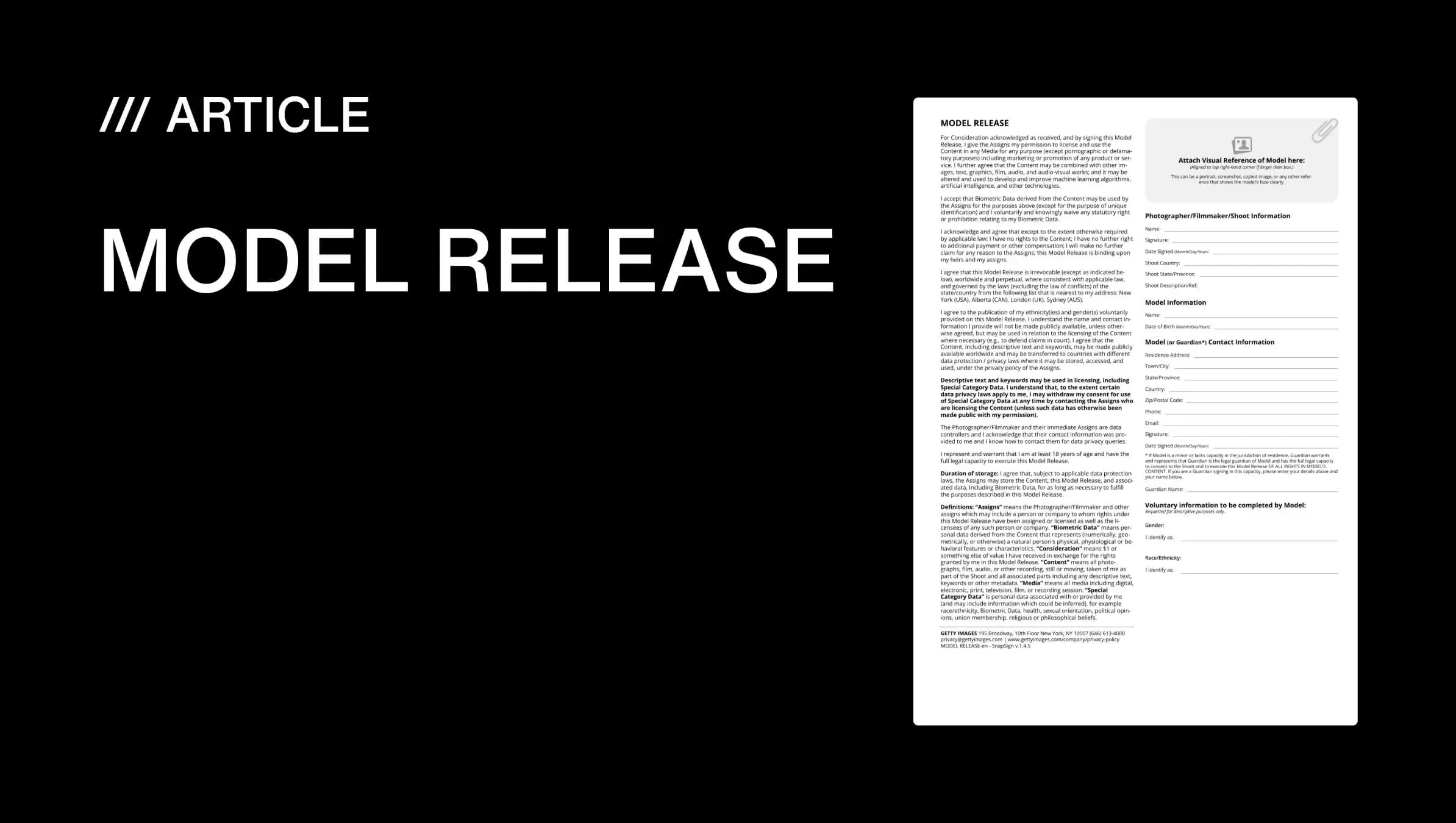
| Model release | Permission to use a person's likeness commercially | The person in the photo (or their guardian) | Any commercial use: stock, advertising, brand content. Not needed for editorial. |
| License agreement | Terms under which someone else can use your photo | Photographer and client / licensee | Any time someone other than you uses the image. Defines territory, duration, media type, exclusivity. |
Copyright release — transfers or licenses the copyright itself from the photographer to someone else. If a brand wants to own the image outright, they need a copyright assignment in writing. If they want to use it for a specific campaign, they need a license agreement defining terms, territory, and duration. Without a written agreement, you retain the copyright even if someone pays you for the shoot.
Model release — gives the photographer permission to use a person’s likeness in the image for commercial purposes. It does not transfer copyright. It does not grant the model any ownership of the photo. It simply says: the person in the frame agrees that their face, body, and likeness can appear in the specified commercial context.
For stock photography, both documents are non-negotiable. Getty Images, Adobe Stock, and Shutterstock all require a signed model release for every recognizable person in every image submitted for commercial licensing. If you are building a stock portfolio, the release workflow is not an afterthought — it is the gate between your hard drive and a licensable asset. For a full breakdown of stock platform requirements, see our guide to licensing your work on global photo stocks.
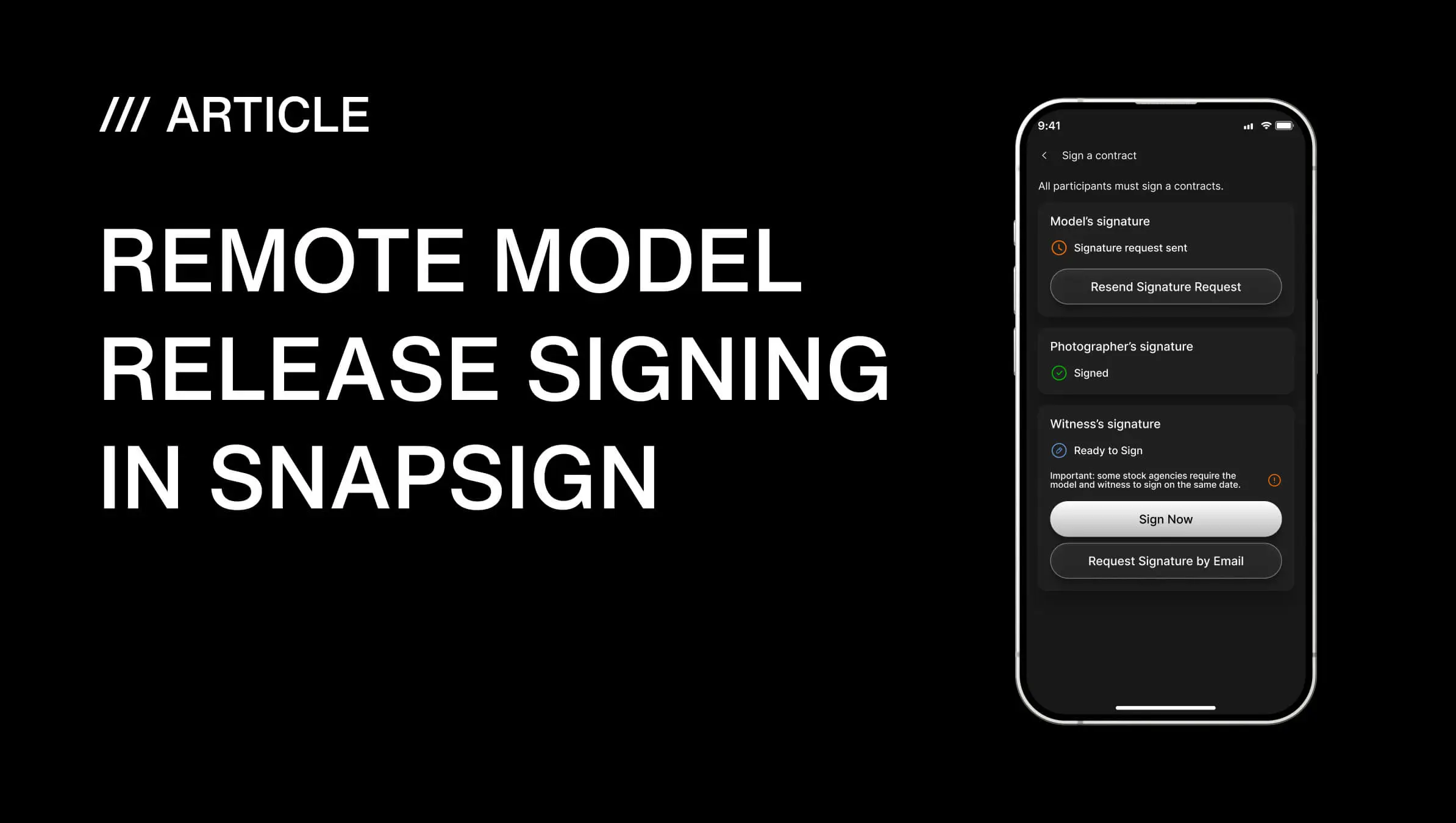
Other legal documents for photographers that round out a professional workflow include property releases for shooting on private property, licensing agreements for client work, and contracts for collaborative projects. None of these need to be long. They need to be clear, specific, and signed before the shutter clicks. For photographers ready to move from paper to digital, our remote signing guide covers how to send, sign, and store releases from a phone — the same phone you use to check light and preview shots.
Registering your copyright and getting releases signed is the offensive game. The defensive game is keeping your images from being stolen in the first place.
How to Protect Your Work Online
Digital theft is a reality, not a hypothetical. No photo posted online is automatically photography copyright free — the default legal state of every image is full copyright protection unless the creator explicitly releases it. Another Reddit thread — a PSA on r/photography about derivative infringement using AI — described photographers discovering their images had been used to train AI models or generate derivative works without consent. The thread carried a blunt warning: if your images are online without protection, they are in someone else’s training set. Here is what actually works to protect your images:
Register first, display second. If an image has commercial value, register it before posting it anywhere publicly accessible. Registration before infringement — or within three months of publication — unlocks statutory damages and attorney’s fees. Without it, you are limited to actual damages, which are harder to prove and often lower.
Use visible watermarks. Not as theft prevention — watermarks can be cropped or cloned out by anyone determined. But as a deterrent for casual infringement and as evidence of willful infringement if someone removes your watermark and uses the image anyway. DMCA penalties increase for willful infringement.
Embed copyright metadata. Lightroom, Capture One, and Photoshop all let you write copyright information into the image file’s IPTC metadata. Include your name, the copyright year, and your contact information. Not all platforms preserve metadata — Instagram strips it, for example — but for images delivered to clients or displayed on your own site, embedded metadata creates a digital trail that is hard to dispute.
Reverse search your best work. Google Images, TinEye, and Pixsy allow you to upload or search for your images and find where they appear online. Run your portfolio images through a reverse search quarterly. When you find unauthorized use, document it with screenshots before sending a takedown request.
Take action fast. When you find an infringement, send a direct message or email first — many unauthorized uses are ignorance, not malice, and a polite request resolves the issue the same day. If that fails, file a DMCA takedown with the hosting platform. If the infringing use is commercial and your work is registered, the Copyright Claims Board is the next escalation — faster and cheaper than federal litigation.
Protecting your work is reactive — it stops theft after it happens. Licensing is proactive — it gets you paid before anyone has a chance to steal anything.
How to License Your Photography Without Losing Control
Licensing is the photographer’s primary revenue tool — and the part of copyright most creators underutilize. A license is a permission slip, not a surrender. It says: “You can use this image, under these conditions, for this duration, in this territory.” The photographer retains copyright. The client gets the specific usage rights they paid for.
The key terms in a photography licensing agreement:
- Usage type — commercial, editorial, promotional, or personal. Be specific. “Commercial use” covers advertising, merchandising, and brand content. “Editorial use” covers news, education, books, and documentary. They are priced differently for a reason.
- Duration — one-time use, one year, perpetual. A perpetual license costs multiples of a one-year license. Do not give away perpetuity when the client only needs a single campaign.
- Territory — local, national, global, specific regions. A global license commands a higher fee than a local one.
- Exclusivity — exclusive means no one else can use the image during the license period, including you. Non-exclusive means you can license the same image to multiple clients. Exclusivity costs more because you are giving up your own right to monetize the image elsewhere.
- Media type — print, digital, broadcast, out-of-home. Different media types carry different value. An image licensed for a billboard campaign costs more than the same image licensed for a website banner.
Set these terms in writing every time — even with friends, even with repeat clients. A verbal agreement about photography usage rights is worth nothing when a dispute reaches a lawyer. For more on how licensing works across global platforms, see our stock photography licensing guide.
Licensing and copyright registration handle the creative side. But if you take money for your work — any money — there is a business layer underneath all of this that matters just as much as the images themselves.
How to Make Your Photography Business Legal
If you earn money from photography — even part-time, even as a side hustle — you are running a business. How to start a photography business legally is a question every working photographer faces at some point, and making your photography business legal is not a single action. It is a checklist of recurring obligations:
Register your business. Sole proprietorship, LLC, or corporation — the right structure depends on your liability exposure and income level. An LLC separates your personal assets from your business debts. If you shoot weddings or commercial work where a client could sue, the liability protection matters.
Use written contracts for every job. A contract defines deliverables, payment terms, usage rights, cancellation policies, and liability limitations. Without one, a client dispute becomes a he-said-she-said that you cannot win — because the burden of proof is on you. A contract shifts that burden onto the document.
Maintain model and property releases. Every person in your frame, every private location you shoot in, every client project you deliver — get the paperwork signed. A signed release converts a legal risk into a licensable asset.
Track income and expenses. Separate your photography finances from your personal bank account. Track equipment purchases, software subscriptions, travel expenses, home office deductions, and licensing revenue. The tax code treats photographers as small business owners — deductions reduce your taxable income, but only if you can document them.
Consult a lawyer who works with creatives. Not a general practice attorney. Someone who has drafted licensing agreements, handled copyright disputes, and represented photographers in infringement cases. Pay for an hour. Ask about your contract template, your business structure, and your copyright registration strategy. That hour costs less than a single infringement case you cannot win because you skipped registration.
Final verdict - Copyright and Creative Freedom
Creative freedom is not the opposite of legal protection. It is what legal protection exists to preserve. Every photographer who has ever watched their work get stolen, relicensed without permission, or fed into an AI training set has learned the same lesson: the law protects those who register, document, and enforce.
The workflow is not complicated. Copyright your photos — they are already copyrighted the moment you take them, but registration makes that right enforceable. License your work on your terms, with written agreements that define usage, duration, and territory. Get model releases signed for every recognizable person in every commercial image. Protect your images online with metadata, watermarks, and reverse image monitoring.
You did not pick up a camera to do paperwork. But the paperwork is what makes sure the person who gets paid for your work is you.