Quick answer — GDPR for U.S. photographers
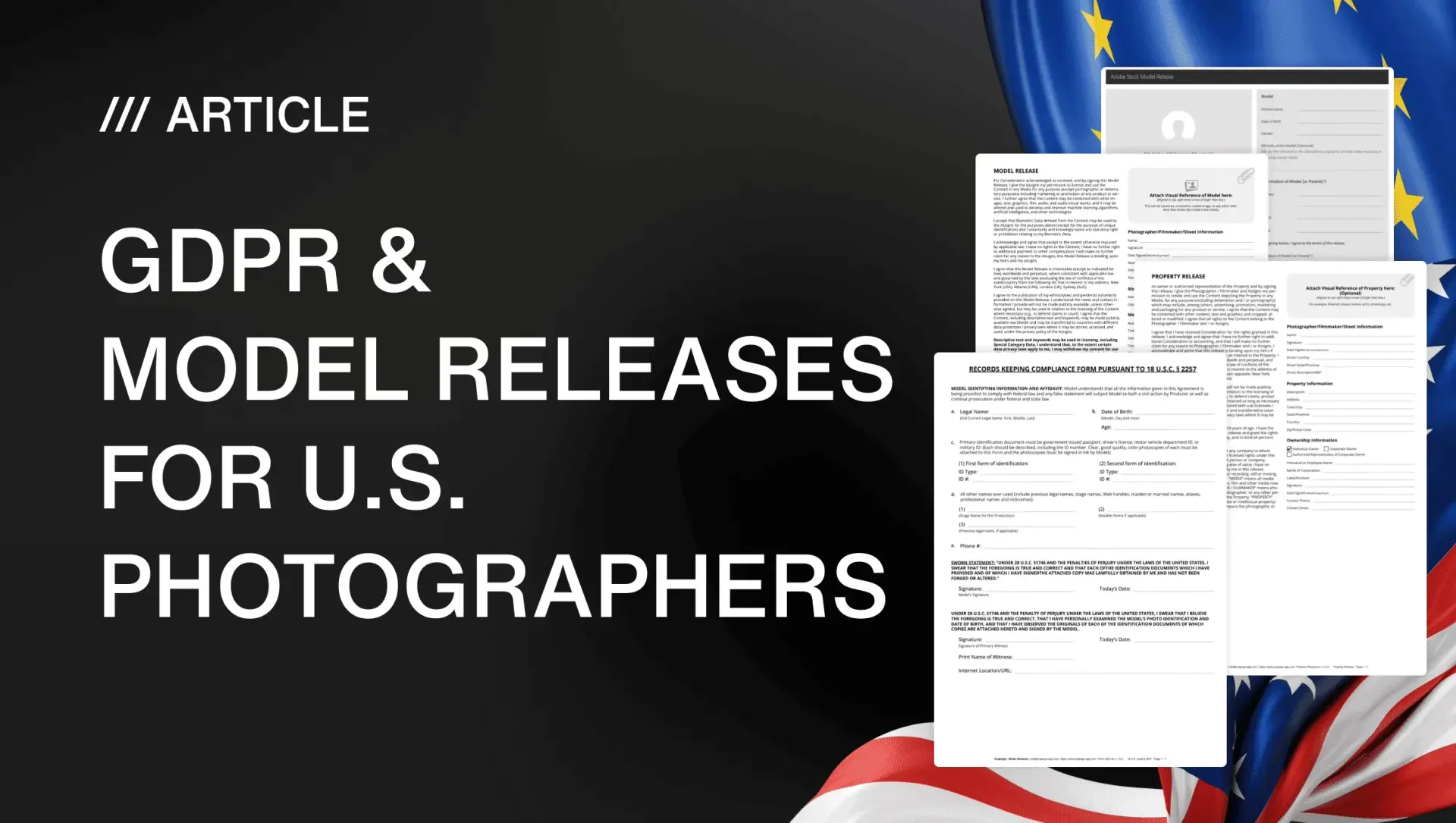
GDPR can apply to a U.S. photographer, but not simply because a client or model is European. For a photographer without an EU establishment, the key questions under Article 3 GDPR are whether the business offers services to people located in the EU, monitors their behavior in the EU, or otherwise falls within the regulation's territorial scope. Recognizable photographs of people and the names, emails, signatures, and identification details collected through model releases may be personal data. When GDPR does apply, photographers need a lawful basis for processing, transparent privacy information, appropriate security, limited retention, and a process for handling data-subject requests.
This guide is for U.S.-based photographers who want to understand when GDPR may reach their work and what their model release workflow should include if it does. It is not legal advice — privacy law is fact-specific, and if your photography business regularly handles personal data from people in Europe, consult a qualified privacy attorney.
I learned the practical stakes a few years ago when a Berlin-based client asked me for a data processing disclosure before she would sign a release for a shoot in Los Angeles. I did not have one. The shoot location was irrelevant — what mattered was her expectation, shaped by European privacy norms, that any document collecting her personal information would explain what happens to that information. That conversation is why we built privacy disclosures into SnapSign templates, and it is the perspective this guide is written from: a photographer who has been in the room when the question came up, not a lawyer reading from a textbook.
When GDPR can reach U.S. photographers
The most common misconception about GDPR among American photographers is that it follows EU citizenship or residence. It does not. Article 3 of the GDPR establishes three routes through which the regulation can reach an organization outside the EU:
- EU establishment (Article 3(1)). If you have a studio, office, or other stable arrangement in an EU country and process personal data in the context of that establishment's activities, GDPR applies.
- Offering goods or services to people in the EU (Article 3(2)(a)). If your photography business actively targets clients located in the EU — for example, through a website in a European language with pricing in euros, marketing specifically to European customers, or mentioning European clients in promotional materials — GDPR may apply to the processing of those individuals' data.
- Monitoring behavior in the EU (Article 3(2)(b)). If you track or profile people while they are in the EU — for example, through analytics that follow their online behavior — GDPR may apply to that processing.
A model's EU citizenship or habitual residence, by itself, does not automatically trigger GDPR for a photographer with no EU establishment, no targeting of the EU market, and no monitoring of behavior in the EU. The regulation is territorial in a legal sense, not a personal one — it does not function as a legal passport that travels with the individual everywhere in the world.
Here is a practical decision framework for U.S. photographers:
| Question | If yes |
|---|---|
| Do you have a studio or stable establishment in the EU? | GDPR may apply (Article 3(1)) |
| Do you actively market services to people located in the EU? | GDPR may apply (Article 3(2)(a)) |
| Do you track or profile people while they are in the EU? | GDPR may apply (Article 3(2)(b)) |
| Is your only connection an EU citizen visiting the U.S. who independently books you? | Not automatically — citizenship alone does not trigger Article 3 |
| Does an EU client contractually require privacy documentation? | Provide it, even if Article 3 remains uncertain — this is a commercial requirement |
For more specific situations, here is how the territorial analysis applies to common photography scenarios:
| Situation | GDPR likely to apply? | Why |
|---|---|---|
| U.S. photographer actively markets portrait services to clients located in the EU | Possibly yes | Offering services to people in the EU (Article 3(2)(a)) |
| U.S. photographer has a studio or establishment in an EU country | Often yes | Processing in the context of an EU establishment (Article 3(1)) |
| German model visits New York and independently books a local photographer | Not automatically | EU citizenship or residence alone does not establish territorial scope |
| Shoot takes place in France | Local rules may apply | GDPR scope and national image-rights law must be assessed separately |
| U.S. photographer stores recognizable photos of U.S. clients entirely in the U.S. | Generally no | No apparent Article 3 connection to the EU |
This distinction matters because U.S. privacy law works differently. American law is sector-specific — HIPAA for health data, COPPA for children's data, a patchwork of state laws for everything else. GDPR is territorial and comprehensive: it applies to the processing itself once the territorial conditions are met, regardless of the data subject's nationality. Understanding which regime applies to which part of your work is the foundation of getting compliance right.
Active marketing to clients in the EU
If your website targets European customers — pricing in euros, testimonials from EU-based clients, advertising directed at European markets — Article 3(2)(a) may apply. A Berlin-based brand finding your portfolio through a general Google search is different from you running Instagram ads targeting users in Germany. The former is passive availability; the latter is active offering.
Shoots in EU countries
A shoot in an EU country can engage national privacy, contract, and image-rights rules. GDPR may also apply depending on the photographer's role, business activities, establishment, and the parties involved — but the physical location of the shoot alone does not automatically subject the photographer's entire business to GDPR. A shoot in Paris involves French law and potentially GDPR; a shoot in Milan involves Italian law and potentially GDPR. National image-rights laws vary significantly across member states and can impose requirements beyond what GDPR covers. The full legal picture depends on the specific circumstances of the engagement, not just the country where the camera shutter clicks.
Uploading to stock platforms serving the EU market
Getty Images, Adobe Stock, and Shutterstock operate globally and may have their own GDPR obligations when processing contributor data on EU infrastructure. Those platform obligations do not automatically mean that every contributor independently falls within GDPR's territorial scope. However, several agencies now include GDPR-related clauses in contributor agreements, contractually requiring contributors to provide lawful, transparent release documentation. We built our model release template designed to meet Getty Images contributor requirements with these expectations in mind — it includes data processing disclosures that align with what stock platforms expect from contributors.
Licensing images to EU-based clients
European brands increasingly conduct privacy-compliance checks on their vendors. If you license images to an EU-based company, you may be asked about your data processing practices regardless of whether GDPR technically applies to your business. Being able to answer those questions with a documented workflow is a commercial advantage even when the regulation itself is not triggered.
Are photographs personal data under GDPR?
Many photography guides say a photograph is only personal data under GDPR if it is paired with a name or contact details. That oversimplification is incorrect and potentially misleading.
Under Article 4(1) GDPR, personal data is any information relating to an identified or identifiable natural person. An identifiable person is one who can be identified, directly or indirectly, by reference to factors including physical characteristics. A clear, recognizable photograph of a person's face can itself be personal data — regardless of whether a name is attached.
The Oxford Law Blogs analysis of GDPR photography explains the distinction: a photo of a street scene in which no individual is recognizable is unlikely to be personal data; a portrait in which the person is clearly identifiable is. The presence of a name or email makes identification more straightforward, but it is not a legal prerequisite. The test is identifiability, not whether contact information was collected.
For photographers, the practical implications depend on context:
- Studio portraits and headshots: The person is the subject of the image. The photograph is likely personal data.
- Street photography: GDPR street photography guidance turns on identifiability. If individuals in the frame are not recognizable or are incidental to the scene, the image may not be personal data. If a single person is the clear subject and is identifiable, it may be — even without a name. National image-rights laws may impose additional restrictions beyond what GDPR requires.
- Event photography: GDPR event photography compliance depends on whether individuals are recognizable and whether images are linked to registration data, name tags, or attendee lists. An attendee spreadsheet handed to you by the organizer is itself a personal data record under GDPR when the regulation applies.
- Commercial model shoots: The photograph is almost certainly personal data. Combined with the identifying information in a model release — name, email, signature, sometimes ID numbers — the data set is clearly regulated when GDPR applies.
Understanding this is essential because it changes how you think about your model release workflow. The release is not just a permission slip for image use. When GDPR applies, it is also a record of personal data processing.
Model release vs. GDPR compliance — two different legal layers
Most photographers treat their model release as a single-purpose document: it grants the right to use someone's likeness commercially. That is correct as far as it goes. But when GDPR applies, a second legal layer sits on top of the same document stack.
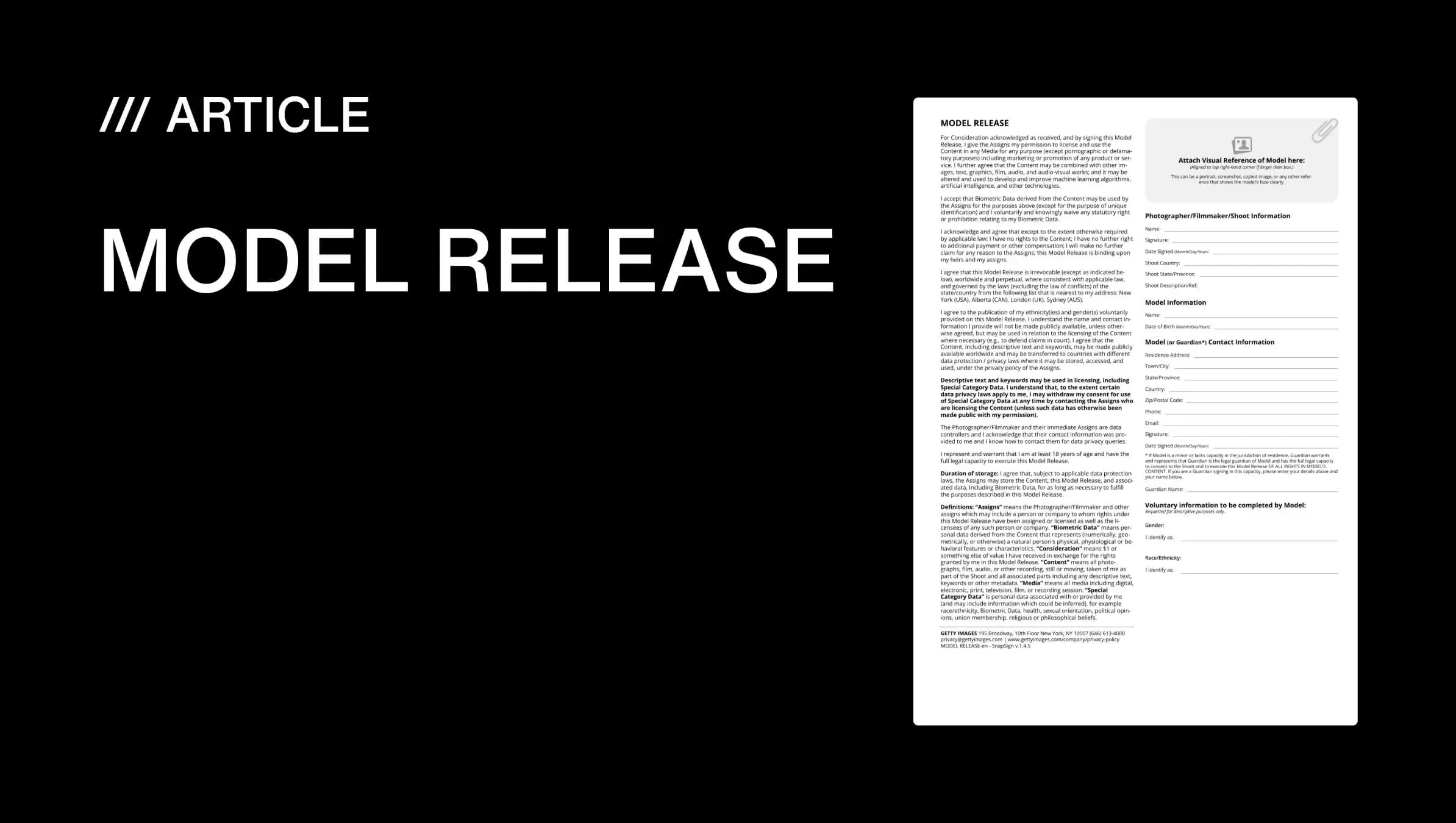
A model release covers image usage rights, commercial licensing permission, and publicity protection. GDPR covers how you handle the personal data collected through that release — the legal basis for collecting it, how you store and protect it, how long you keep it, who accesses it, and what happens when the data subject exercises their rights.
These are not the same thing. A signed model release does not automatically satisfy GDPR's transparency and accountability requirements. The disclosure about data processing can live inside the release itself or in a separate privacy notice — the form matters less than the substance. What matters is that the information exists and the data subject receives it.
| What it covers | Standard U.S. model release | GDPR-aware model release workflow |
|---|---|---|
| Image usage rights | Yes | Yes |
| Commercial licensing permission | Yes | Yes |
| Explanation of what personal data is collected | Rarely | Yes — lists the data fields and their purpose |
| Legal basis for data processing | No | Yes — consent, contract, or legitimate interest |
| Data retention information | No | Yes — how long and under what policy |
| Data subject rights disclosure | No | Yes — access, correction, deletion, portability |
| Third-party data sharing disclosure | No | Yes — categories of recipients |
The gap is not theoretical. A thread from 2025 on r/LegalAdviceUK that continues to be referenced in photography communities describes a school photographer who received a subject access request from a parent demanding unwatermarked images under UK GDPR Article 15. The photographer was caught between copyright and data protection law — a collision that happens because most photographers have never had to think about their image files as personal data. The top response in the thread cited Article 15(4), which states that the right to obtain a copy of personal data "shall not adversely affect the rights and freedoms of others" — including intellectual property rights. The photographer was not obligated to hand over unwatermarked files. But the thread revealed a deeper problem: even professional photographers often do not know where the boundary sits, and most do not have a process in place for when a data request arrives.
What a GDPR-aware model release includes
When GDPR applies, the UK Information Commissioner's Office guidance provides a useful reference for what transparency requires — though EU-based photographers should also consult the relevant EU supervisory authority and the European Data Protection Board (EDPB), as the UK GDPR and EU GDPR are now separate regimes. Here is what your release workflow should address:
- What personal data you collect. Name, email, phone, address, date of birth, and signature fields — be specific about which ones you use. Recognizable photographs should be acknowledged if they form part of the data you process.
- Why you collect it — the lawful basis. Consent is one option, but not the only one. Contractual necessity may apply where processing particular data is objectively necessary to perform the agreement — not merely because the release says the data will be collected. Legitimate interest GDPR photography compliance often relies on this third basis: you have a business need — licensing images, maintaining records, defending legal claims — that does not override the model's rights and freedoms. If you rely on legitimate interests, document the purpose, why the processing is necessary, and why the model's rights do not override that interest — this is a Legitimate Interests Assessment. State which basis applies and why.
- How long you keep it. Define a retention period linked to the commercial life of the images, licensing agreements, or legal obligations. Avoid "indefinitely" — a defined period demonstrates accountability.
- Who sees it. Stock platforms, clients, agencies, cloud storage providers — name the categories of recipients. If data is transferred outside the EU, explain the legal framework that governs the transfer.
- Data subject rights. Access, rectification, erasure, restriction of processing, data portability, and the right to object — acknowledge these rights and explain how to exercise them. The exact rights available depend on the lawful basis and type of processing; for example, data portability applies to processing based on consent or contract and carried out by automated means, and does not apply in every situation.
These disclosures do not require a 10-page legal document. A well-structured model release can cover them in a few paragraphs. The point is that the information exists, is accurate, and is provided to the data subject before or at the time of collection — not buried in a privacy policy the model never sees.
Data minimization — reducing risk by reducing data
One of the core GDPR principles is data minimization: collect only what is adequate, relevant, and limited to what is necessary for the purpose. Article 5(1)(c) states this requirement in plain terms.
For photographers, the application is practical. Do you need a passport number for a lifestyle shoot in a park? Almost never. Do you need a home address for a headshot session when you already have the model's email? Probably not. Every extra field increases the volume of data you must protect, explain, and eventually delete or respond to requests about.
Go through your current release template and cross out every field that is not necessary for your typical shoot type. You will likely find two or three. That is meaningful risk reduction in two minutes.
SnapSign's Default Templates ask for the minimum fields needed to establish identity and consent. Additional fields are available for shoots where they are genuinely necessary — such as collecting ID details for 2257 compliance — but are not enabled by default. This is data minimization built into the form: you cannot collect what the form does not ask for.
Digital storage and managing personal data
When GDPR applies, you need appropriate technical and organizational measures to protect personal data. For photographers, the practical checklist includes:
- Structured storage. Releases should be stored in one organized system, not scattered across hard drives, email attachments, and cloud folders. When a data subject exercises their rights, you need to be able to locate their data efficiently.
- Access discipline. Not everyone who works with you needs access to every release. Limit who can view and handle personal data.
- Retention policy. Define and document how long you keep releases and what triggers deletion. A release from a 2014 editorial shoot you never licensed is a liability, not an asset.
- Audit capability. Know the status of each release — when it was signed, whether it is complete, and where the record lives. SnapSign's Certificate feature provides a downloadable audit trail for each signed Contract, giving you a record of the signing event.
Paper releases are not prohibited by GDPR. They can be managed in compliance with the regulation through locked storage, restricted access, organized filing, a documented retention policy, and secure destruction procedures. The challenge with paper is practical, not legal: locating a specific release, responding to a data access request, and securely deleting information are all slower and harder to document at scale with paper than with a structured digital system. Digital platforms can make these workflows faster and more auditable — but paper, properly managed, is not automatically non-compliant.
SnapSign generates a SHA-256 hash for each signed Contract. This hash lets you verify that a PDF has not been altered since it was signed — it is an integrity check, not a privacy or security feature. It proves the document matches the version that was signed, which is useful if a dispute arises about the content of a release. Integrity verification supports good record-keeping; it does not by itself satisfy GDPR's security or accountability requirements.
What photographers actually ask about GDPR
Community threads and forum discussions reveal the scenarios that legal guides often skip. These are the questions photographers actually encounter.
The r/LegalAdviceUK thread mentioned above — a school photographer receiving a subject access request — drew more than 60 responses and reflects a recurring concern: photographers do not know what to do when a data rights request lands in their inbox. Beyond that specific case, several questions come up repeatedly:
- Can I delete data I no longer need? Yes, and when GDPR applies you should. The regulation encourages data controllers to delete personal data they no longer have a legitimate purpose for retaining. A documented retention policy that triggers deletion after a defined period is both compliant and protective — it reduces the data you hold and the requests you may need to respond to.
- Does a model release cover social media use? Only if the release explicitly says so. Many standard releases limit usage to the named project. The question of GDPR photos on social media comes up constantly in photography forums: personal posts fall under the GDPR household exemption and are not regulated; business marketing posts using client photos to promote your services are commercial data processing and may require a lawful basis and transparency information. Whether consent is the appropriate basis depends on context, platform, and the nature of the imagery.
- What about photographing minors? GDPR contains special rules for children in Article 8, but this provision applies specifically to information society services offered directly to a child — it is not a universal consent age for all photography. For model releases involving minors, parental or guardian authorization may also be required under contract law, national image-rights law, and platform-specific rules. The GDPR provides a framework; national law and the specific context of the shoot determine the full set of requirements.
Right to erasure — what it means in practice
Under Article 17 GDPR, data subjects have the right to request deletion of their personal data under certain conditions. This provision causes more anxiety among photographers than any other part of the regulation.
A deletion request does not automatically cancel copyright or image-usage rights granted through a signed model release. But neither can a photographer assume that all usage rights always survive a deletion request. The outcome depends on several factors:
- The lawful basis for processing. If processing is based on consent and the data subject withdraws that consent, the photographer must determine whether another lawful basis supports continued processing — for example, the legitimate interest of maintaining a licensing record or the establishment, exercise, or defense of legal claims.
- Applicable exceptions. Article 17 itself lists exemptions, including compliance with a legal obligation and the establishment, exercise, or defense of legal claims. Maintaining a model release to prove you had permission to license an image may fall under these exemptions.
- Contract terms. The specific language of the release agreement matters.
- Retention obligations. Other legal requirements — tax records, copyright registration, platform contributor agreements — may require you to retain certain information regardless of a deletion request.
GDPR generally requires a response without undue delay and within one month, with the possibility of a two-month extension for complex or numerous requests — provided the data subject is informed of the extension within the first month. This is not a "30 days" rule but a one-month deadline with built-in flexibility for genuinely difficult cases. The practical takeaway: have a process. Know who handles incoming data requests, how you locate the relevant data, and what criteria you use to assess whether deletion, restriction, or retention is the correct response.
Cross-border data transfers
GDPR's Chapter V on international transfers typically applies when a controller or processor subject to the regulation discloses personal data to a separate controller or processor in a third country such as the United States. It is not triggered by every physical movement of data across a border. Direct collection of personal data by a U.S. photographer from a person in the EU, and subsequent storage with a U.S. cloud provider, can involve distinct legal analyses depending on the photographer's territorial scope under Article 3, the contractual relationship with the provider, and where the data originated.
When a transfer does fall under Chapter V, recognized mechanisms include:
- Standard Contractual Clauses (SCCs) — pre-approved contract terms issued by the European Commission.
- EU-U.S. Data Privacy Framework (DPF) — for U.S. organizations that have self-certified under the framework. The European Commission has confirmed that the DPF allows free data transfers to participating U.S. companies.
Many major cloud providers and stock platforms incorporate these mechanisms into their Data Processing Agreements (DPAs). A standard account signup should not be assumed to provide a valid transfer mechanism — check whether the provider's contractual terms include a DPA, SCCs where required, or coverage under the DPF. Photographers should also verify the provider's DPF certification status if relevant and understand where subprocessors are located. The obligation to ensure an adequate transfer framework ultimately rests with the data controller.
GDPR compliance checklist for U.S. photographers
This GDPR for photographers checklist covers five practical steps. Each can be done in under an hour:
- Determine whether GDPR applies to you. Do you have an EU establishment? Do you actively market your photography services to people in the EU? Do you monitor the behavior of people in the EU? If the answer to all three is no, GDPR likely does not apply to your business under current Article 3 criteria. Document your assessment.
- Audit your model release for privacy content. Does your release explain what data you collect and why? If GDPR applies, add those disclosures. They can live in the release itself or in a separate privacy notice provided to the model at the time of collection.
- Practice data minimization. Remove fields from your release template that are not necessary for your typical shoot. Every field you remove is data you do not need to protect, explain, or respond to requests about.
- Organize your storage and retention. Know where your releases live, who can access them, and how long you keep them. Write down your retention policy and follow it.
- Prepare a data-request process. Decide who handles incoming requests, how you locate the relevant data, and what criteria guide your response. GDPR generally requires a response within one month — the time to build a process is before the first request arrives.
SnapSign supports a GDPR-aware release workflow through structured Templates with built-in disclosure fields, SHA-256 integrity verification for signed Contracts, a downloadable Certificate providing an audit trail, and organized Contract storage. Photographers remain responsible for configuring their workflow and legal language for their specific jurisdiction and business — no template or platform can guarantee GDPR compliance, because compliance depends on how you use the tools, not just which tools you use.
Final verdict — GDPR for U.S. photographers
GDPR is not an automatic obligation that attaches to every EU citizen worldwide. It is a regulation with specific territorial triggers: an EU establishment, active offering of services to people in the EU, or monitoring of their behavior there. For U.S. photographers who do trigger those conditions, the practical response is not a legal department — it is a privacy disclosure in or alongside your model release, a short list of data fields, structured storage with a retention policy, and a documented process for handling data requests. For U.S. photographers who do not trigger Article 3, understanding the regulation is still useful: European clients, agencies, and stock platforms increasingly expect privacy-aware documentation as a condition of doing business. Being prepared is a competitive advantage even when GDPR compliance itself is not legally required.