Quick Answer
A model release is a signed document that gives a photographer permission to use photos of you. That is the whole thing in one sentence. Everything below is context — why it exists, what it covers, and what it means for you as the person in front of the camera.
I have handed this form to models who have signed a hundred releases and to people who have never been photographed professionally. The reaction is the same: a pause, a quick scan of the legalese, and then the question — “what am I actually signing?”
This article is for the people asking that question. If a photographer sent you this link, they want you to understand what you are agreeing to before you put your signature down. No jargon, no pressure. Just what the form says in plain English and why it matters.
Who this guide is for
This guide is written for people who have never signed a model release before — first-time models, friends of photographers, anyone handed a form and told “this is standard, just sign here.” If you are about to do your first modeling shoot and someone put a release in front of you, this page explains everything in plain English.
If you are a photographer looking for the full legal framework behind model releases, see our model release guide instead. That article covers copyright law, jurisdiction clauses, and industry compliance. This one is the plain-English version your models can read on their own.
Why photographers need a signed release
The simplest way to explain this is practical.
If a photographer takes your photo and wants to do anything with it — post it in their portfolio, submit it to Getty Images, include it in a gallery show, license it to a magazine — they need written proof that you said yes. That proof is the model release.
Stock photography platforms require it. Getty Images, Adobe Stock, and Shutterstock will not accept a single image showing a recognizable face without a signed release attached. No release, no sale. Commercial clients — brands, ad agencies, publishers — have the same requirement. They will not touch an image that could put them at legal risk.
This is not the photographer being difficult. This is how the industry works. The release is the document that turns a great photo into a usable asset. Getty Images’ contributor guidelines spell this out explicitly — a model release is mandatory for any image depicting a recognizable person submitted for commercial licensing. The same rule applies across Adobe Stock, Shutterstock, and every major stock platform.
What happens if you do not sign
The photographer keeps the photos. That is it. They do not publish them, do not post them, do not submit them anywhere. The images stay on a hard drive.
For a TFP shoot — where the model trades time for photos — this is a problem for both sides. The model does not get portfolio images they can use, and the photographer does not get work they can show. Everyone’s time is wasted.
For a paid shoot, the photographer may still pay you for your time, but the images will not be usable commercially. Some photographers include the signed release as a condition of payment in their contract — make sure you understand this before the shoot starts.
In short: no release means no published photos. The images exist, but they cannot leave the photographer’s private collection.
What the form actually says
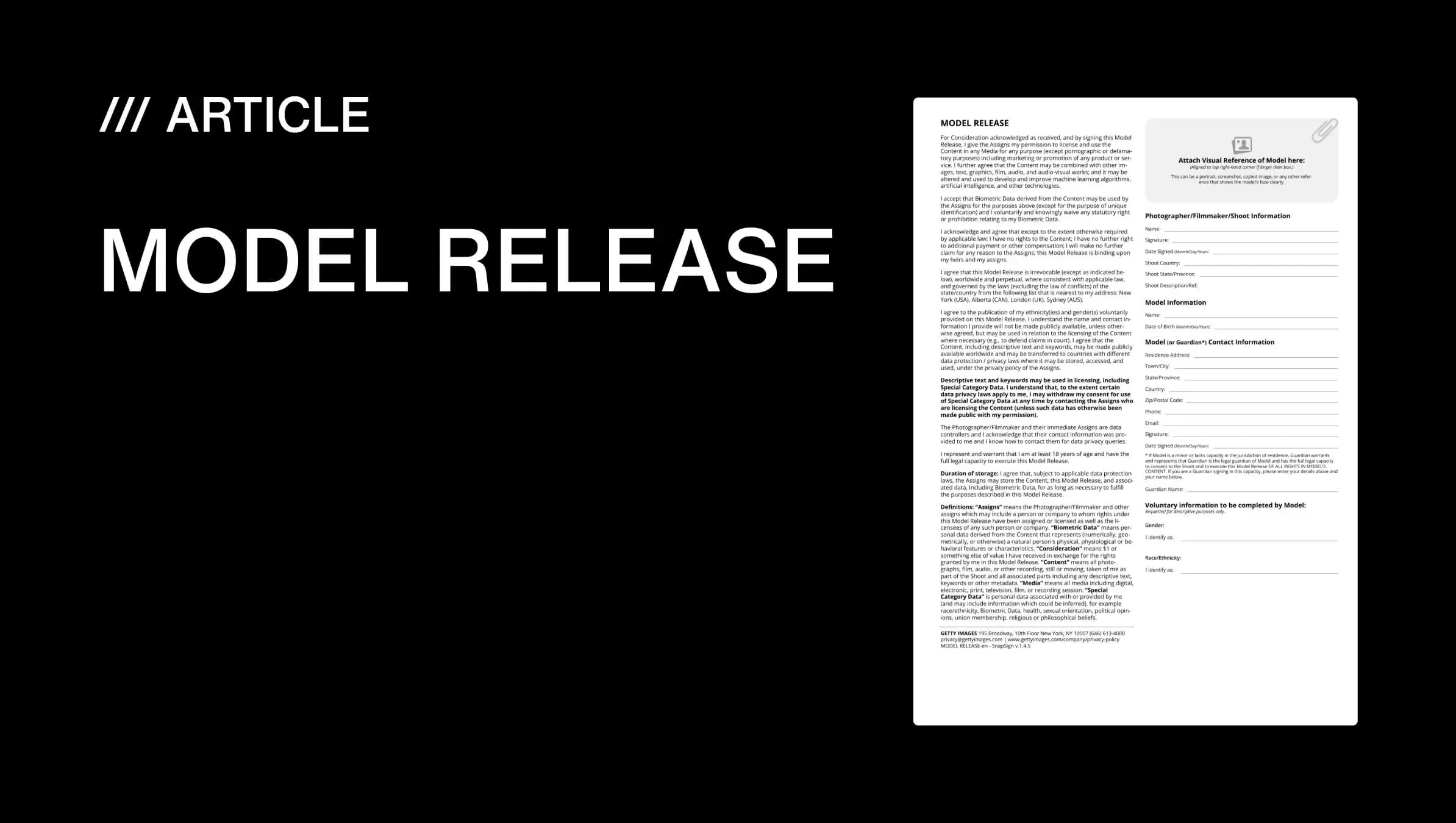
Most model releases follow the same structure. The Wikipedia entry on model releases confirms that a standard release identifies the parties, describes the shoot, grants usage rights, and collects signatures. Here is what each section means in practice:
| Section | What it asks for | Why it matters |
|---|---|---|
| Your name and contact info | Full legal name as it appears on your ID, email, and sometimes a physical address | This is the core of the release. Name mismatches with your government ID are the number one reason stock agencies reject submissions. |
| Photographer's name | The person or entity that will own the usage rights | Defines who can use the images. If the photographer works under a company name, the company is usually listed. |
| Shoot description and date | What the shoot was, when it happened, and sometimes where | Limits the release to a specific session. A release for a July portrait session does not cover photos taken in December. |
| Usage rights | What the photographer can do with the images — commercial use, editorial use, print, digital, advertising | This is the core of the agreement. Read it carefully. It defines where your face can appear. If something makes you uncomfortable, negotiate it. |
| Model photo | A recent photo of your face, often taken at the shoot | Proves that the person signing is the person in the images. Stock agencies use this to verify identity. |
| Signatures | Your signature, the photographer's, and sometimes a witness | The legal act of agreeing. A witness adds an extra layer of validity — some platforms require it. |
That is it. Five or six fields, one signature. It looks more intimidating than it is.
What you are NOT giving away
This is where most people’s hesitation lives, so let me address it directly.
You are not giving away ownership of your face. A model release grants usage rights. It does not transfer your identity to someone else. The photographer cannot claim they took the photo of someone else, cannot use the images in a way the release does not permit, and cannot prevent you from modeling for other photographers.
You are not signing away your privacy forever. Most releases are scoped to a specific shoot, a specific date, and specific usage types. If the photographer wants to use the images three years later for a completely different purpose, they need a new release — or the original must explicitly permit that scope.
You can negotiate. A model release is not a take-it-or-leave-it document. If you are uncomfortable with a specific use — say, the images being sold as stock photos that could appear in any context — tell the photographer. Most will adjust the terms. A photographer would rather have a limited release than no release at all.
The photographer is not trying to trick you. They are trying to protect both of you. The release is the line between “we had a nice shoot” and “here is what we both agreed to in writing.”
What a model release does NOT cover
Just as important as what the form says is what it does not say. A model release has clear limits, and knowing them helps you understand what you are actually agreeing to.
It does not transfer copyright. The photographer owns the copyright to the images they took, regardless of the release. The release only covers usage — how those images can be published and licensed. These are separate legal concepts. The American Society of Media Photographers explains this distinction clearly: copyright is about who created the image; the release is about who can use it.
It does not guarantee payment. A model release is a permission document, not a payment contract. If the photographer agreed to pay you, that should be a separate agreement — or at minimum mentioned in writing somewhere outside the release itself. The release only says “I allow you to use these images.” It says nothing about money.
It does not cover shoots outside the stated date. A release dated July 15 covers photos taken on July 15. If the photographer shoots you again in September, they need a new release. One form, one session — unless the release explicitly states a date range.
It does not prevent you from working with other photographers. You can sign a release with one photographer and work with ten others the same week. The release grants usage rights for specific images — it does not create an exclusivity arrangement.
It is not a 2257 compliance form. If the shoot involves adult content, the photographer needs a separate federal record-keeping document under 18 U.S.C. § 2257. A standard model release does not satisfy this requirement. We cover this in detail in our 2257 compliance guide.
Knowing these limits should make the release feel less like a blanket permission slip and more like what it actually is: a narrow, specific tool for one shoot on one day.
Digital releases vs paper — what changes for you
If the photographer hands you a paper form, you read it, sign it with a pen, and they scan it. That is the old way. It works, but paper gets lost, coffee gets spilled, and “I forgot to bring the release” is a cliché for a reason.
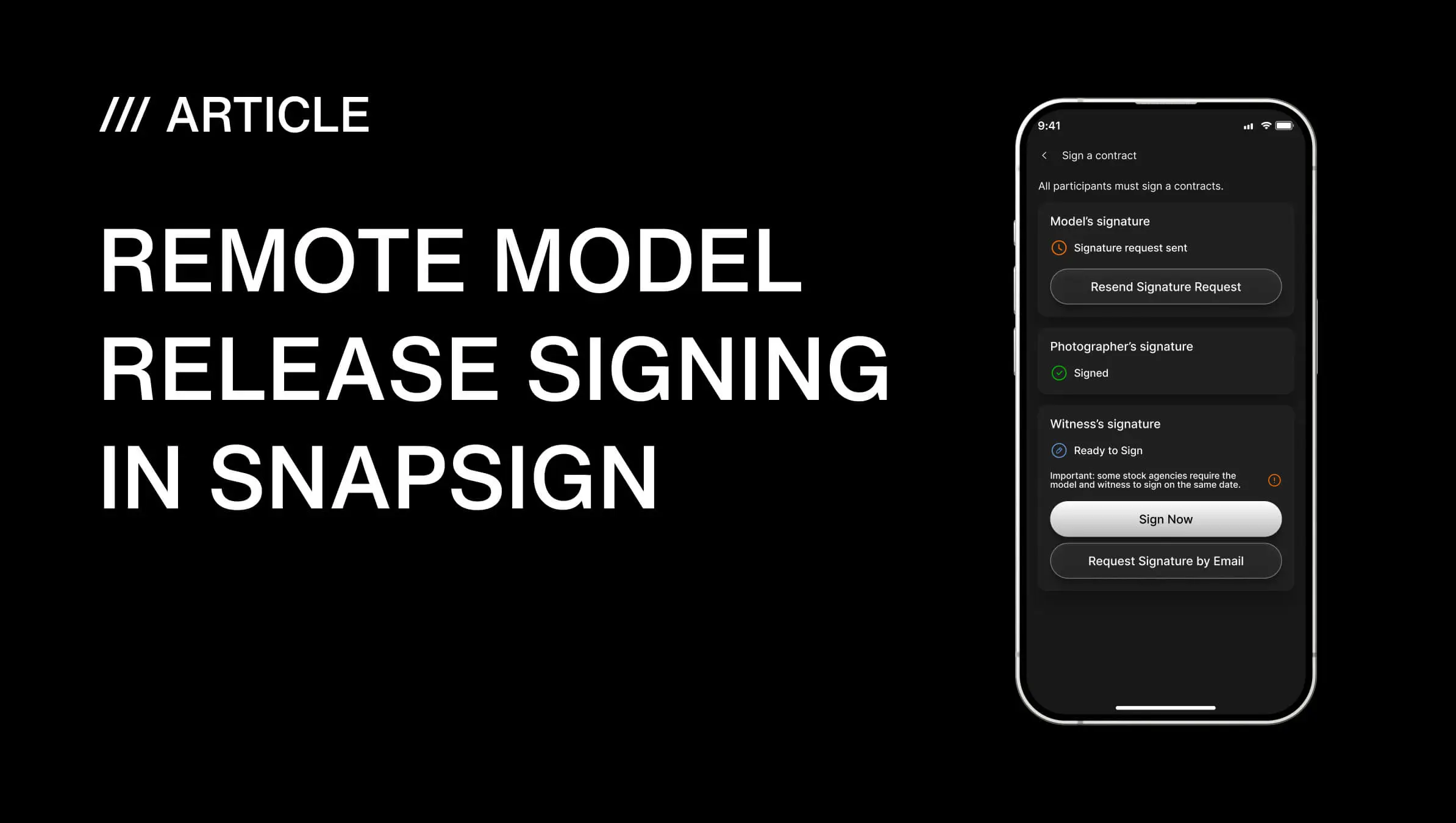
If the photographer uses a digital release app, you get a link — usually by email or text. You open it on your phone, read the terms, fill in your details, and sign with your finger. The signed PDF is generated instantly. You get a copy. The photographer gets a copy. Nobody has to scan anything.
We built SnapSign to handle exactly this workflow. The model opens a secure link, reviews the release on their own device, and signs in under a minute. No app install, no account, no paper. The signed PDF is stored in the app and can be verified cryptographically — every signed contract gets a SHA-256 hash that proves it has not been altered.
For more on how digital signing works, read our remote model release signing guide.
When you can say no — and when you probably should not
Some photographers ask for broad, perpetual usage rights — “all media, worldwide, forever.” That is standard in the stock photography industry, and it is not as scary as it sounds. Most stock images live quiet lives in blog posts and marketing PDFs.
But if the photographer works in a niche that makes you uncomfortable — or if the release includes uses you explicitly do not want — say so. Common restrictions models negotiate:
- Editorial use only (news, education, commentary — no advertising)
- No resale to third-party stock libraries
- Time-limited usage (images can be used for two years, then the release expires)
- Platform exclusions (no use on specific websites or in specific industries)
A good photographer will respect these boundaries. If they push back hard on reasonable requests, that tells you something about who you are working with.
| Situation | What to do |
|---|---|
| You read the release and everything looks fine | Sign it. The terms are standard, and the photographer has been transparent with you. |
| Something seems off but you are not sure what | Ask the photographer to walk you through the usage rights section. A good photographer will explain every clause in plain language without getting defensive. |
| You are uncomfortable with a specific use | Say so. Ask if that use can be removed. Most photographers will adjust the terms rather than lose the release entirely. |
| The photographer refuses to explain or negotiate | Do not sign. A photographer who will not discuss what you are agreeing to is not someone you want controlling your image rights. |
A real conversation: model asks, photographer answers
Here is what a healthy conversation about a model release looks like — not a legal negotiation, just two people clarifying terms:
Model: “Can these photos end up on a stock photo site?”
Photographer: “Yes, that is one of the uses I listed. They might appear on Getty or Adobe Stock.”
Model: “I would rather not have my face on stock sites. Can we limit it to your portfolio and social media?”
Photographer: “Sure. Let me update the release to editorial and portfolio use only.”
That is it. Two minutes, no drama, and both sides walk away with clarity. This is what informed consent looks like in practice — not a legal lecture, just a conversation where you understand what you are agreeing to.
If a photographer reacts to reasonable questions with irritation or pressure, that is a red flag. Model rights start with the right to ask questions before you sign.
Questions models actually ask
These are the questions I hear most often from first-time models — not the legal ones, the human ones:
“What if I hate the photos?”
You can still sign the release. The release is about usage rights, not your personal opinion of the images. If you genuinely do not want certain photos published, discuss it with the photographer before signing. Most will agree to exclude specific shots.
“Can someone use my photo for something I did not agree to?”
Not legally — if the release specifies the scope. A release that says “editorial use only” does not permit the photographer to sell the image for a billboard ad. If they do, they are in breach of contract. The release protects you as much as it protects them.
“What if I change my mind later?”
This depends on the release terms and your local laws. In some jurisdictions, you have a right to revoke consent for future use, though you cannot undo uses that have already occurred. In others, the release is binding once signed. Read the document before signing — that is your window to negotiate.
“Do I need a lawyer?”
For a standard model release, no. The form is designed to be straightforward. If the photographer is asking for unusual terms — perpetual exclusive rights, a non-compete clause, or a waiver of your right to sue — have someone look at it. But for a normal portrait, TFP, or stock shoot, the standard release is fine.
“What does ‘released’ mean in modeling?”
“Released” is industry shorthand. It means the model has signed a release form and the images are cleared for use. When a stock agency asks a photographer “are these images released?” they are asking: “do you have a signed form for every recognizable person in these photos?” A released image can be licensed. An unreleased image cannot. That is the entire distinction.
“Is this the same thing OnlyFans creators use?”
Different document, same principle. Adult content creators use a 2257 compliance form — a federal record-keeping requirement under U.S. law. It verifies the age and identity of every person appearing in the content. A standard model release does not satisfy 2257 requirements. If the shoot involves adult content, the photographer needs a separate 2257 form. We cover this in our 2257 compliance guide.
Before you sign: a 30-second checklist
You do not need a law degree. You just need to do these five things before you put your name down:
- Read the usage rights section. That is the only part that affects you directly.
- Ask about anything you do not understand. No question is too basic.
- Negotiate if something makes you uncomfortable. A limited release is better than no release — for both sides.
- Sign once you are clear on what you are agreeing to.
- Keep a copy of the signed release. You have the right to a copy — digital or paper, make sure you get one.
That is the entire beginner model guide to handling a release. Read, ask, negotiate, sign, keep a copy. Five steps, two minutes, and you walk into the shoot knowing exactly where your images can — and cannot — appear.
Final verdict - Explaining model releases
A model release is not a trap. It is a tool. It defines the boundaries of what happens to the photos after the shutter clicks. For the photographer, it is the difference between a photo that sits on a hard drive and one that builds a career. For the model, it is a document that says exactly what you agreed to — nothing more, nothing less.
If you are holding a release right now and a photographer is waiting for your signature, read the usage rights section. That is the part that affects you. If it says something you do not like, say so. The conversation takes two minutes. The signature lasts as long as the release says it does.