Quick Answer: Minor Model Releases
A minor model release is a legal document signed by a parent or legal guardian that grants a photographer permission to use a child’s image for commercial purposes. Under the law of minors and contracts, a person under 18 cannot legally enter into a binding agreement — so the minor’s own signature has no legal weight, no matter how close they are to turning 18. Without a properly signed release from the parent or guardian, images of anyone under 18 are commercially unusable — and using them anyway exposes you to legal claims from parents who never consented.
I am Pavel Demidovich, a film photographer and filmmaker, and the founder of SnapSign. We built our Minor Model template specifically to solve this — with built-in guardian fields, birthdate verification, and remote Signature Requests so parents can sign from any device. The legal requirements for photographing minors are stricter than most photographers realize, and the guidance here reflects what we have learned from those who found out firsthand that a standard release and a minor release are not interchangeable.
The rule is unambiguous: if the subject is under 18 and the use is commercial, the signature must come from a parent or court-appointed legal guardian. Not the minor. Not a family friend. Not an aunt who said it was fine. The parent.
| Scenario | Release needed? | Who signs |
|---|---|---|
| Stock photography submission | Yes | Parent or legal guardian |
| Advertising / brand campaign | Yes | Parent or legal guardian |
| Portfolio website | Yes | Parent or legal guardian |
| Sponsored social media | Yes | Parent or legal guardian |
| Editorial / journalism | Usually no | N/A — but get one if uncertain |
| Personal / private use | No | N/A |
| Any scenario where the minor signs | Invalid | Must be parent/guardian — minor's signature is void |
Minor vs Adult Releases — Why the Difference Matters
The definition is straightforward. The reason a separate release exists at all is where photographers get into trouble — and it is not a technicality. It is the difference between a valid contract and a void document.
A standard model release form assumes the signer has the legal capacity to enter into a contract. A minor does not. Contracts signed by minors are voidable — meaning the minor or their parent can later invalidate the agreement. If a parent decides two years later they do not want their child’s face in a stock image library, an adult release signed by the minor provides no defense. The parent wins by default, and the photographer loses access to images they may have already licensed.
| Factor | Adult release | Minor release |
|---|---|---|
| Signer | The subject themselves | Parent or court-appointed legal guardian |
| Legal basis | Subject's right of publicity | Parental consent + subject's right of publicity |
| Required fields | Name, contact, usage scope, signatures | All of the above + minor's birthdate, guardian's legal authority clause |
| Contract voidability | Binding on the signer | Voidable by minor upon reaching majority in some jurisdictions |
| Stock platform acceptance | Standard adult release accepted | Minor-specific release required — adult form rejected |
| Guardian verification | Not required | Required — must confirm signer has legal authority |
This gap alone makes keeping separate templates non-negotiable. A minor release form must add fields that an adult form does not even acknowledge as relevant. The signer question especially trips people up — here is who can and cannot legally put their name on the dotted line:
| Person | Can sign? | Why |
|---|---|---|
| Parent (on birth certificate) | Yes | Has legal custody by default |
| Court-appointed legal guardian | Yes | Has documentation proving legal authority |
| Grandparent | No | Unless they hold court-appointed guardianship |
| Aunt / uncle | No | Family relation ≠ legal authority |
| Older sibling (18+) | No | Not a parent or court-appointed guardian |
| Teacher / coach | No | No legal authority over the child's image rights |
| The minor themselves | No — void | Minors cannot legally enter into contracts |
We built our Minor Model template to include guardian fields and birthdate verification by default — the structure enforces what the law requires and makes it impossible to accidentally hand the pen to the wrong person.
Mistakes That Make a Minor Release Worthless
Understanding why the adult form fails is step one. Step two is knowing what else can go wrong — because the parent-signature rule is not the only way a minor release collapses. These are the mistakes I have made or watched other photographers make, each one turning a signed document into a piece of paper with zero legal weight.
Letting the minor sign. This is the most common mistake — and the costliest. An entire shoot with a 17-year-old model becomes commercially unusable if the model signed instead of a parent. The fact that the parent was “fine with it” does not make the document enforceable. A release signed by the minor alone is void.
Verbal agreements. “We talked about it, so we’re good” is not a defense. If the agreement was not written down and signed, it does not exist in any legal sense. A parent’s lawyer will not be impressed by your recollection of a conversation.
Missing birthdate or guardian verification. A release that says “Parent: Jane Smith” with no birthdate for the child and no verification that Jane is the legal guardian is incomplete. It is not enough to assume the person signing is the parent — a court will ask for proof. For paid commercial work, attach a copy of the parent’s government-issued ID to the release. This connects a real, verified person to the signature.
Skipping notarization or a witness for high-value work. Most standard portrait sessions and portfolio shoots do not require notarization. A clean digital or paper signature from the parent is sufficient. But for national ad campaigns, stock submissions with high licensing value, or shoots in states with strong right-of-publicity laws — California and New York in particular — a notarized signature or an independent witness adds a layer of protection that can make the difference in a dispute. It is not required everywhere. It is insurance for the situations where the financial exposure justifies the extra step.
Avoid these mistakes and your release is structurally sound. Now the question becomes: when do you actually need one?
When You Need a Minor Model Release
The stakes are now clear: a wrong signature voids the document, a verbal agreement is no agreement, and missing verification collapses the whole thing. With that context, here is exactly when the release is required — because guessing wrong costs the same as not knowing at all.
Is the subject under 18? → No → A standard model release applies. → Yes → Is the use commercial? → No (editorial, personal, fine art) → No release needed. → Yes (advertising, stock, portfolio, sponsored content) → Parent or legal guardian must sign. The minor cannot.
That is the rule. Courts consistently rule that publishing a minor’s image for commercial purposes without parental consent violates the minor’s right of publicity and exposes the photographer to liability.
Commercial Use
If the images promote, sell, or advertise anything — your photography services, a brand campaign, stock photography, sponsored social media — you need a signed minor model release. Even a small Instagram collaboration with a local brand requires a minor photo release form if the post markets your business. Your photography Instagram counts as commercial use.
Editorial and Personal Use
Editorial use — journalism, documentary work, fine-art photography exhibited without commercial licensing — is generally exempt. A photo essay about a community event published in a newspaper does not require a release. But the line is thinner than most photographers realize. A personal project posted online becomes commercial the moment a brand reposts it. A fine-art print sold through a gallery crosses into commercial territory. If your work could ever generate revenue or attract clients, get the release. The form takes minutes. Litigation takes years.
For photographers who produce adult content or work in spaces where age verification is a legal requirement, see our 2257 compliance guide — minor releases overlap with federal record-keeping obligations in those contexts.
What a Minor Model Release Must Include
You know why the adult form fails, what mistakes void a release, and when one is required. Now the document itself — because every missing field is a gap a lawyer can exploit.
Major stock platforms enforce these requirements strictly. Getty Images requires a signed model release for every identifiable person in a commercial submission — and for minors, the release must clearly identify the parent or guardian signer. Adobe Stock and Shutterstock maintain the same standard. Submitting an image of a child without a properly executed minor release — commonly searched as a photo release form for minors, child model release form, or minor model release form — will result in rejection. The American Society of Media Photographers provides a standard release for a minor child that reflects the minimum requirements across all major platforms.
| Field | Why it matters |
|---|---|
| Minor's full legal name and birthdate | Proves the subject is under 18 at the time of the shoot. Without a birthdate, there is no way to establish that the release was required. |
| Parent or legal guardian's full name and signature | Only a parent or court-appointed guardian can grant consent. A signature from an aunt, grandparent, or family friend without legal guardianship is not valid. |
| Photographer's name and signature | Establishes who holds the rights to use the images. |
| Scope of use | Must specify where and how the images will be used: portfolio, advertising, stock submission, social media, print. Vague language creates disputes about what was agreed. |
| Waiver of future compensation claims | Prevents the parent from returning years later demanding payment for images published with consent. |
| Guardian's legal authority clause | A statement confirming the signer is the minor's legal guardian with authority to grant consent. Closes the loophole where a non-guardian parent signs. |
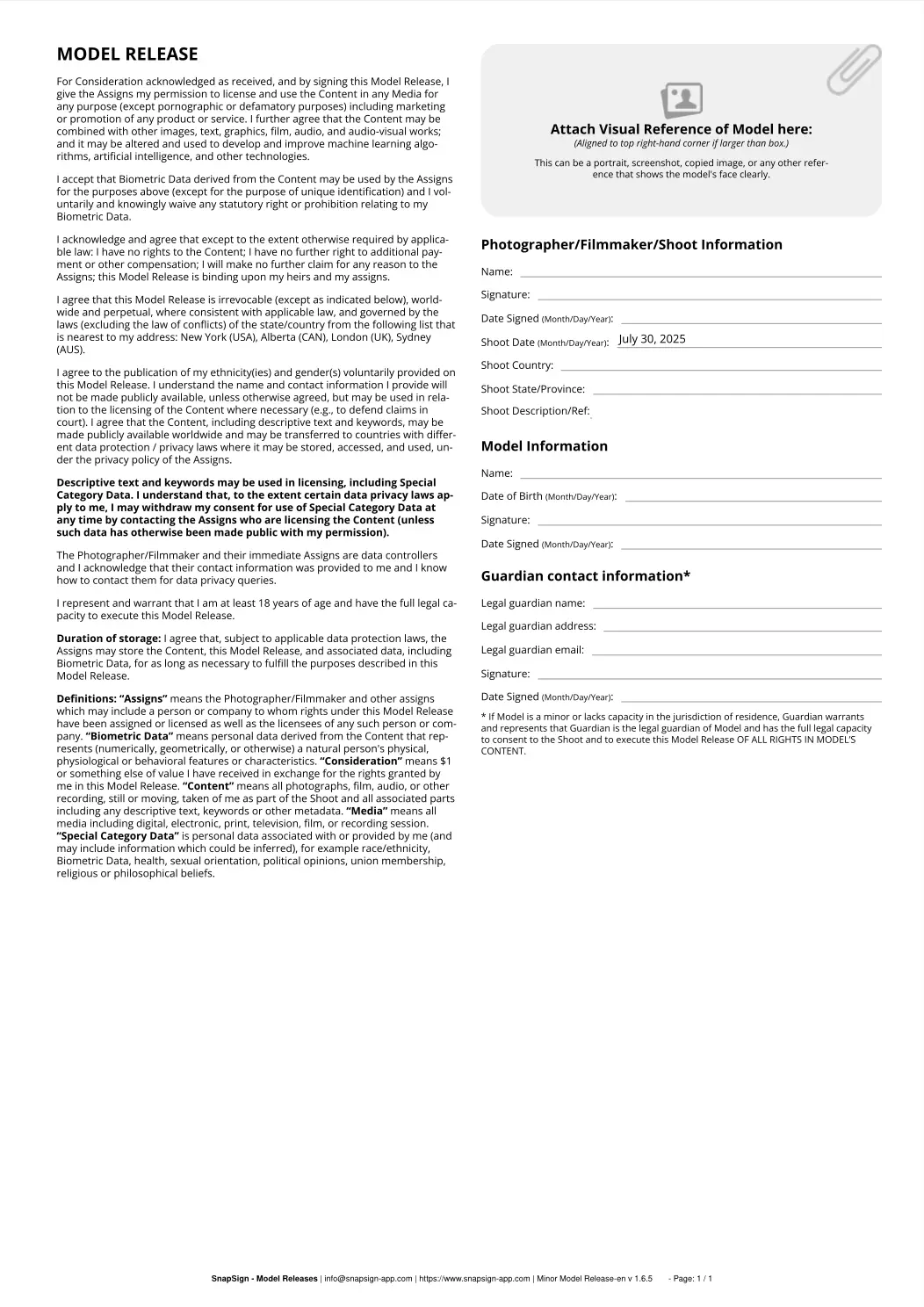
Download Free Minor Model Release Form (PDF) for Photographers
How to Get a Minor Release Signed Without Paper
The fields are settled. Now the part most photographers overlook until it is too late: the signing workflow. A correctly structured release that never gets signed protects no one.
Paper releases create friction. You print the form, hand it to a parent who may not have a pen, hope they fill in every field, and then store a physical document that can be lost, damaged, or disputed years later. A digital release solves all of this.
With SnapSign, the workflow is straightforward. Open the app, select the Minor Model template — it already includes the guardian signature fields and birthdate verification that a standard adult release lacks. Fill in the minor’s information. Send a Signature Request to the parent’s email — a secure, tokenized link that expires after 48 hours. The parent reviews the release on their phone, signs, and the signed PDF is stored in your account. No printing, no scanning, no chasing paper.
A digital release also gives you an audit trail that a paper form cannot provide:
Signed PDF SHA-256: 9f2c7a1e4b6d803f5a2e9c1d4f7b0a3e6c9d2f5b8a1e4c7d0f3a6b9c2e5d8f1a
Timestamp: 2026-07-01T14:30:00Z
Signer IP: verified
Signer: Jane Smith (legal guardian of Emily Smith, DOB 2015-03-14)
If the validity of the consent is ever questioned, cryptographic proof plus a timestamped signature record answers the question definitively. You can verify any signed contract yourself using our contract integrity validator — upload the PDF and confirm the hash matches in seconds. Read our remote signing guide for the full step-by-step workflow.
Questions Photographers Actually Ask
The legal structure is one side of the equation. The human side — the conversation with the parent, the edge cases, the scenarios that no template covers — is where photographers either get the signature or lose the shot. These are the questions that come up on set, in forums, and in my inbox. The answers are the way I would give them to another photographer over coffee.
How do I actually ask a parent to sign this without making it weird?
Photographers who avoid the release conversation out of discomfort end up with legally unusable images. The conversation is not a confrontation — it is a standard professional step. Here is language that works:
“This release gives me permission to use the photos in my portfolio and for promotional purposes. It also protects both of us — it puts in writing exactly what the images can and cannot be used for, so there are no surprises later.”
Parents appreciate clarity. Explain what the images will be used for, reassure them that the release is standard professional practice, and make the signing process easy — a digital Signature Request they can complete on their phone while standing next to you. If a parent hesitates, offer to walk them through each clause. Transparency builds trust faster than avoiding the conversation entirely.
What if the parent refuses to sign?
You have two options: shoot anyway and accept that the images are for personal use only — no portfolio, no stock, no social media promotion — or do not shoot. There is no third option. A parent who refuses to sign has not given consent, and using the images commercially anyway is exactly the kind of fact pattern that produces lawsuits. If the refusal happens before the shoot, explain why the release is standard practice and offer to let them review it with someone they trust. Some refusals come from confusion, not objection — clarity sometimes turns a no into a yes. But if the answer is still no, respect it and move on.
What if the parents are divorced? Who signs?
The parent with legal custody signs. If custody is joint, either parent can typically sign — but this varies by jurisdiction and by the specific terms of the custody agreement. When in doubt, ask to see the custody order. A signature from a parent who does not have legal custody is no better than a signature from a stranger. If the situation is contested or unclear, consult a lawyer before the shoot — not after.
Can a grandparent, aunt, or older sibling sign?
No — unless they have court-appointed legal guardianship. Being related to the child is not the same as having legal authority to grant consent. A grandparent who regularly picks the child up from school does not automatically have signing authority. The only acceptable signers are: a parent listed on the birth certificate, or a court-appointed legal guardian with documentation to prove it. If the person in front of you cannot produce that documentation, do not hand them the pen.
Age of Majority and Consent Rules by Country
Those real-world questions all share a common thread: the answer depends on where you are standing when you ask them. The parent-conversation script works everywhere. The legal age at which someone stops being a minor does not.
The core rule is universal: a minor cannot legally consent to commercial use of their image. The parent or legal guardian signs. What varies is the age of majority, the legal framework that governs image rights, and how aggressively those rights are enforced — and the gap between, say, California (18) and Mississippi (21) is three full years of legal exposure if you guess wrong.
| Jurisdiction | Age of majority | Legal framework | What photographers need to know |
|---|---|---|---|
| United States | 18 (most states), 19 (AL, NE), 21 (MS) | Right of publicity — state law | Parent or guardian must sign. California allows minors to disaffirm contracts after turning 18 — parent signature is the only safeguard. Follow the strictest state standard applicable. |
| Canada | 18 (AB, MB, ON, PE, QC, SK), 19 (BC, NB, NL, NT, NS, NU, YT) | Personality rights — provincial + PIPEDA | Parent or guardian consent required. Quebec's Civil Code adds specific personality-right protections stronger than common-law provinces. |
| United Kingdom | 18 (England & Wales, Scotland, NI) | UK GDPR + common law privacy | Parent or guardian consent required. UK GDPR classifies a child's image as personal data — consent must be explicit, informed, and verifiable. |
| European Union | 18 (all member states) | Personality rights + GDPR | Parent or guardian consent required. GDPR Article 8 sets digital consent age at 16 (member states may lower to 13). Germany and France have the strongest personality-right protections — penalties are higher for unauthorized use of a minor's image. |
| Australia | 18 | Common law privacy + Australian Privacy Principles | Parent or guardian consent required. Less litigious than the US, but commercial use without consent still exposes photographers to claims under privacy law. |
| Japan | 18 (lowered from 20) | Personality rights + Act on Protection of Personal Information | Parent or guardian consent required until age 18. Unauthorized commercial use of a minor's image carries both civil and reputational risk. |
If you work across borders, follow the strictest applicable standard between the shoot location and the model’s country of residence. A release signed by a parent or legal guardian that includes the minor’s full name, birthdate, scope of use, and waiver of future claims meets the minimum threshold in every jurisdiction listed above. For the full cross-border picture, read our guide on legal differences in model releases around the world.
Laws may change — always confirm current local requirements before commercial use.
When to Call a Lawyer
The rules, the jurisdictions, and the templates cover most situations a photographer encounters. But certain scenarios push beyond what a template can handle, and knowing where that line is matters more than knowing every clause in the release.
For most photographers, a well-constructed template is enough. The exceptions are:
- National ad campaigns where the minor’s face will appear on billboards, product packaging, or television commercials
- Stock photography submissions where images may be licensed for unrestricted commercial use by unknown third parties
- Shoots involving sensitive or revealing imagery — even if the parent consents, the content itself can raise legal questions
- Foster care situations where legal guardianship is held by the state, not an individual — the consent chain is more complex and must be verified through the relevant agency
In any of these scenarios, spend an hour with a media or intellectual property attorney who understands photography releases. The consultation costs a few hundred dollars. Defending a right of publicity claim involving a minor costs orders of magnitude more — and the reputational damage is often worse than the financial hit.
Best Practices That Prevent Problems
The rules, the fields, the mistakes, the jurisdictions, and the edge cases give you the full picture. Now the habits that keep you out of trouble on a real shoot — because no amount of legal knowledge helps if you forget the release on the kitchen counter.
The first habit is the simplest and the most frequently broken: bring the minor-specific form. Do not show up with an adult release and improvise. A standard form will be rejected by stock platforms and will not protect you in a dispute. Keep a separate minor release template ready in your app or camera bag, and make it the only form you reach for when the subject is under 18.
The second habit is verifying who is actually signing. Ask to see government-issued ID. Confirm the signer’s name matches the birth certificate or guardianship document. “I’m his mom” is not verification — it is an assumption that costs photographers cases. This takes thirty seconds and it is the difference between a valid release and a void one.
The third: sign before you shoot. Once the session ends, your leverage disappears. The parent has no incentive to sign afterward, and you have no easy way to get the document in front of them. Make the signature step one — before the first frame, not after the last.
Fourth, explain the scope clearly and write it into the release. Tell the parent exactly how the images will be used — portfolio, advertising, stock, social media. A parent who understood the terms at signing is a parent who will not challenge the release later. Two sentences of explanation prevent months of dispute.
Finally, store releases with the ID verification attached. Cloud backup, organized by shoot date. The signed release and a copy of the parent’s ID live in the same folder. A release with no proof of who signed it is weaker than you think — and a release you cannot find is the same as no release at all.
Here is a pre-shoot checklist you can run through in 30 seconds:
- Minor release template ready (not adult form)
- Minor’s full legal name and birthdate confirmed
- Parent or guardian’s ID verified — name matches legal documents
- Guardian’s legal authority clause included in the release
- Scope of use explained to parent and documented in the release
- Cloud backup folder created for this shoot
Run that list before every shoot with a minor and you will never be the photographer holding a void release when a stock platform comes asking. Now for the bottom line.
Final verdict - Minor model releases
A minor model release is the only document that legally permits commercial use of a child’s image. A standard adult release does not cover a minor — the gap is not a nuance, it is a void contract. The parent or legal guardian must sign. A digital release with built-in guardian fields, timestamped audit trails, and cryptographic verification makes the process faster than paper and far stronger in a dispute. Get the release before the first frame. One missed form can make an entire session commercially unusable — and no photograph is worth that risk.
Download a free minor model release form (PDF)
The blank minor model release, including the parent or guardian consent block required for anyone under 18. Free to download, or send it for signing in the app.