What Is a Media Release Form?
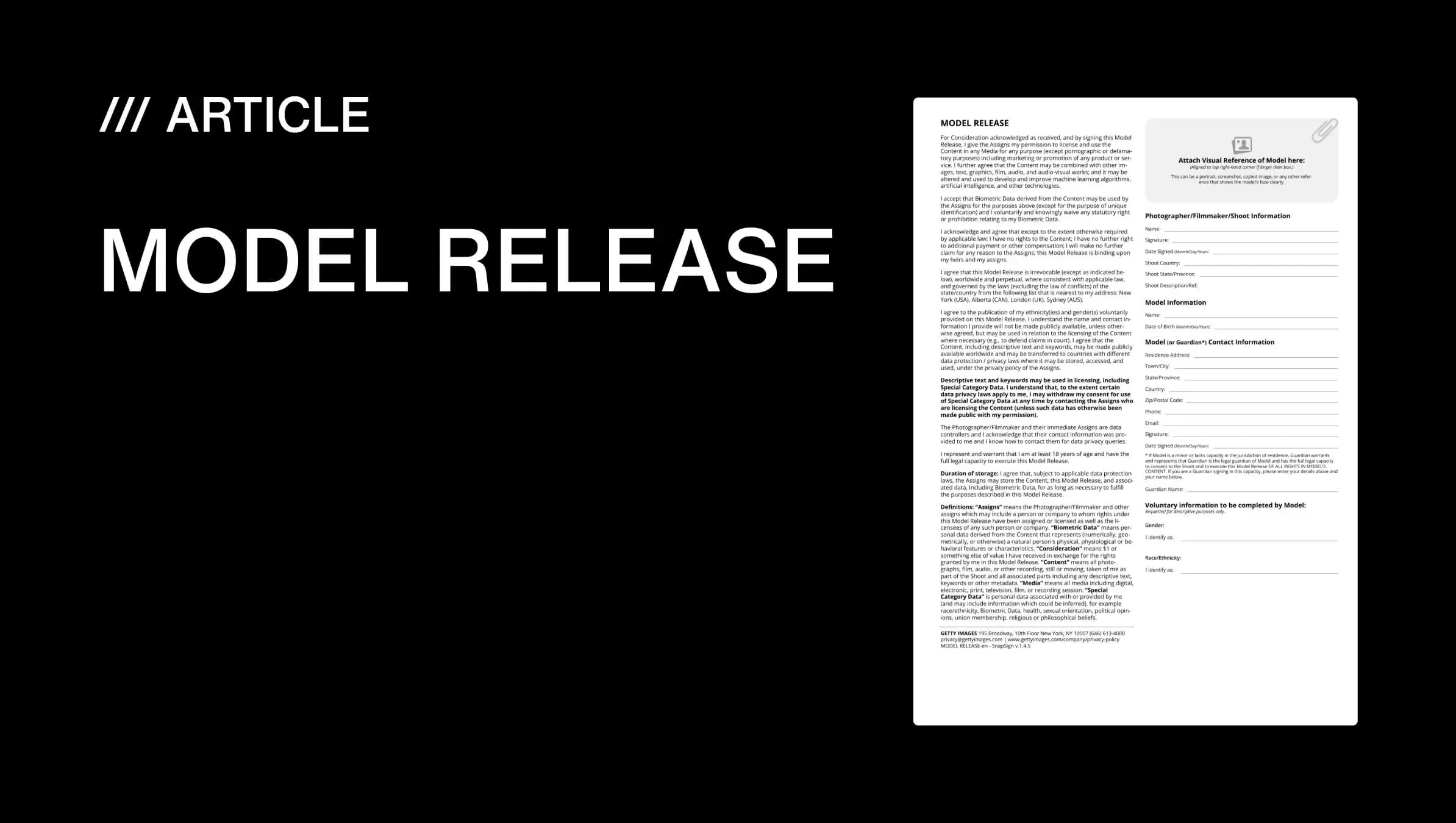
A media release form is a legal document that grants a photographer or filmmaker permission to use a person’s likeness, voice, or performance in a production. If you come from still photography, you know this as a model release for photographers. If you work in film or video, you probably call it a talent release form — or an actor release form when the subject is on-screen talent. Same function, different vocabulary — and in both worlds, it is the piece of paper (or screen) that separates a distributable project from a hard drive full of footage you cannot use.
This guide explains the difference between media release forms, talent releases, video release forms, and traditional model releases — and when each one is required. It covers commercial productions, independent films, YouTube, stock photography, and live events. By the end, you will know exactly which form goes with which person on which kind of shoot, what belongs inside it, and how to get it signed before the first take.
I learned this the hard way. On one of my first independent film shoots, we wrapped a three-day production with a cast of twelve. Everyone was thrilled with the footage. Then the distributor asked for the release paperwork. I had talent releases for the lead actors — but not for the background performers who appeared in wide shots. Those scenes had to be recut, and we lost the best takes. One form per person. That is the rule.
A video release form covers more ground than a standard model release because video captures voice, movement, and performance — not just a static likeness. On set you will hear it called by several names: a talent release, a video consent form, or — when a shoot captures both stills and footage — a photo and video release form. The label changes by industry and by habit, but “release” is the more precise term than “consent”: consent can be withdrawn; a release is a binding contract. Whatever term shows up on the paperwork, the legal core is the same: you need documented permission from every recognizable person in your frame before you can distribute, license, or monetize the work.
But terminology only gets you so far. The real question is what happens when you do not have that permission — and the answer is worse than most filmmakers assume.
Why Release Forms Matter on a Production
The Stakes Are Higher Than Most Filmmakers Realize
Skip a release form on a photo shoot and you might lose a stock photography submission. Skip a talent release form on a video production and you might lose an entire film. The difference is scale: a photo shoot involves one or two subjects; a film set involves cast, background actors, voice performers, and sometimes crew who appear on camera. Each person without a signed release is a legal vulnerability.
The right of publicity — the legal principle that gives every person control over the commercial use of their own likeness — is the foundation here. In the United States, this right varies by state. In the European Union, GDPR adds another layer: a person’s image is personal data, and using it without consent can trigger regulatory penalties beyond civil lawsuits. The Wikipedia article on model releases and the ASMP legal resources both provide deeper background on the legal framework for photographers and filmmakers.
The financial risk is not theoretical. A production that cannot prove it has releases for every identifiable person in every frame is a production that cannot get distribution, cannot license footage to stock platforms, and cannot run ads against the content. The release form is not creative — it is infrastructure. And infrastructure fails silently until the moment you need it.
The good news: once you know which forms exist and what each one covers, the entire paperwork layer collapses into a simple checklist. Here are the release types you will actually encounter on a working set.
Types of Production Release Forms You Actually Need
On a working set, you encounter a handful of release types. The names overlap more than you would expect, and different industries use different labels for functionally identical documents. The table below maps out what each form covers, who signs it, and — most importantly — which production types actually need it.
| Release type | Also called | Who signs | Covers | Needed for |
|---|---|---|---|---|
| Talent release form | Media release form, video release form, actor release form | Actors, presenters, voice performers, on-camera subjects | Likeness, voice, performance, and name in video or film productions | Films, commercials, YouTube, branded content, documentaries with distribution |
| Model release form | Photo release form, photography release form | Models, photo subjects | Likeness and image in still photography — commercial, stock, and portfolio use | Portrait sessions, fashion shoots, stock photography, advertising stills |
| Photo and video release form | Combined release, multimedia release form | Subjects appearing in both stills and video from the same shoot | Likeness, voice, and performance across both photography and video | Behind-the-scenes shoots, social media campaigns, content days with mixed deliverables |
| Property release form | Location release form | Property owner, business owner, venue manager | Interiors, exteriors, and identifiable private property appearing in the production | Commercial shoots on private property, stock photography of interiors, films with recognizable locations |
| Minor model release | Child talent release, photo release form for minors | Parent or legal guardian | Likeness of anyone under 18 — the subject cannot sign for themselves | Any production involving minors — commercial shoots, films, stock, YouTube, school events |
Most productions need at least two categories in play: talent releases for everyone on camera and property releases for every private location. A commercial shoot in a rented studio with three actors? Three talent releases and one property release from the venue owner. A commercial photography release works the same way — the release covers the specific commercial use of the images, whether stills or video. A documentary interview in a subject’s home? One talent release and one property release. The math is simple — one form per person, one form per private location.
On larger productions, film production release forms multiply fast. A feature film set can generate dozens of pieces of film production paperwork before the first take: talent releases, location agreements, crew deal memos, and film production contracts for above-the-line talent. Some producers start from a production contract template and adapt it per project — faster than drafting from scratch, but you still need a lawyer to review the final version. A film crew release form covers crew members who appear on camera — and yes, it happens more often than you would think. Sound mixers, makeup artists, and grips end up in behind-the-scenes footage and B-roll, and if that footage is used promotionally, they need a release too. None of this is creative — it is logistics. But logistics are what separate a professional set from a weekend project that falls apart in post.
For more detail on location paperwork, see our property release guide. For the fundamentals of model releases in still photography, start with our model release guide.
Which Release Do You Need? A Decision Tree
If the table above feels like a lot to take in, here is the simpler version — a yes/no path that gets you to the right form in three questions.
- Is a person recognizable in the frame? → If yes, continue. If no (silhouette, back of head, blurred crowd), you do not need a release from that person.
- Is the person under 18? → If yes, you need a minor model release signed by a parent or legal guardian. No exceptions.
- Photo only, video only, or both?
- Photo only → Model release form.
- Video or film → Talent release form (also called media release form or video release form).
- Both → Photo and video release form (combined release).
- Are you shooting on private property? → If yes, you also need a property release form from the owner — regardless of the talent releases above.
That is the decision tree. Person or property → age check → format → done. Two minutes of your call sheet, and every person and location on your shoot is covered.
Release Selector by Project Type
If you already know the project format, here is what goes in your paperwork kit:
| Project type | Forms you need |
|---|---|
| Portrait or fashion shoot | Model release |
| Commercial film or ad | Talent release + Property release |
| Documentary with distribution | Talent release (for interviews) + Property release (for locations) |
| Wedding photography / video | Model release or Talent release + Property release |
| YouTube video with guests | Talent release |
| Stock photography | Model release + Property release |
| Live event or festival | Crowd release notice + Individual releases for close-ups |
| Behind-the-scenes / BTS | Photo and video release form for cast + Film crew release form for crew on camera |
| Content day (mixed stills + video) | Photo and video release form (combined) |
Minor Talent Releases: The Rule With No Exceptions
If the person on camera is under 18, they cannot legally sign a release — period. A parent or legal guardian must sign. This is true across all U.S. states and in most countries. Productions that work with child actors, student filmmakers shooting on a college campus, and YouTubers who feature their own kids all fall under this rule. A talent release form for minors is not valid without the guardian’s signature, and no amount of verbal agreement changes that.
Now that you can identify each release type, the next question is practical: when does each one actually become necessary — and when can you skip it?
When You Need a Release Form — and When You Do Not
The line between “need a release” and “fine without one” comes down to how the footage will be used, not how it was shot. The same clip of a street performer might need a release if it ends up in a brand campaign and need nothing if it runs in a news segment. The table below covers the most common scenarios.
| Scenario | Release required? | Why |
|---|---|---|
| Commercial ad or brand campaign | Yes | Any commercial use of a person's likeness requires documented permission |
| Stock footage for licensing | Yes | Getty Images, Adobe Stock, and Shutterstock all require releases for recognizable people. See [Adobe Stock's release guidelines](https://helpx.adobe.com/stock/contributor/help/model-release.html) and [Getty Images' contributor requirements](https://contributors.gettyimages.com/) for specifics. |
| Monetized YouTube video | Yes | Ad revenue and sponsorships make the content commercial |
| Wedding video for private client | Recommended | If you use excerpts in your portfolio or marketing, the use becomes commercial |
| Documentary interview in public space | Usually no | Editorial use in public settings is protected — but secure a release anyway for festival distribution |
| Street photography / photojournalism | No | Editorial and artistic use does not require a release in most jurisdictions |
| Personal project, no distribution | No | If the footage never leaves your hard drive, a release is unnecessary |
A common trap: assuming an unpaid shoot does not need a release. Whether money changes hands between you and the subject is irrelevant. What matters is how the final work is used. A TFP collaboration that ends up in a portfolio used to pitch commercial clients? That is commercial use. The release protects you both.
Knowing when you need a release is step one. Knowing what actually goes into one — the nine fields that make or break its enforceability — is step two.
What Belongs in a Production Release Form
A release form does not need to be long — the strongest releases fit on a single page. Whether you are working from a sample video release form found online, a sample photo and video release form downloaded from a production resource, or a photo and video release form template provided by a legal team, what matters is specificity. Every field that is vague today is a dispute waiting to happen tomorrow. A solid talent release form template or video release form template should include:
- Full legal name of the subject — not a nickname, not a stage name. The actual name on their ID.
- Description of the production — the project title, shoot date or date range, and a brief description of the type of content being created.
- Scope of permitted use — commercial, promotional, editorial, all media, or specific platforms. Be explicit. “All media now known or hereafter devised” is standard legal phrasing that covers future formats.
- Duration — perpetual or time-limited. Most commercial releases are perpetual; some documentary releases are limited to the project’s distribution window.
- Compensation terms — even if the compensation is zero, state that explicitly. “For good and valuable consideration, including the opportunity to appear in the production” is the boilerplate for unpaid shoots.
- Third-party usage and transfer rights — the ability to license the footage to distributors, stock platforms, or broadcasters. Without this clause, you cannot sell or transfer the content to anyone else.
- Release of liability and indemnification — protects the production from future claims by the subject. Standard language confirms the signer waives the right to sue over the agreed-upon usage.
- Waiver of inspection or approval rights — the subject agrees they cannot demand to review or veto the final edit before it is released. This is standard in commercial production releases and prevents post-production gridlock.
- Signature and date — handwritten or digital, from the subject or their legal guardian.
For minors, add the guardian’s printed name, relationship to the minor, and contact information. For property releases, add the full address of the location and the owner’s relationship to the property.
One more clause that matters for film and video specifically: union talent riders. If you are working with SAG-AFTRA actors, the union agreement sets baseline terms for compensation, working conditions, and residuals. A standard talent release form alone is not sufficient — the union contract takes precedence. Independent productions with non-union talent can use the release form as the sole agreement, but if any cast member is union-affiliated, consult the relevant guild contract before relying on a standalone release.
A well-written release on paper is still just paper. The format you choose — clipboard or cloud — changes everything about how reliably that release protects you six months later. For a deeper dive into release form components, Rev’s guide to video consent and release forms covers the legal clauses in detail — useful as a cross-reference when drafting or reviewing your own template.
Digital vs. Paper Releases on Set
Every filmmaker who has worked on location knows the paper-release routine: a clipboard with a stack of forms, a pen that runs out of ink, and a gust of wind that sends half the stack into a puddle. Paper releases are fragile, messy, and — worst of all — easy to lose.
| Factor | Paper releases | Digital releases |
|---|---|---|
| Speed on set | Slower — print, pass around, collect, file | Fast — sign on a phone or tablet, done in under a minute |
| Legal validity | Valid — but must be stored and retrievable | Valid — e-signatures carry the same weight under the ESIGN Act and eIDAS |
| Storage and retrieval | Manual filing, physical damage risk | Cloud storage, searchable, backed up automatically |
| Remote signing | Not possible — must be in person | Participants sign from their own device anywhere |
| Audit and verification | None — a paper release can be forged or altered | Cryptographic hash verification proves the document has not been altered |
| Multi-participant shoots | Print a form for each person, track manually | Group Events — send one link, track signatures from a single dashboard |
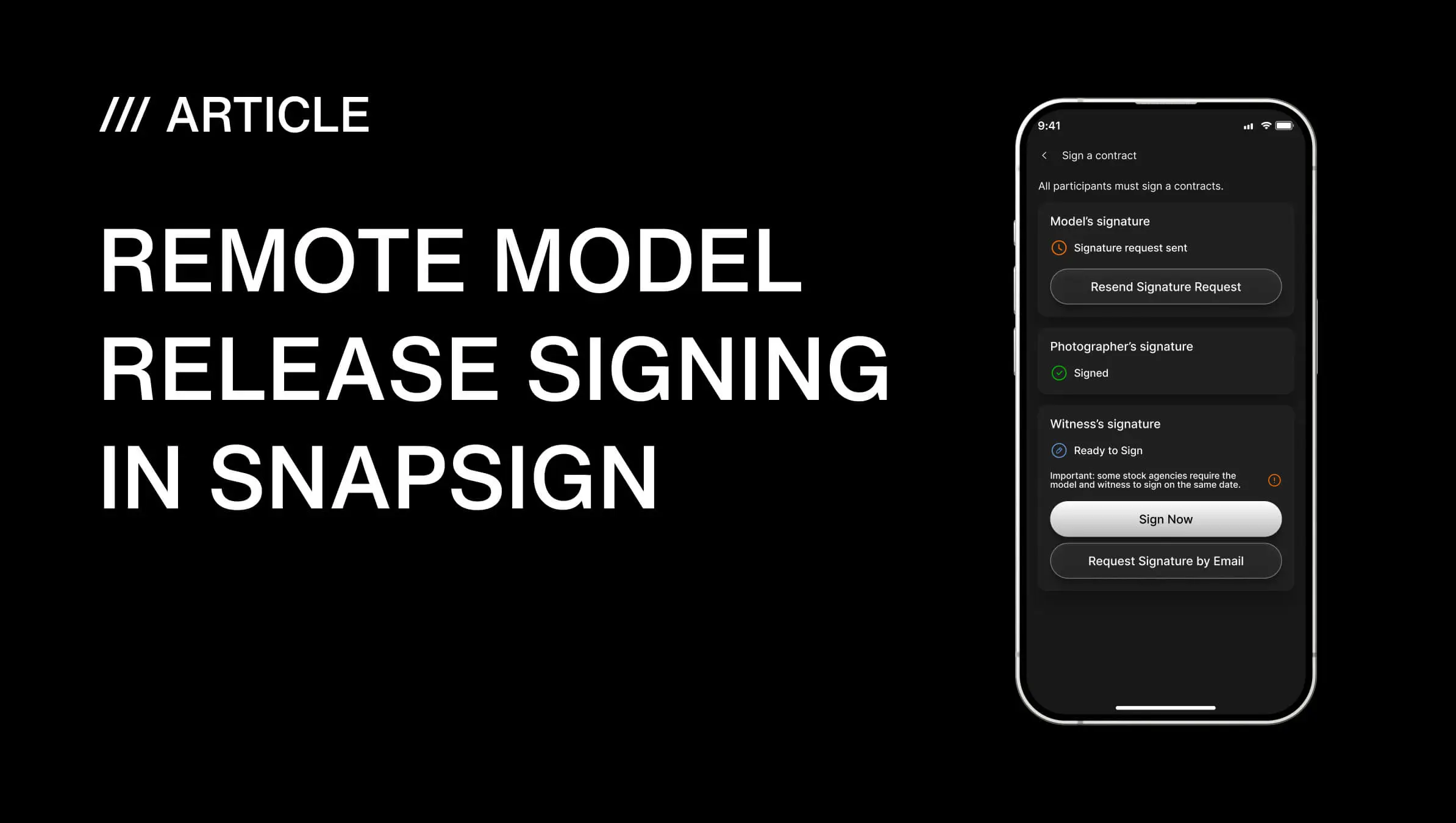
We built SnapSign to replace the clipboard stack. You open the app, pick a template — we include a standard model release, a Getty Images-compliant release, a property release, and ten other templates covering the most common filmmaking forms — fill in the shoot details, and either hand your phone to the subject to sign or send them a Signature Request by email. The email link is valid for 48 hours while signing is pending, and after the release is signed, the same link stays open for 30 minutes so the signer can review what they agreed to. Every signed Contract generates a PDF stored in the cloud — no need to hunt for a talent release form PDF in an email attachment or Dropbox folder months later. Every signed release is also protected with a SHA-256 cryptographic hash — you can verify that the document has not been altered since the moment it was signed.
Even with the right format, the same mistakes surface across productions of every size. The tool is only as good as the person using it.
Common Mistakes That Come Back to Haunt Productions
Some mistakes are recoverable — blown focus on a take, a mic that drops during an interview. Release form mistakes are not. Here are the ones that show up again and again:
Missing releases for background performers. The lead actors sign. Nobody thinks about the five extras visible in the background of the wide shot. On a feature film, this is handled by an assistant director with a stack of forms. On an independent production, it is handled by nobody — until distribution asks for paperwork.
Vague language in the release. “Some commercial use” is not an enforceable scope. A release that does not specify what the footage can be used for, on which platforms, for how long, and in which territories is a release that can be challenged. Use clear, specific terms — even if the language feels formal.
Assuming a verbal agreement is enough. It is not. A handshake does not hold up when a dispute reaches a lawyer. “We agreed on set” carries no weight without a signed document. Every release must be in writing with a signature attached.
Forgetting that minors need a guardian. A 16-year-old actor cannot sign their own release. If the guardian is not present on set, the release is not valid — and you cannot use the footage. This is the mistake with the least room for argument. The law is unequivocal.
Not getting a property release for the location. You have talent releases for every person on camera, but you are shooting in a recognizable coffee shop, hotel lobby, or private home. Without a property release from the owner, that footage is also at risk. Talent releases and property releases are separate documents — you need both.
What Photographers and Filmmakers Actually Run Into
These mistakes are not hypothetical. They play out in real workflows every month — and reading through photography and filmmaking communities gives you a front-row seat to what goes wrong.
Take a thread that surfaced on r/photography. An experienced event photographer — twenty years in the business — took a job where the client demanded a signed release from every single person photographed at an outdoor family festival with live bands, food stalls, and no ticketed entry. The client also wanted each person’s name baked into the image filename. The top response, with over eighty upvotes: “The organizers need a general crowd release and notice of filming posted around the event. This is an event task, not a photographer one.” The photographer ultimately walked away from the job after explaining the logistics. As another commenter put it: “It is nice when the bullet dodges you.”
The thread captures a tension every working photographer and filmmaker recognises: clients often do not understand what a release workflow actually costs. Asking one person to sign a talent release form takes thirty seconds. Asking thirty people at a live event — while shooting, tracking names, and matching forms to faces — is a separate job. This is exactly where digital signing changes the equation. Instead of a clipboard stack and a second hire to manage it, you hand each person a phone. They sign. It is stored. You move on.
Another common scenario: models supplied by the client. A separate discussion on r/photography covered this — twelve comments from photographers sharing how they handle shoots where the client arranges the talent. The consensus: the photographer still needs the model release signed directly with the subject, not with the client. If the agency or brand arranged the model, get the release from the model — not the middleman. A release signed by someone who does not appear in the frame is worthless.
These are not edge cases. They are Tuesday. And they all point to the same conclusion: the release workflow needs to be fast, mobile, and idiot-proof — because on a real set, there is no time to explain legal nuance between takes.
For events where individual releases are genuinely impractical — a music festival with five thousand attendees, a convention floor, a street fair — there is a middle ground. Post visible signage at every entrance stating that photography and filming are in progress and that attendance constitutes consent. Include the same notice in pre-event materials, registration forms, and ticket terms. This is called a crowd release or notice of filming, and it is standard practice at large public events. It is not a substitute for individual releases when you need close-up, identifiable footage of specific people — but it covers wide shots, crowd scenes, and general atmosphere. Just do not confuse it with a signed release. A sign on a wall is a disclosure, not a contract.
How to Get Releases Signed Without Slowing Down Your Shoot
Knowing what goes wrong is half the equation. The other half is making sure it does not go wrong on your set. Here is what works:
Make it part of call time. The release gets signed before the first light is set — never after the shoot. Once filming wraps and the subject leaves, leverage disappears. Treat the release like a location agreement or an insurance certificate: if it is not signed before the first take, the shoot does not start. When releases are part of the routine, nobody questions them. When they are an afterthought, someone always pushes back.
Use a digital signing app. Paper forms create friction. A mobile app that lets subjects sign on their own device — or yours — cuts the signing process to under a minute. For shoots with a large cast or multiple participants, we built Group Events in SnapSign: you create a roster, each person gets a secure link, and you track signing progress from a single dashboard. No chasing forms across a set.
Explain the release in plain language. Do not hand someone a form full of legal jargon without context. “This says I can use your image in the film and any promotional material for it” is enough. If the subject has questions, answer them. If they hesitate, do not pressure them — a signed release under duress is not worth much.
Store signed releases somewhere you cannot lose them. A signed release that lives only on one phone is one drop away from being gone forever. We built SnapSign with cloud sync as the default — every signed Contract generates a PDF stored in your account, backed up and verifiable. You can search by name, date, or project. When a client or distributor asks for proof of a release from a shoot two years ago, you find it in seconds.
Verify before distribution. Before you submit to a film festival, license footage to a stock platform, or publish a monetized video, audit your releases. Every recognizable face in the frame needs a matching signed release. One missing form is all it takes for a rejection.
These workflow habits apply whether you are on a fifty-person film set or filming solo in your living room. But the creator economy has its own set of rules — and its own blind spots.
Do YouTubers and Social Media Creators Need Releases?
The short answer: if you monetize, yes. The longer answer depends on the content type.
A YouTube creator filming a talking-head video in their own studio generally does not need a release for themselves — but as soon as a guest appears on camera, the math changes. If that video runs ads, has a sponsorship, or drives viewers to a paid product, the guest’s appearance is commercial use. A signed talent release form protects the creator if the video takes off and the guest later objects.
The same logic applies to Instagram Reels, TikTok, and any platform with a monetization path. A video that starts as organic content can become a brand asset if it goes viral. Getting a release signed on the day of the shoot costs two minutes and eliminates a risk that could surface months later.
For street interviews, reaction videos, and man-on-the-street formats, the rules are looser — these typically fall under editorial use. But if you plan to license the footage or repurpose it for a brand client, secure the release. The creator economy blurs the line between personal content and commercial media more than any previous format, and the safest position is always to have the paperwork in place.
The rules are different across every format — film set, photo shoot, YouTube studio, public street — but the principle is the same everywhere. Here is the bottom line.
Final verdict - Media Release Forms
A production release form — whether you call it a media release, talent release, or video release — is not optional paperwork. It is the document that makes your footage legally usable. Without it, you have a hard drive full of images and clips that cannot be distributed, licensed, or monetized. With it, you have a film, a stock asset, a commercial, a YouTube video — whatever you set out to create.
The workflow is not complicated. Identify every person on camera and every private location in the frame. Get the right form signed — a talent release for people, a property release for places. Do it before the first take, not after the wrap party. Store the signed releases where you can find them in two years. And if you work with minors, double-check the guardian signature — there is no wiggle room.
Two minutes of paperwork at the top of the day saves you from losing the entire shoot. That is the whole equation.