What Is a Property Release?
A property release form is a legal document that grants you permission to use images or footage of someone else’s property for commercial purposes. If you photograph a private home, a designer shop interior, a distinctive car, or even a recognizable piece of artwork — and you plan to license, sell, or publish that image commercially — you need the property owner’s signed consent.
Without a signed property release, stock photography platforms will reject your submission. Clients who license your work may face legal exposure. And property owners who see their space in an ad they never approved can demand takedowns, licensing fees, or damages.
This is a mistake I made exactly once, and it was enough. Early in my career, I photographed a beautiful indie bookstore — warm light, floor-to-ceiling shelves, the kind of space that makes a frame sing. I uploaded the shots to a stock platform. A week later, the owner called, furious. I had no release. The images came down, and I lost the licensing revenue. That day, property releases stopped being optional paperwork and became part of my pre-shoot checklist — every location, every time. — I’m Pavel Demidovich, Film Photographer, Filmmaker, Founder of SnapSign
We built SnapSign to make that checklist fast. Our property release template comes pre-loaded in the app — you open it, fill in the property details, and collect a signature on the spot or remotely through a Signature Request. No printers, no clipboards, no chasing paper. If you are new to the broader topic of photography releases, start with our complete guide to model releases — it covers the fundamentals that apply to all release types.
TL;DR — The Rule in One Sentence
If you photograph private property and use the image commercially — stock, ads, client work — you need a signed property release. Editorial use usually doesn't require one. Public space doesn't grant automatic permission. No signature means no commercial use. Period.
| Subject | Commercial use? | Why |
|---|---|---|
| Private house | ✅ Release required | Private property — owner consent needed |
| Hotel / Airbnb interior | ✅ Release required | Private commercial property — branded décor may also need clearance |
| Public park | Usually fine | Public space — check local commercial permit requirements |
| Mural / street art | ⚠️ Often release needed | Copyright belongs to artist — incidental background may not need one |
| Tattoo | ⚠️ Depends | Focal point = release. Background detail = usually fine |
| LEGO / Apple / branded product | ⚠️ Avoid or release | Trade dress + trademark — recognizable even without logos |
| Drone footage over private land | ✅ Release required | Airspace doesn't override property rights for commercial use |
When Do You Need a Property Release?
You need a property release whenever an image or footage of private property will be used commercially. The key word is commercial — if the content promotes a product, sells a service, appears in an advertisement, or is licensed through a stock photography platform, you need permission.
Editorial use — news reporting, documentary work, educational publication — generally does not require a property release. Editorial content informs; it does not sell. But the line blurs quickly. If a documentary still ends up on a streaming platform’s promotional banner, it becomes commercial use. Always clarify the end use before deciding a release is unnecessary.
Commercial Use vs. Editorial Use
The distinction comes down to purpose:
- Commercial use: advertising, marketing, product packaging, stock photography licensing, sponsored social media content, corporate brochures, website hero images for businesses. If money changes hands for the use of the image, it’s commercial. Get the release.
- Editorial use: news articles, documentary films, textbooks, museum catalogs, blog posts that report facts without selling a product. The image illustrates a story, not a sales pitch. A release is usually not required, but confirm with your publisher or platform.
Private Property vs. Public Space
Shooting from a public sidewalk does not exempt you from needing a property release. If a private building, home, or recognizable interior is the subject of your image — not incidental background, but the actual focal point — you need permission regardless of where you stood to take the shot.
Public parks, government buildings, and truly public spaces are generally safe for both editorial and commercial use, though some municipalities restrict commercial photography without a permit. Always check local regulations before setting up a commercial shoot in what appears to be public space.
When a Property Release Is Required — Quick Reference
| Scenario | Release Required? | Notes |
|---|---|---|
| Stock photography submission | Yes | All major platforms require property releases for identifiable private property |
| Commercial ad campaign | Yes | Any property featured in advertising must be cleared |
| Real estate photography | Yes | The owner's listing agreement typically covers this; confirm in writing |
| Wedding at a private venue | Yes | Venue interiors are private property; get a release from venue management |
| News editorial | No | First Amendment protections apply; confirm editorial classification with publisher |
| Public park or government building | No | Check for commercial photography permit requirements |
| Street photography (candid, non-commercial) | No | Personal or fine art use; if you later license it, the equation changes |
Property Release vs. Model Release — What's the Difference?
A model release covers a person’s likeness — their face, body, identifiable features. A property release covers a physical place or object — a building, a room, a vehicle, a piece of art. They serve the same legal function (granting commercial usage rights) but apply to fundamentally different subjects.
Many shoots require both. A fashion editorial shot inside a boutique hotel needs a model release from the model and a property release from the hotel owner. A commercial filmed in a private home with actors needs property releases for the location and model releases for every person on screen.
| Aspect | Model Release | Property Release |
|---|---|---|
| Covers | A person's likeness, image, identity | A physical location, building, object, or artwork |
| Signed by | The model (or legal guardian for minors) | The property owner or authorized representative |
| Legal basis | Right of publicity, privacy rights | Property rights, trademark/copyright law |
| Required for stock | Yes — any recognizable person | Yes — any recognizable private property |
| Common shoots needing both | Fashion editorials in private venues, commercial films, branded content in shops/hotels, lifestyle ads in homes | |
When You Need Both Releases
Many commercial shoots require both a model release and a property release. The most common scenario is a fashion or lifestyle shoot in a private venue — a model in a boutique hotel, an actor in a private home, a product being demonstrated inside a branded workspace. The model release covers the person. The property release covers the location. Miss either one, and the commercial value of the entire shoot is compromised.
A fashion shoot I ran in a boutique hotel is the reason I never skip this step now. Every model on set signed a release before we started. The hotel’s manager had verbally agreed to let us shoot in the lobby and one of the suites, so nobody thought to put anything in writing. Three weeks later, the client’s ad agency ran the images past legal, who flagged the unreleased interior — the lobby’s custom fixtures and artwork were recognizable enough to need the owner’s signed consent. We ended up reshooting two setups in a rented studio to avoid pulling the hotel entirely. Now the property release goes out before I even confirm model call times, not after.
Specific scenarios where you need both:
- Fashion editorial in a private venue — model release from the model, property release from the venue owner
- Commercial film with actors on private property — model releases for every person on screen, location release form for the property
- Lifestyle ad shot inside a branded business — model releases for talent, property release for the business interior and any visible logos
- Stock photography with a model and recognizable private property — both releases required by all major stock platforms, including Getty Images and Adobe Stock
- Wedding photography at a private venue — model releases for identifiable guests if used commercially, property release from venue management
The photographer community on r/photography echoes this consistently: get both releases before the shutter clicks. Once the shoot is over and you have left the location, your leverage to obtain signatures evaporates.
Who Must Sign a Property Release?
The person whose signature makes a property release legally valid is not always obvious. The signer must have the legal authority to grant commercial usage rights — and assuming the wrong person has that authority is how releases fall apart under scrutiny.
The Property Owner
The person or entity that holds legal title to the property must sign. For a private home, that’s the homeowner. For a business, that’s the owner or an officer of the company. Do not accept a signature from a tenant unless the lease explicitly grants them the right to authorize commercial photography — and even then, get the owner’s confirmation in writing.
Authorized Representatives
Property managers, venue coordinators, and location scouts often handle release logistics. They can sign if they have documented authority to grant usage rights on the owner’s behalf. Before the shoot, ask for a quick email from the owner confirming the representative’s signing authority. It takes two minutes and prevents the “I never approved this” phone call months later.
“The person who unlocks the gate is not always the person who can legally sign the release. Verify authority before you roll.”
What Types of Property Require Releases?
A property release covers far more ground than most photographers expect. Private homes and business interiors are the obvious cases, but stock platforms like Adobe Stock and Getty Images draw the line around anything identifiable and owned — from a tattoo on a model’s arm to a Lego brick in a product shot. Here is what needs a release, category by category.
Residential Buildings
Any private residence — houses, apartments, condos, vacation rentals — requires a property release if it appears in commercial imagery. Even if only part of the building is visible, if it is recognizable to the owner or someone familiar with the property, get the release. This applies to interiors and exteriors equally.
Business and Commercial Interiors
Restaurants, retail stores, hotels, coworking spaces, warehouses, and office buildings all require releases. These spaces often contain additional protected elements — logos, branded décor, proprietary layouts — that belong to the business. One uncleared sign in the background of a commercial shot can trigger a trademark complaint. I once had to blur half a frame because a branded sign crept into the corner of an otherwise clean interior shot. I don’t make that mistake anymore.
Recognizable Landmarks and Architectural Icons
This surprises many photographers: some landmarks are protected by intellectual property law. The Eiffel Tower’s nighttime light display is copyrighted — daytime photos of the tower itself are fine, but images of the illuminated tower at night used commercially require permission. Similarly, some modern buildings are protected architectural works. If a landmark is the focal point of a commercial image, research its IP status before the shoot. The ASMP’s legal resources provide guidance on architectural photography rights.
Artwork, Murals, and Graffiti
Copyrighted artwork — murals, sculptures, gallery installations, street art — requires a release from the artist or rights holder when it is the primary subject of a commercial image. Public visibility does not override copyright. If you photograph a model standing in front of a commissioned mural, and the mural is a significant element of the composition, you need both a model release and permission from the mural artist or their estate.
Graffiti and street art occupy a gray zone: they are often copyrighted, but Adobe Stock provides three specific scenarios where you may not need a release. The graffiti is incidental to the overall scene — not the subject. You use a shallow depth of field that renders the art unrecognizable. Or you shoot at an extreme close-up where only a small portion of the artwork appears, functioning as a backdrop for a model rather than a featured element. In every other case, treat graffiti like any other copyrighted artwork — get permission from the artist or rights holder.
Tattoos
Tattoos are works of art, and copyright in the tattoo design belongs to the tattoo artist. Adobe Stock’s guidelines distinguish between incidental and featured tattoos. You do not need a property release if the tattoo is not the focal point of the image — a portrait where a small wrist tattoo happens to be visible falls into this category.
You do need a property release when the tattoo is the main focal point (a close-up of the ink itself), when it depicts a recognizable person (a celebrity portrait tattoo), or when the subject is trademarked or copyrighted — a Disney character, a sports logo, a brand mark. The tattoo artist may also need to sign if their distinctive style is identifiable from the work.
One more wrinkle: a person who is identifiable by their tattoos alone needs a model release, even if their face is not in the frame. A full-sleeve tattoo that is well-known in the tattoo community can identify the wearer as clearly as a portrait.
Protected Product Designs
Product designs are among the most enforceable intellectual property categories in stock photography. Logos, brand names, and distinctive shapes are all protected, and stock platforms maintain known restrictions lists that go well beyond the obvious.
Some products are so universally recognizable that they are rejected even without visible logos — removing the logo does not make them safe. Adobe Stock specifically flags: Rubik’s Cubes, Red Cross symbols, Christian Louboutin red-bottomed shoes, Hershey’s Kisses, Apple devices, Lego and Duplo building sets and figures, Crayola products, Louis Vuitton goods, the Oscar statuette, and UPS uniforms (the brown color alone is distinctive enough to identify the brand).
The rule of thumb: if a product has a recognizable shape, color, or design language that the public associates with a specific brand, it is protected — with or without a logo in the frame. Check the platform’s known restrictions list before submitting. When in doubt, remove the product from the shot or replace it with a generic equivalent.
Note: the specific products listed above reflect stock platform guidance at the time of writing. Platforms update their known restrictions lists periodically — always review the latest contributor guidelines before submitting commercial content. A product that was acceptable previously may be restricted today.
Currency
Every country has its own rules about depicting banknotes. Adobe Stock draws a bright line: if more than 75% of a banknote is visible, the content will be refused. Coins and partial currency details may be acceptable, but close-up, full-bill images of paper currency are not. If currency appears in your commercial image, keep it incidental — a few bills on a table, not a frame-filling macro shot.
Vehicles, Aircraft, and Distinctive Objects
A vintage car, a custom motorcycle, a private plane — if the object is unique enough to be identified by its owner, and it is the subject of a commercial image, get a release.
Animals
Standard pets and wildlife do not require property releases — your neighbor’s Labrador is not protected IP. But two exceptions apply. Famous animals with recognizable public personas — Grumpy Cat, Doug the Pug, Jiffpom — are treated like celebrities and require releases from their owners. Zoo animals also require releases from the institution that houses them, because the zoo controls commercial photography of its collection.
Drone and Aerial Photography
Flying a drone over private property does not exempt you from needing a property release. If the property is recognizable from the air and the footage is commercial, you need permission — same as if you were standing in the front yard with a tripod. This surprises drone photographers who assume airspace is public domain, but property rights extend to commercially exploiting images of the land below.
Drone photography also layers on additional legal requirements that ground-level photography does not. In the US, the FAA requires Part 107 certification for any commercial drone flight — even if the drone weighs under 250 grams. Local jurisdictions may restrict drone flights over private property regardless of FAA rules. And in the EU, GDPR considerations apply if your drone captures identifiable people or private spaces from the air. Before sending a drone up for commercial work: confirm FAA or local aviation authority compliance, check municipal drone ordinances, and get the property release — all three. The air is public; the view of someone’s home is not.
For a deeper dive into the intersection of drone photography and legal releases — including model releases for aerial footage, stock platform rejection patterns, and a pre-flight release checklist — see our drone photography releases guide.
Airbnb and Short-Term Rentals
Photographing inside an Airbnb or vacation rental for commercial use requires a property release from the property owner — not the guest, not the host who happens to be present during the shoot. The host may grant you access, but only the legal owner can grant commercial usage rights. If you are shooting interiors for a hospitality brand, a real estate listing, or stock photography, verify the owner’s identity and get the release signed before you unpack your gear. The same principle applies to hotel photography: the front desk agent who let you in is not authorized to sign a property release. You need the hotel’s management or corporate office.
Museums and Galleries
Museums are private property that contain copyrighted artwork — a double release requirement. You need a property release from the museum administration for the space itself, and you need permission from the artist or estate for each artwork that appears as a focal point in your image. Many museums also have their own photography policies that restrict or prohibit commercial photography entirely, separate from release requirements. Before shooting in a museum or gallery for stock or commercial work, check the institution’s photography policy and budget time to clear both the space and the art. In most cases, editorial use — photographing an exhibition opening for a news outlet — is permitted under the institution’s press policy without a release. Commercial use — turning the same image into a stock photo — is not.
Location Release Form — The Filmmaking Angle
In filmmaking, the document is often called a location release form rather than a property release form — but the legal function is identical. A location release form grants the production company the right to film on private property and use the resulting footage commercially.
If you shoot narrative films, documentaries, music videos, or commercial spots on private property, a location release form is non-negotiable. Without it, a distributor or streaming platform may reject your project during the clearance review. A shoot I ran at a retro arcade proved that the hard way — the footage was rejected by a distributor because the arcade’s copyrighted posters and signage hadn’t been cleared. The location owner had given verbal permission, but without a signed location release form that covered the interior elements, the footage was unusable.
Key additions for a location release form versus a standard property release:
- Access dates and hours: When can the crew be on site?
- Alteration permission: Can you move furniture, adjust lighting, or modify the space?
- Naming rights: Will the real location name appear in the film, or will it be fictionalized?
- Indemnification: Who is liable if equipment damages the property?
StudioBinder and the DMA Institute provide film-specific location release templates. Our SnapSign property release template covers the core usage rights, and you can create a Custom Template to add film-specific terms for your production workflow.
Stock Photography Platform Requirements
Property release photography has a specific set of platform rules that go beyond general photography law. Every major stock platform requires property releases for images depicting identifiable private property, and their requirements are similar but not identical. Here is what the major platforms expect:
| Platform | Property Release Required? | Key Requirement |
|---|---|---|
| Getty Images | Yes | Release must identify the property, grant commercial rights, and include owner signature. Our releases are Getty Images certified. |
| Adobe Stock | Yes | Requires a release for all private property — interiors, exteriors, and recognizable objects. Follow Adobe Stock's model and property release guidelines. |
| Shutterstock | Yes | Property releases required for any content depicting private property used commercially |
| Alamy | Yes | Offers both commercial and editorial licensing; releases required for commercial use only |
We built SnapSign’s property release template to meet the requirements of all four major platforms. Read more about how our releases meet Getty Images standards. For the full platform-specific rules, consult Getty Images’ contributor release guidelines for their submission requirements — every platform maintains its own known restrictions list, and the specifics vary.
Key Elements of a Property Release Form
A property release agreement must be specific enough to hold up if challenged. Vague language — “I give permission to use photos of my place” — invites disputes. Every property release form should include these elements:
1. Property Description
Describe the property in enough detail that no one can claim they did not know what was being photographed. Include the full address and a short description (“the interior living room and front façade of the single-family home at 123 Maple Street”). Even better: attach a reference photo to the release. We designed SnapSign to support reference images within the contract — the property owner signs next to a photo of exactly what was shot.
2. Usage Rights Granted
Specify the scope: worldwide or regional? Perpetual or time-limited? Print, digital, broadcast, or all media? “All media, worldwide, in perpetuity” is the standard for stock photography submissions because platforms redistribute globally without end dates. For client-specific work, narrower terms may be appropriate.
3. Compensation Terms
State whether the property owner is being paid, and if so, how much and when. Even if the payment is zero — many owners grant permission for free — the form should state that no compensation is being provided, to prevent post-publication claims for payment.
4. Signatures and Contact Information
Full legal names, phone numbers, email addresses, and dated signatures. Digital signatures, collected through a platform that records consent and timestamps the signature event, are legally binding in the US, UK, EU, and Australia. Every signed contract in SnapSign is cryptographically hashed with SHA-256 — you can verify its integrity at any time, proving the document has not been altered since signing.
Download a Free Property Release Form Template
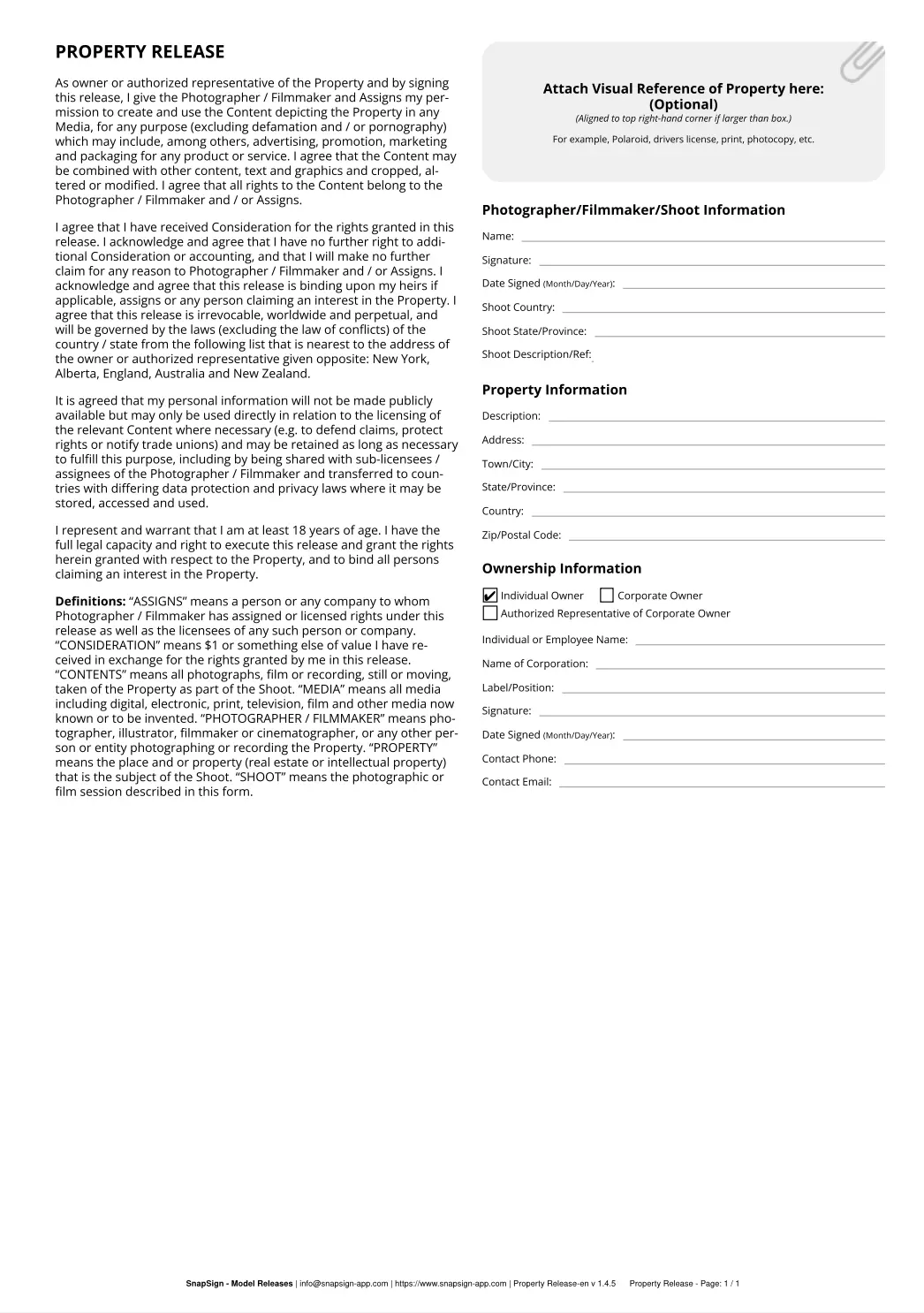
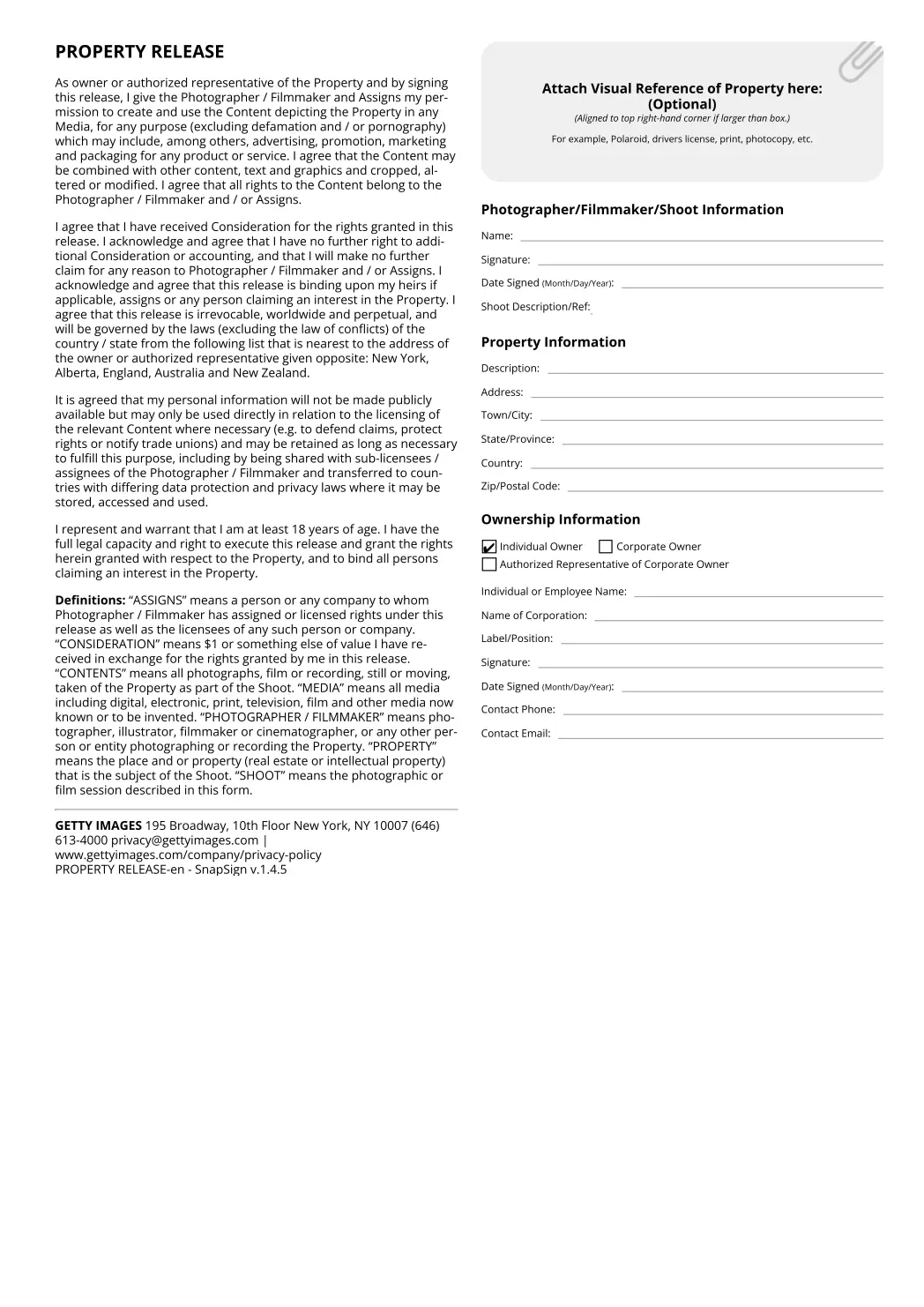
A property release form photography template saves you from drafting legal language from scratch. Starting with a solid form ensures you don’t miss critical clauses and gives you a foundation you can adapt to your specific shoot. We provide two free downloadable templates, built from years of on-set experience and reviewed for stock photography platform compliance:
- Download SnapSign Property Release Template — the same template we include in our app, formatted as a ready-to-print PDF. Covers commercial usage rights, worldwide perpetual license, property description, and compensation terms.
- Getty Images Property Release — available through your Getty Images contributor account, meeting Getty’s specific format requirements.
Both templates work as standalone forms. But if you want to stop printing, scanning, and filing paper releases, our app handles the whole workflow — create the release, collect signatures on any device, and store the signed PDF in the cloud with contract hashing for integrity verification.
“A template gets you started. A digital signing workflow keeps you organized across dozens of shoots.”
How to Draft a Property Release
Drafting a property release comes down to one principle: the document must be specific enough to hold up if challenged and clear enough that the property owner signs it without hesitation. The best release is the one that actually gets signed.
DIY Templates vs. Legal Counsel
For most photographers and filmmakers, a well-crafted property release form template covers the majority of shoots. Templates from reputable sources — stock platforms, photography trade organizations, established apps — are drafted with standard commercial usage scenarios in mind.
When to involve a lawyer:
- The shoot involves a high-value commercial campaign (national TV, major brand)
- The property is in a jurisdiction whose laws you do not know
- The property owner’s legal counsel is reviewing the release and proposing changes
- You are shooting on a location with multiple stakeholders (co-owners, tenants, lienholders)
A lawyer review typically costs a few hundred dollars — cheap insurance against a six-figure licensing dispute.
Language Tips for Clarity
Write releases in plain language. The property owner should understand exactly what they are agreeing to without needing a law degree.
Good: “You grant us the right to use photographs and video footage of your property at 123 Maple Street for advertising, marketing, and stock photography licensing, worldwide, with no time limit.”
Avoid: “Licensor hereby grants to Licensee an irrevocable, royalty-free, fully paid-up, worldwide, sublicensable right and license to reproduce, distribute, publicly display, and create derivative works of the Licensed Content in any and all media now known or hereafter devised.”
The first sentence a property owner can read and understand. The second makes them suspicious — and a suspicious property owner does not sign.
Digital Property: Do You Need a Release?
Digital property follows the same legal logic as physical property: if a real-world place or object is recognizable in your digital work and the use is commercial, you need permission. The medium changes — the law does not.
NFTs, Virtual Spaces, and Digital Twins
If you create a 3D model or digital twin based on a real building, and you sell or license that digital asset, you may need a property release. The underlying legal principle does not change just because the output is digital — if the real property is recognizable and the use is commercial, the owner’s rights are engaged.
Screenshots and Game Footage
Gameplay footage exists in a gray zone. The game developer’s EULA (End User License Agreement) governs whether you can monetize content captured in their software. Some developers explicitly permit monetization of gameplay videos; others restrict it. Always read the EULA of the game you are capturing — do not assume that because other creators monetize similar content, your use is permitted.
AI-Generated Images Based on Real Properties
Generating an AI image trained on or depicting a recognizable private property raises unsettled legal questions. Current copyright and property rights frameworks were not written with generative AI in mind. Until case law and regulation catch up, the safest approach is the same one that applies to traditional photography: if you are using a recognizable real property for commercial purposes, obtain a property release. Our guide to AI model releases and deepfake legal issues covers the broader AI landscape.
International Considerations
Property release requirements vary by country. In the United States, property releases are primarily a matter of state law, with the right of publicity and property rights forming the legal basis. In the European Union, privacy laws and personality rights — particularly in France and Germany — can impose stricter requirements on photographing private spaces, even for editorial use.
When shooting abroad:
- Research local property and privacy laws before you travel.
- Use a release translated into the property owner’s native language by a professional translator — not machine translation. A mistranslated clause can void the entire document.
- Confirm whether the country’s legal system recognizes digital signatures collected through your signing platform.
We offer our app interface in 20 languages, and our property release template is available in multiple languages. When working across borders, communicate with property owners in their language — it builds trust and reduces the chance of misunderstanding.
Best Practices for Managing Property Releases
The best time to collect a property release is before the camera comes out of the bag, and the best place to store it is somewhere you can retrieve it in 30 seconds when a platform or client asks. These three habits have saved me more times than I can count.
Get the Release Before You Shoot
Once the shoot is over and you have left the location, your leverage is gone. A property owner who was enthusiastic during the shoot may ghost you when the release email arrives. Get the signature first.
When you approach a property owner, be direct about what you are asking. Explain the project, describe how the images will be used, and be upfront about compensation — even if it is zero. A photographer on r/stockphotography put it simply: be clear about how you are profiting and what is in it for them. If the owner still refuses, you have two options: negotiate terms they are comfortable with, or shoot the property anyway and license the images as editorial-only — no commercial use, no advertising, no stock submissions that require a release.
With SnapSign, you can hand your phone to the property owner on site and collect their signature before the first frame. Or, if you are scouting ahead of time, send a Signature Request by email — the owner signs from any device, and the signed release is stored in your account before the shoot day.
Organize and Store Releases
A signed property release is worthless if you cannot find it when a stock platform or client asks for it. Use cloud storage with a consistent naming convention. I organize releases by project, location, and date: Paris_FashionShoot_LeMaraisApartment_Release_Spring. We store all signed contracts in your account with search by keyword, contract type, and date range — no digging through email attachments or paper files.
Keep Multiple Copies
Store your signed property release forms in at least two places: the signing platform’s cloud storage plus a local or secondary cloud backup. If you use paper releases, scan and save them immediately — paper gets lost, coffee gets spilled, and “I know I had it somewhere” is not a defense when a platform requests proof of consent.
Pre-Shoot Release Checklist
Before you press the shutter on any commercial shoot, run through these five questions. If the answer to any of the first four is “yes,” get the corresponding release signed.
- Are there identifiable people in the frame? → Model release, signed by each person (or legal guardian for minors).
- Is there private property in the frame — a building, interior, vehicle, or artwork? → Property release, signed by the property owner.
- Are both people AND private property in the frame? → Both releases. Fashion shoot in a hotel, commercial film on private land, lifestyle ad in a branded space — these always need both.
- Is the use commercial? → If the image sells a product, appears in an ad, or goes to a stock platform, the answer is yes. Get the releases.
- Are the releases signed before the shoot? → This is the one that saves you. After the shoot, your leverage is gone. Before the shutter, before the setup, before anything else — signatures first.
What Happens Without a Property Release?
Skipping a property release puts your images, your revenue, and your client relationships at risk. The consequences range from a rejected stock submission to a multi-year legal dispute — and none of them are worth the five minutes it takes to get a signature.
Takedowns and Platform Rejections
Stock photography platforms will reject any submission depicting identifiable private property without a corresponding release. No release means the image never reaches the marketplace. Enforcement is not always consistent — photographers on r/stockphotography report that identical images can get different results depending on who reviews them. A church might be rejected for intellectual property one day and accepted the next. Do not rely on inconsistent enforcement as a strategy — get the release. If you already licensed the image through a platform and the property owner files a complaint, the platform will remove it — and may suspend your contributor account.
Legal and Financial Risk
A property owner who discovers their home, business, or artwork in a commercial ad they never approved can send a cease-and-desist letter, demand licensing fees, or sue for damages. Even if the lawsuit ultimately fails, the legal fees and time lost are real. The cost of obtaining a property release — five minutes with a digital signing app — is negligible compared to the cost of defending a lawsuit.
Lost Client Trust
If a brand licenses your image and later receives a legal complaint from the property owner, that brand will not hire you again. They will also tell other brands. Reputation damage from one missing release can cost you years of client relationships.
Final Verdict — Get the Signature, Keep Creating
A property release form is a small document that carries enormous weight. It is what separates a usable commercial image from a liability. Whether you call it a property release, a location release form, or a property release agreement, the function is the same: documented permission from the owner, granting you the right to use images of their property for commercial purposes.
Get the signature before the shoot. Use clear, plain language in your release. Store the signed document where you can retrieve it instantly. And when the property is someone’s home, someone’s business, or someone’s artwork, do not rely on a verbal “sure, go ahead” — get it in writing.
We built SnapSign to make this workflow fast and foolproof. Our property release template is pre-loaded in the app — open it, describe the property, and collect a signature on the spot or send a Signature Request for remote signing. Every signed contract is cryptographically hashed for integrity verification, and all your releases are searchable in one place. Focus on creating — we will handle the paperwork.
To learn more about the broader release landscape, read our complete guide to model releases.