Quick Answer: Film Release Forms for Independent Filmmakers
Every filmmaker — whether you are shooting a documentary interview, a short film for the festival circuit, or a feature with a cast of twenty — needs signed release forms before distribution. A film release form is a legal document granting permission to use a person’s likeness, a location, or creative work in your production. Without a complete set of signed releases, distributors will not touch your film, festivals will reject your submission, and streaming platforms will not license it.
I learned this the hard way. On a documentary shoot in rural Portugal, I skipped releases for five people who appeared briefly in background shots — local farmers who walked through the frame during an interview sequence. The footage was beautiful. The edit was locked. And then the distributor’s legal team asked for the release packet. Those five missing signatures meant five faces blurred in post-production, at a cost that exceeded the budget for the entire sound mix. I have never shot without a release form on hand since.
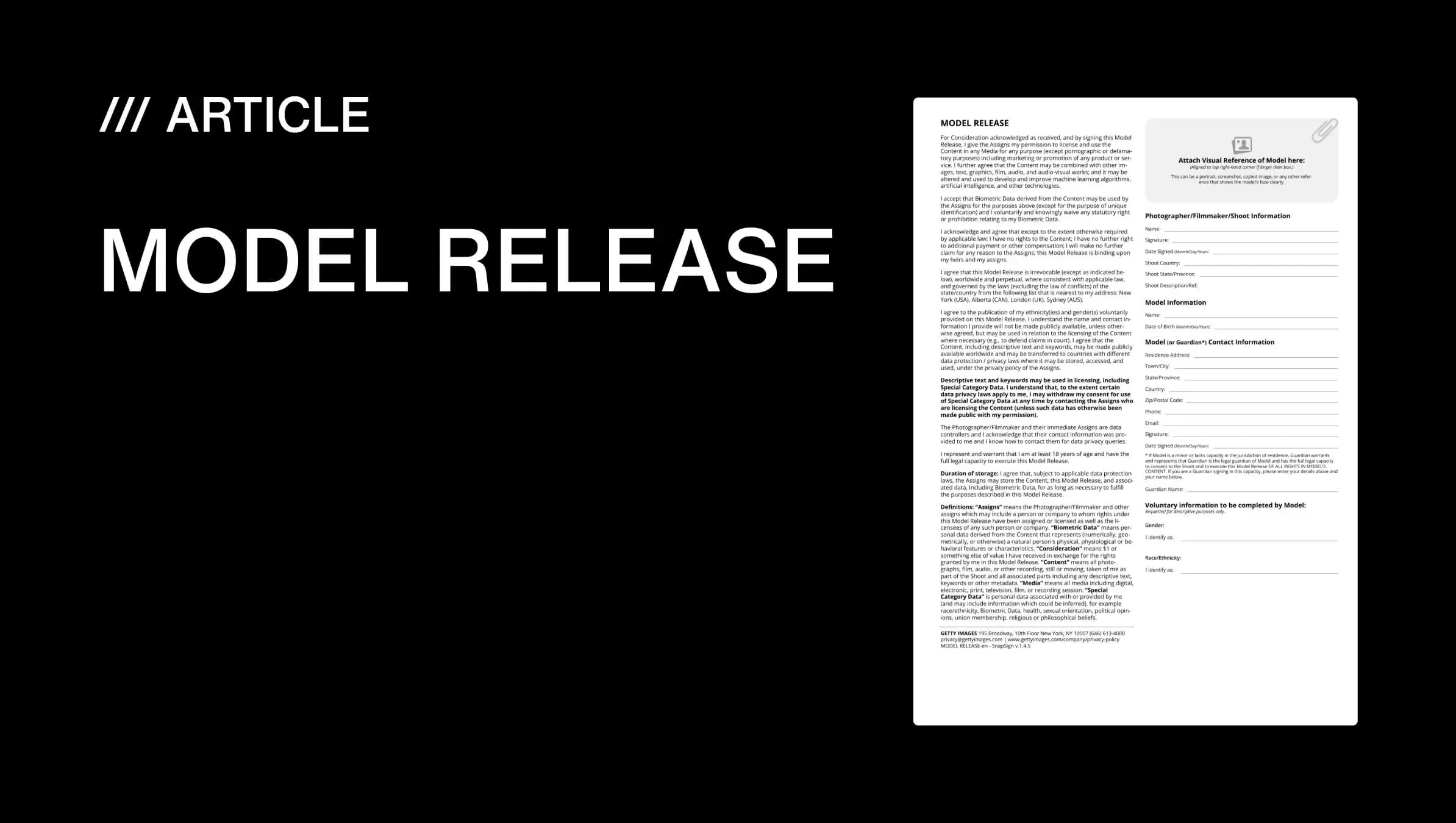
What is a release form in film? It is the difference between a finished film and a liability. An actor release covers the performers. A location release covers the space. A documentary release covers interview subjects and incidental appearances. A crew release covers behind-the-camera contributions. Each one is a single piece of paper — or a single digital signature — that protects months or years of work from collapsing at the distribution stage. And for independent filmmakers working without a legal department, understanding these forms is not optional. Much like a model release for photographers, a film release form establishes written consent before the image is used commercially — the principle is the same, but the stakes are higher because film involves dozens of contributors across weeks of production. This guide focuses on the independent filmmaker’s path — documentaries, festival submissions, and chain of title. If your shoot is closer to a branded video, a content day, or a commercial photo/video production, our guide to release forms for photo and video productions covers that ground in more depth.
Why Film Productions Collapse at the Paperwork Stage
Independent film runs on momentum. You raise a budget, assemble a cast and crew, shoot for three weeks, edit for three months, and submit to festivals. The paperwork — the film production documents that nobody wants to think about on set — gets deferred to «later.» Then later arrives. A festival acceptance email lands, followed by a legal checklist. The distributor’s contract includes a representations and warranties clause. And suddenly every shot with a recognizable face, every interior filmed in a borrowed apartment, every piece of background music becomes a liability.
Most filmmakers discover the release form problem at the worst possible moment: after the film is finished, when the only options are retroactive signing, digital blurring, or cutting footage. Each of those options costs money. The first costs time — tracking down people you filmed months ago. The second costs post-production budget — frame-by-frame rotoscoping is not cheap. The third costs creative integrity — removing the shot that made the scene work.
The film industry has a term for the stack of signed releases, location agreements, and rights clearances: chain of title. It is the legal paper trail proving you own every element in your film. Without a clean chain of title, your film is unsellable. Not «harder to sell.» Unsellable. StudioBinder’s production guides emphasize this point repeatedly: no signed release, no distribution. The platforms that fund and distribute independent film — from grant organizations to streaming services — all verify chain of title before writing a check.
Here is what a complete chain of title looks like — every link must be intact for the chain to hold:
| Link | Document Required | Who Signs | What It Proves |
|---|---|---|---|
| Script & Story | Writer agreement / work-for-hire | Screenwriter | You own the screenplay, not the writer |
| Performers | Actor / talent release forms | Every performer on camera | You have permission to use their likeness and performance |
| Crew | Crew work-for-hire agreements | DP, composer, editor, designer | Production owns their creative contributions |
| Locations | Location release forms | Property owner | You have permission to film and exploit footage of the space |
| Music | Sync license + master use license | Publisher + record label | Music in your film is legally cleared for distribution |
| Archive / Third-Party | Footage license + fair use documentation | Rights holder | Archival clips, photographs, and third-party material are cleared |
Think of this chain of title checklist as a clearance report — the document a distributor’s legal team reviews before signing a deal. One broken link in this chain does not weaken the film. It kills the deal. The rest of this article focuses on the three links most independent filmmakers lose control of: performers, locations, and crew.
Most mistakes start with a misunderstanding. Before you can decide which forms to skip and which ones are non-negotiable, you need to know what each form actually covers — so let us lock that down first.
The Four Film Release Forms Every Production Needs
Different productions need different combinations of forms. A documentary needs interview releases and location releases. A narrative short needs actor releases. A commercial shoot needs all four. Here is the breakdown.
| Release Type | Who Signs It | Required For | Without It |
|---|---|---|---|
| Actor / Talent Release | Every performer appearing on camera | Narrative films, commercials, music videos | Distribution blocked; festivals reject; performer can sue |
| Location Release | Property owner or authorized manager | Any private property — homes, businesses, venues | Owner can demand footage removal or seek damages |
| Documentary / Interview Release | Interview subjects, incidental participants | Documentaries, journalism, oral history projects | Subject can revoke consent; funders may withhold grants |
| Crew / Work-for-Hire Release | Crew members, composers, designers | Any production with paid or volunteer crew | Crew member may claim ownership of their contribution |
The Film Actor Release Form
A film actor release form grants you permission to use a performer’s likeness, voice, and performance in your production and all derivative works — trailers, posters, behind-the-scenes footage, festival screenings, streaming, broadcast, and home video. It should also cover still images extracted from footage for promotional use.
The release should specify: the performer’s legal name, the production title, the shoot dates, the rights granted (comprehensive and irrevocable), and compensation terms — even if compensation is zero. A «for credit only» performer still needs a signed release. Platforms and festivals do not care about the payment amount; they care that the paperwork exists.
For child actors, a parent or legal guardian must sign. Some festivals require a copy of the guardian’s ID alongside the minor’s release. Some states require a trust account for child performer earnings — but the release form itself is universal: guardian signature, printed name, date, and witness.
The Film Location Release Form
A film location release form is what you need before filming on private property — sometimes called a location release form for filming or a location filming release form, they are all the same document with the same purpose. It grants access for specific dates and times, permits alterations to the space (moving furniture, adjusting lighting, mounting equipment), and releases the property owner from liability for production-related incidents while protecting you from later claims about how the property was used or depicted.
The property owner — not a tenant, not a manager — must sign. StudioBinder’s production templates and FilmDaft’s location release guide both stress this point. A tenant can grant you access, but only the owner can grant you the right to commercially exploit footage of the property.
A film location release should include: the full address and description of the property, the exact dates and hours of access, areas included and excluded, compensation (if any), permissions for set modifications, a waiver of liability, and a clause confirming the signer has authority to grant the release. Take photos of the property before filming — a walkthrough with the owner documenting pre-existing conditions prevents disputes about damage after wrap.
For documentary filmmakers, location releases matter just as much — a documentary location release form is functionally identical to a standard film location release, but documentary-specific templates from grant organizations and film schools often include additional clauses for sensitive filming contexts. A documentary shot inside a private business, a subject’s home, or a restricted-access area needs the same signed permission as a narrative feature. The fact that the footage is «real» does not exempt it from property rights. Many film production paperwork checklists treat location releases as secondary — until the property owner sees the finished film and objects to how their space was portrayed. Location releases and property releases serve the same legal function — if you own a space you filmed in, you do not need one, but if someone else owns it, the paperwork is non-negotiable.
The Documentary Release Form
Documentary filmmaking has a release form problem that narrative film does not. In a scripted film, everyone who appears on camera was hired to be there. In a documentary, people wander through the frame. Conversations happen spontaneously. Interview subjects bring up topics the filmmaker did not plan for. And sometimes, the most powerful footage in the film involves someone who never signed anything.
A documentary release form — also called a documentary appearance release form or documentary interview release form — covers the subject’s likeness, voice, statements, and any personal information disclosed during filming. If you are looking for a documentary film release form template, most grant organizations and film schools provide free PDFs, but make sure the template includes the clauses below before using it. The International Documentary Association recommends getting releases signed before filming begins, not after. Once the subject has shared their story on camera, they may become protective of how it is used — and a retroactive signing request can feel like a betrayal if the edit portrays them differently than they expected.
Key clauses to include:
- Media types covered: video, still images, audio, and written transcripts
- Usage scope: festival screenings, broadcast, streaming, educational distribution, promotional clips
- Third-party rights: the right to license or sell the footage to distributors and broadcasters
- Duration: indefinite — avoid expiration dates unless the subject specifically negotiates one
- Editing: the right to edit, rearrange, and contextualize the subject’s appearance
- Compensation: stated explicitly — even if zero
For sensitive documentary topics — addiction, mental health, immigration status, political dissent — additional protections matter. Some subjects want anonymity provisions. Some want review rights before public release. These are editorial decisions, not legal ones — but they should be documented in writing so the filmmaker and the subject share the same expectations.
The documentary film release form cluster is one of the few film production niches where an authoritative organization — documentary.org — provides specific guidance. Most film release form advice online is generic template marketing. The IDA’s resources are written by documentary professionals who understand that a release form is also a trust document: it tells the subject what you plan to do with their story, in writing, before you do it.
Crew and Work-for-Hire Releases
A crew release confirms that the work created by your cinematographer, composer, editor, sound designer, or production designer is owned by the production, not by the individual who created it. Under copyright law, the creator of a work owns it by default — including the shot composition, the score, the edit structure. A work-for-hire agreement signed before the work begins transfers those rights to the production company.
For independent films with volunteer crews, this is especially important. A composer who scores your film as a favor can legally claim ownership of the music if there is no written agreement. A cinematographer who shot your short film for credit only can block a distribution deal if they decide the terms are unfair. A crew release signed at the start of production prevents every one of these scenarios.
Here is what happens when each document is missing — the risk matrix every filmmaker learns the hard way eventually:
| Missing Document | Immediate Consequence | Worst Case |
|---|---|---|
| Actor release | Distributor rejects the film | Performer sues for unauthorized commercial use of their likeness |
| Location release | Footage from that location becomes unusable | Property owner seeks damages and injunction against distribution |
| Crew work-for-hire | Copyright dispute over creative contributions | Composer or DP blocks distribution deal over ownership claim |
| Music license | Festival rejects submission | Label/publisher demands statutory damages per infringement |
| E&O insurance | No distributor will touch the film | Legal defense costs out of pocket — can exceed the film's budget |
Now that you know what each form covers — and what happens when you skip one — the question becomes less about which forms exist and more about where missing paperwork actually catches up with you. For most independent filmmakers, that place is the festival submission portal.
Release Forms and Film Festivals: What Submissions Actually Require
Film festival submission checklists are the most common place independent filmmakers first encounter the words «chain of title.» Festivals like Sundance, SXSW, Tribeca, and IDFA require proof that you have permission to use everything in your film — every face, every location, every piece of music. The requirement is not theoretical. Festival programmers have pulled films from the lineup days before screening because the legal team flagged missing releases.
Mid-tier and regional festivals are increasingly adopting the same standards. A festival that programs 100 films per year cannot afford the legal exposure of screening one film where a subject later objects. Even if the festival’s submission form does not explicitly ask for a release packet, the acceptance email will.
For documentary-specific festivals like IDFA (International Documentary Festival Amsterdam), Hot Docs, and DOC NYC, the release requirements extend beyond talent and location to include archival footage licenses, fair use documentation, and music synchronization licenses. Documentary funders — the Sundance Documentary Fund, the IDA Enterprise Fund, Catapult Film Fund — all require proof of releases as a condition of grant disbursement. A filmmaker who receives a $50,000 grant and cannot produce signed releases for their principal subjects will not receive the second tranche of funding.
The practical takeaway: build your release packet during production, not after picture lock. A completed release file — one folder with every signed form from every shoot day — is the single document that turns a finished edit into a distributable film. This is your film distribution paperwork — the difference between a film that screens and a film that collects dust.
Here is what a complete festival submission package looks like — what programmers and legal teams actually expect in your deliverables package:
| Deliverable | Required by Most Festivals | Notes |
|---|---|---|
| Chain of title documentation | Required | All signed releases — actor, location, crew, music, archive |
| E&O insurance certificate | Required by major festivals, recommended for all | Errors & Omissions insurance — distributor may require it before signing |
| Music cue sheet | Required | Every track, duration, publisher, and sync license confirmation |
| Archival / third-party clearance report | Required if applicable | License documentation for any footage, photo, or artwork not created by the production |
| Subtitles / closed captions file | Increasingly required | SRT or VTT format — many festivals now mandate accessibility |
| Film stills and poster | Required | High-res JPEGs — festival program and press kit depend on them |
| Synopsis and director's statement | Required | Short and long versions — 50 words and 250 words standard |
Most of these deliverables depend on work done during pre-production. Chain of title cannot be assembled retroactively without tracking down people you filmed months ago. Music cue sheets are trivial if you log tracks as you add them to the timeline. E&O insurance providers require proof of releases before issuing a policy — and without a policy, no distributor signs. Every item on this checklist traces back to a decision made, or unmade, before the first day of principal photography.
Of course, not every shot needs paperwork. The exceptions matter because they prevent over-lawyering a low-stakes production — but they only make sense once you understand what the rules protect you from.
When You DON'T Need a Film Release Form
Not every shot requires paperwork. Knowing the exceptions saves time and prevents over-lawyering a low-stakes shoot.
Public Spaces and Incidental Crowds
If you are filming a wide establishing shot of a public street, a park, or a festival crowd, and no individual is recognizable or featured, you generally do not need releases from every person in the frame. Public spaces carry a lower expectation of privacy, and courts have consistently ruled that incidental inclusion in footage shot in a public place does not violate publicity rights — as long as the person is not singled out, named, or used to endorse a product or idea.
The line is recognizability. If a specific face is visible for more than a fleeting moment, or if the camera follows a specific person through a crowd, the «incidental» defense weakens. Film festival legal teams use a practical test: would a reasonable person watching this footage recognize themselves? If the answer is yes, get a release.
News and Journalistic Exceptions
Documentary filmmakers operating in a journalistic capacity have more flexibility than commercial productions. Footage of newsworthy events — protests, public speeches, government proceedings — generally does not require individual releases from everyone depicted. This exception is grounded in the First Amendment and varies by jurisdiction, but the practical reality for most independent documentarians is: if the footage documents a matter of public concern and was captured in a public setting, the release requirement is less strict than for commercial content.
However — this exception is narrower than most filmmakers assume. A documentary about a social issue that uses interview footage shot in a private home does need releases. A verité scene captured on a public sidewalk may not. When in doubt, get the release. A signed form costs five minutes. A legal dispute costs the festival slot.
Your Own Production Company's Property
If your production company owns the location — your studio, your office, your soundstage — you do not need a third-party location release. Some distributors will ask you to confirm this in writing, but you will not need a signed form from a property owner because you are the property owner.
Crew Members Covered by Union Agreements
If your production is signatory to SAG-AFTRA, the DGA, or the WGA, the union collective bargaining agreements already include grant-of-rights language that covers performer appearances, director contributions, and writer copyright transfers. You still need paperwork — union signatory forms, deal memos, and contracts — but the release language is standardized by the union, not negotiated individually.
These exceptions cover the edge cases. For the 90% of independent filmmakers operating outside union agreements and filming on borrowed locations with volunteer casts, the paperwork is unavoidable. The question is not whether you need it — it is how you manage it without turning your shoot into a document-filing operation.
The Digital Advantage: Why Paper Release Forms Are Failing Film Productions
Paper release forms have been the standard on film sets for decades, and they have the same problems they have always had. Forms get lost between location moves. Ink smears on humid outdoor shoots. A production assistant stuffs a clipboard into a duffel bag, and three actor releases disappear into the void. On a feature with twenty shoot days across five locations, the paper release packet becomes an archaeological challenge — and a single missing form can block distribution.
A good digital release system solves all three problems at once, but only if it does four things right:
- Cloud storage with offline resilience. The system must work when you have no signal — a remote location shoot does not pause because the cell tower is on the wrong hill. Signatures captured offline should sync automatically when connectivity returns.
- Searchable, organized access. Twenty shoot days, fifty releases — you need to find the specific actor release for a specific performer in seconds, not by flipping through folders. Search by name, date, or production title.
- Auditable integrity. A scanned PDF of a paper form proves nothing — anyone can alter a PDF. The system must provide cryptographic proof that the document has not changed since the moment of signing.
- Remote signing that does not require the signer to install anything. A property owner across town, a crew member who left set early — they should be able to sign via a secure link in their email without downloading an app or creating an account.
We built SnapSign to meet these four requirements for film production workflows. Our templates include actor release forms, location release forms, and crew work-for-hire agreements that can be customized for your specific production. A performer signs on your phone between takes. The signed PDF is stored in the cloud and accessible from any device. If there is no signal on location, the signature is captured locally and syncs the moment connectivity returns. No clipboards. No scanning at 2 a.m. before the festival deadline.
For productions with large casts, our Group Events feature sends a single signing request to every cast member at once. Each person receives a secure link, signs on their own device, and the completed release lands in your account. On a short film with fifteen cast members, that is fifteen releases signed before the first AD calls wrap — without a single piece of paper changing hands. For location-heavy productions where the property owner is not on set, a Signature Request by email lets them sign remotely. The release is valid, timestamped, and stored — no driving across town to collect a signature from a landlord.
Every signed contract in SnapSign is hashed with SHA-256, which cryptographically proves the document has not been altered since signing. For a filmmaker submitting to a festival, this means you can demonstrate release integrity without carrying a binder of original paper forms. The hash is verifiable proof — something a scanned PDF of a paper form cannot provide.
Now for the practical part: when do you actually collect these signatures, and in what order?
Getting Your Film Release Forms Right: A Pre-Production Checklist
The release form workflow starts in pre-production, not on set. Here is the sequence that prevents paperwork problems from delaying your distribution:
| Phase | Action | Why It Matters |
|---|---|---|
| 1. Pre-Production | Prepare release templates for every type you need: actor, location, crew, documentary interview. Customize for your production name and scope. | Templates ready before Day 1 mean you never improvise a release on set. |
| 2. Location Scout | Get the location release signed during the tech scout — not on the shoot day when the owner may be unavailable. | Shooting without a signed location release = footage you may never be able to use. |
| 3. Call Time | Cast signs releases before entering hair and makeup. Crew signs before touching equipment. | Signatures collected up front = zero paperwork debt at wrap. |
| 4. During Shoot | Any new person appearing on camera signs immediately. No exceptions, no «we will get it later.» | Later almost always becomes never — and that person's footage becomes unusable. |
| 5. Post / Delivery | Compile the release packet as a single organized folder. Share with your distributor, festival, or sales agent on request. | A clean chain of title is the document that turns your film from a creative work into a licensable asset. |
For documentary filmmakers, the checklist has one additional item: get the release signed before the interview, not after. Once the camera is off and the subject has shared deeply personal material, the power dynamic shifts. The subject may feel exposed. The filmmaker may feel indebted. Negotiating release terms at that point is harder for both sides. Before the interview: explain what the film is about, what the release covers, and what rights the subject retains. Have them sign. Then start the camera.
Final verdict - Film Release Forms
Film release forms are not creative work, and they are not why anyone becomes a filmmaker. But they are the difference between a film that screens at festivals and sells to distributors, and a film that sits on a hard drive because the chain of title is incomplete. The independent filmmakers who treat releases as part of pre-production — who prepare templates, collect signatures at call time, and organize their release packet before picture lock — are the ones whose films move through the festival circuit and into distribution without legal friction. The rest learn the same lesson the same way: at the worst possible moment, with a deadline looming and a release that should have been signed three months ago.