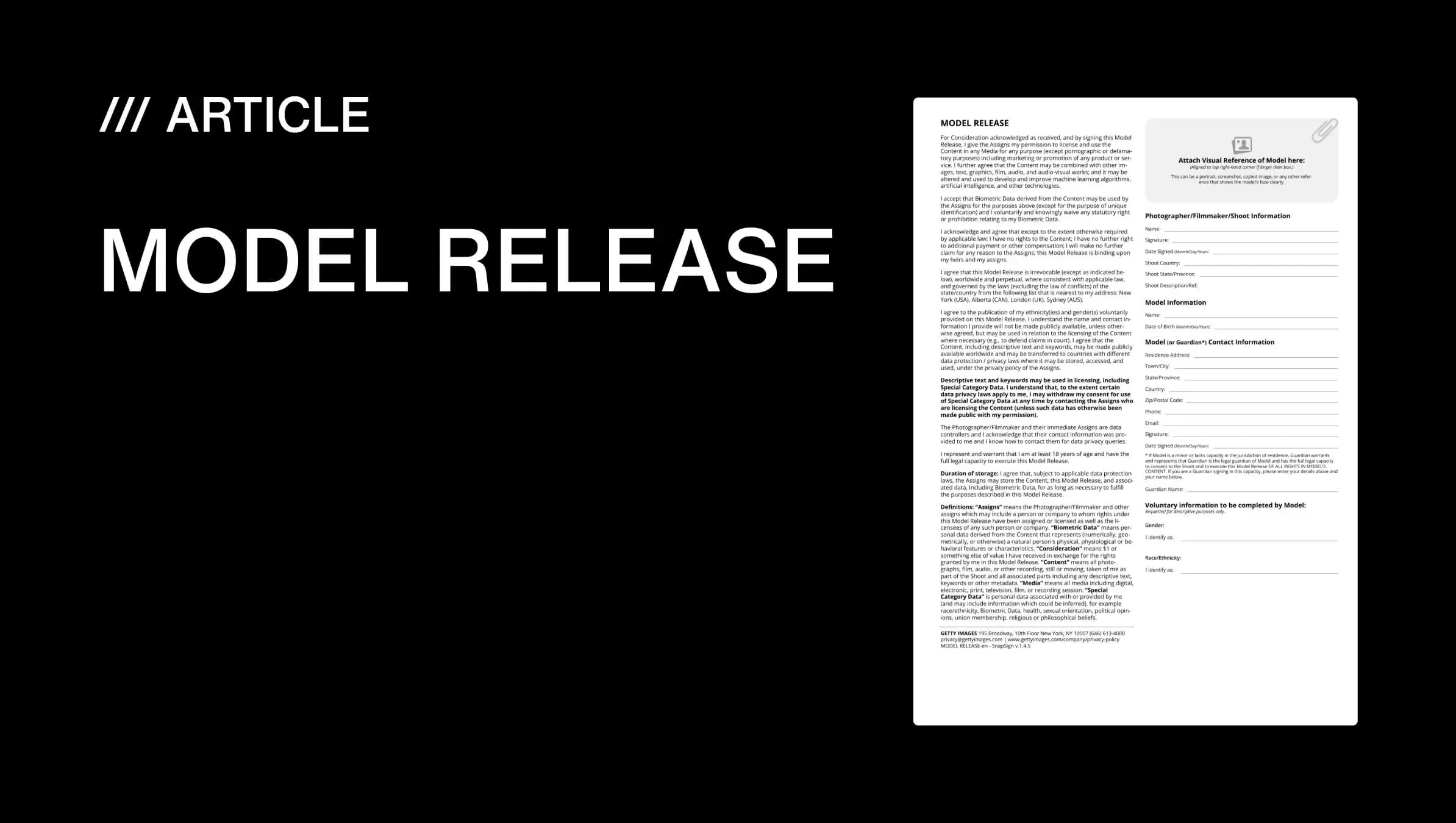
Quick Answer - Is Verbal Consent Enough for a Model Release?
Verbal consent may have legal significance in some jurisdictions, but it is not a reliable substitute for a signed model release. A casual "yes" on set rarely documents the exact media, territory, duration, compensation, sublicensing rights, or commercial uses the model accepted. Commercial clients and stock platforms generally require a written release for recognizable people, and a signed document provides far stronger evidence if a dispute arises. For advertising, commercial stock, and uses that imply endorsement, get a written release before licensing or publishing the image.
I learned this through experience, not a textbook. I still remember a shoot in Byron Bay — early morning light, ocean mist, everything dialed in. The model absolutely owned the frame. We wrapped, hugged it out, and I forgot the release. That missed signature nearly cost me the entire set. We built SnapSign so no photographer ever has to choose between keeping the momentum of a shoot and getting the paperwork right. But before we get to the tool, let us walk through why verbal agreements so often fail when they matter, and what a release that actually protects you looks like.
What a Model Release Actually Is — and Why Photographers Skip It
A model release is a document in which a person grants a photographer or filmmaker permission to use their likeness for specified purposes — commercial licensing, portfolio display, advertising, or editorial publication. Without a valid release, your ability to license or commercially publish images of recognizable people is significantly limited.
Major stock platforms enforce this strictly for commercial submissions. Getty Images, Adobe Stock, and Shutterstock generally require a signed model release for commercial content featuring recognizable people. Editorial submissions follow separate eligibility and documentation rules. A single missing signature where one is required can mean a rejected submission. If the image was already licensed, it can mean a takedown and lost earnings.
On r/photography, one photographer with 25 years of experience captured the tension perfectly: "For paid shoots, get a release. For TFP, it is good to have on hand, but it may affect the flow of the shoot." That friction — the release as a buzzkill — is exactly why so many photographers skip it. In the same thread, photographers admit to doing hundreds of TFP shoots without a single signed form. That approach works until the one time it does not — and the one time is expensive enough to regret every shoot where you skipped it.
For the full legal framework, our model release pillar guide covers when releases are required, how different jurisdictions handle image rights, and the types of releases available for different shoot scenarios.
Verbal Consent: Why It Rarely Holds Up When It Matters
Every photographer knows the moment. The light is perfect. The model is in the zone. Stopping to pull out a clipboard kills the energy instantly. A nod, a "yeah, we're good," and you keep shooting. Verbal consent feels efficient. In hindsight, it is often the most expensive shortcut in your workflow.
The core problem is not whether oral agreements can theoretically be valid — in some jurisdictions, they can. The problem is proof. If a dispute arises, you must demonstrate what was agreed to, when, and under what terms. A casual on-set conversation rarely covers territory, duration, commercial use scope, sublicensing rights, or platform compatibility. Without a recording, a witness, or a written record, the photographer may have difficulty proving the scope of the permission they relied on.
I have watched this play out in real life. A filmmaker colleague shot a lifestyle reel, got a verbal "all good" on camera, and used the footage in a promo two months later. The model said she never gave permission for commercial use. No written form. No recording of the consent discussion beyond the shoot itself. The client pulled the entire campaign rather than deal with the legal exposure. The filmmaker lost the job and the relationship in a single email thread.
Here is how different forms of consent compare in practice:
| Evidence type | Practical reliability | Typical limitations |
|---|---|---|
| Verbal conversation only | Low | Scope nearly impossible to prove; no record of specific terms |
| Recorded verbal permission | Moderate | Better evidence of consent, but may still lack complete terms |
| Email or text messages | Moderate to good | Useful written record, but often incomplete or informal |
| Signed written release | Strong | Must be properly drafted; terms must be specific |
| Signed digital release (platform-compatible) | Strongest practical option | Must meet platform-specific form requirements |
A written release does not make every dispute disappear — but it gives you something to point to that is dated, signed, and specific. In most cases, that is enough to resolve the issue before it escalates.
What a Written Model Release Should Include
Not every release needs every element below — requirements vary by jurisdiction, platform, and intended use. But a strong commercial release generally covers these points. Treat this as a checklist of what to look for, not a universal legal requirement.
- Identifying information. Enough detail to connect the signer, the photographer, the shoot date, and the resulting images. Specific platforms or clients may require full legal names and contact details — check their current guidelines.
- Permitted uses — be specific. Spell out what the release covers. Commercial licensing, portfolio display, social media, advertising — vague terms like "promotional use" create gaps. I once had a model in Berlin sign a form that said "perpetual use." She thought that meant one Instagram post. The misunderstanding nearly escalated to lawyers. Walk through the terms verbally before the model signs — it prevents surprises later.
- Territory and duration. Worldwide or limited to specific countries? Perpetual or time-bound? A worldwide usage clause clarifies the intended geographic scope, but it does not by itself determine governing law, jurisdiction, or whether mandatory local protections apply.
- Compensation. State the agreed compensation or confirm that the shoot is unpaid, TFP, or supported by other consideration. A release that is silent on payment creates ambiguity a dispute can exploit.
- Required signatures. At minimum, the model or authorized guardian must clearly sign the grant of permission. Include all signatures required by the specific release form, platform, client, or applicable law. Some release forms are structured as one-sided grants signed only by the model — check what your platform or client requires. For minors, parental or legal guardian consent is mandatory, and the release must identify the minor and guardian separately — our minor model releases guide covers those requirements.
Digital vs Paper Releases: What Actually Changes
Paper releases were the standard for decades. They worked — when they were not lost, coffee-stained, or folded into origami at the bottom of a camera bag. I lost a release form in a muddy backpack after a shoot in Prague. That was the last paper release I ever used. Digital releases solve the logistics problems that make paper unreliable, and a well-designed digital workflow can create stronger and more accessible evidence than an informal paper process.
| Factor | Paper Release | Digital Release (SnapSign) |
|---|---|---|
| Loss risk | Higher — paper gets damaged, lost, or destroyed | Lower when backed up and managed correctly |
| Tamper evidence | Manual and harder to verify consistently | SHA-256 hash provides cryptographic integrity verification |
| Remote signing | Slow — requires printing, scanning, or mailing | Signature Request via email, sign on any device |
| Searchability | Manual — flip through folders | All Contracts searchable in-app by name or date |
| Platform acceptance | Yes — if legible and complete | Yes — e-signatures legally recognized under ESIGN Act and eIDAS |
| Audit trail | Usually manual and fragmented | Timestamped Certificate with signing metadata |
| Speed | Minutes — print, fill, sign, scan, file | Under 60 seconds — sign on-device or remotely |
For a deeper walkthrough of the full digital signing workflow, our remote signing guide covers Signature Requests, tracking signing status, and managing releases across multiple participants.
Scenarios Where Photographers Get Burned — and How to Avoid Them
The gap between verbal and written consent is easiest to see through real situations. These are drawn from what photographers actually experience — on set, in their inboxes, and sometimes in court.
The Stock Submission Problem
You submit a portrait to a stock platform as commercial content. It is accepted and licensed. Later, the platform requests the model release during a review. Without one, the platform may reject the content, request documentation, reverse affected licenses, or take action under its contributor terms. Adobe Stock's model release requirements are clear — commercial submissions with recognizable people generally require a signed release. The image may be excellent, but without the paperwork, licensing it commercially is not an option.
The Social Media Dispute
You photograph a friend for a creative project. They give verbal permission — "yeah, use them however." A year later, one of those images appears in a paid brand collaboration. Your friend sees it tagged as an ad, feels it was used in a way they never intended, and demands a takedown. Without a written release specifying commercial use, your choices are limited: comply and lose the brand fee, or risk a legal dispute. Even if you prevail, the brand relationship is likely damaged.
The International Production
You film in Portugal with a Canadian model. The final cut is distributed in Australia. Three legal jurisdictions, and the only record of the model's consent is a conversation from the shoot day. If the model contests usage, the first question is which country's law applies — and that question alone can be expensive to resolve. A written release with a clearly stated territory clause does not determine governing law by itself, but it creates a consistent record of intent that makes cross-border disputes far easier to manage.
When You Do Not Need a Model Release
Not every photograph requires a release. Knowing the boundary keeps your workflow lean. But the line is thinner than many photographers assume, and the consequences of crossing it are asymmetrical — you can lose far more than you saved by skipping the form.
You generally do not need a model release for:
- Editorial use in news reporting. Images published as part of genuine news, documentary, or educational content are typically protected by press freedoms. This does not extend to commercial use of the same image — editorial and commercial rights are separate. Even editorial use can raise privacy, defamation, or confidentiality concerns under applicable law.
- Wide crowd shots without a focal commercial subject. Images where people are incidental to the composition — a concert crowd, a street scene — often do not require individual releases. Event terms, jurisdiction, intended use, and platform rules still matter. If a single person is recognizable and compositionally central, even in a crowd, the analysis changes.
- Public spaces with no reasonable expectation of privacy. Photographing someone on a public street is legally different from photographing them through a window. But the right to take a photograph and the right to use it commercially are separate questions. Commercial use in advertising or brand promotion still generally requires a release regardless of the setting.
- Fine art in a gallery context. Limited-edition prints exhibited as art receive different legal treatment than images licensed for advertising. This distinction varies by jurisdiction — do not rely on it as a blanket exemption without legal advice for your specific circumstances.
The critical dividing line is whether the use implies endorsement, advertising, or promotion. If the image is licensed for advertising, commercial stock, or brand use, a written release is nearly always required. Editorial and expressive licensing may follow different rules, but when in doubt, get the signature. The effort it takes is orders of magnitude cheaper than the alternative.
How We Built SnapSign to Make Written Releases Effortless
We built SnapSign because we lived the problem. Clipboard releases lost in backpacks. Models who needed to sign from another city. Group shoots where collecting a dozen paper forms ate half the morning. The friction of paper pushed photographers toward shortcuts — and shortcuts pushed them toward legal exposure. We wanted the written release to be fast enough that skipping it stops being tempting.
Here is the workflow. Open the app, select a Model Release template, fill in the shoot details and model information, hand your phone to the model. They review the terms on screen and sign with their finger. Under a minute, total. If the model is remote, send a Signature Request by email — a secure tokenized link lets them complete their information and sign from any device, no app install needed. The link expires after 48 hours if unsigned. For shoots with multiple participants, Group Events let you send releases to an entire roster at once via Invitation Links or QR codes. For models you work with regularly, Model Profiles save their information and auto-fill it across future Contracts.
Every signed Contract receives a SHA-256 hash — a cryptographic fingerprint that can be used to verify the document has not been altered. You can verify any Contract PDF on our website. We also generate a timestamped Certificate with signing metadata for each completed Contract.
The point is not that we built an app. The point is that the gap between "I will deal with the paperwork later" and "the paperwork is already done" is under a minute. When getting a release is faster than explaining to a client why you cannot license an image, the decision makes itself.
Final Verdict - Verbal vs Written Releases
Verbal consent is difficult to prove, usually too vague for commercial licensing, and generally unacceptable for stock-platform workflows. A signed written release is the clearest and most reliable way to document usage rights, satisfy platform requirements, and protect yourself when a dispute lands in your inbox. Digital releases remove the friction that makes shortcuts tempting. If you are still relying on conversations and handshakes, switch to a written workflow — your future self will thank you.